Heroes
Diego Maradona's 1986 World Cup: The Whole Tournament
Five goals, five assists, an unbeaten run through Mexico, and a match-winning pass in the final itself. There was a lot more to Maradona's 1986 than four minutes against England.
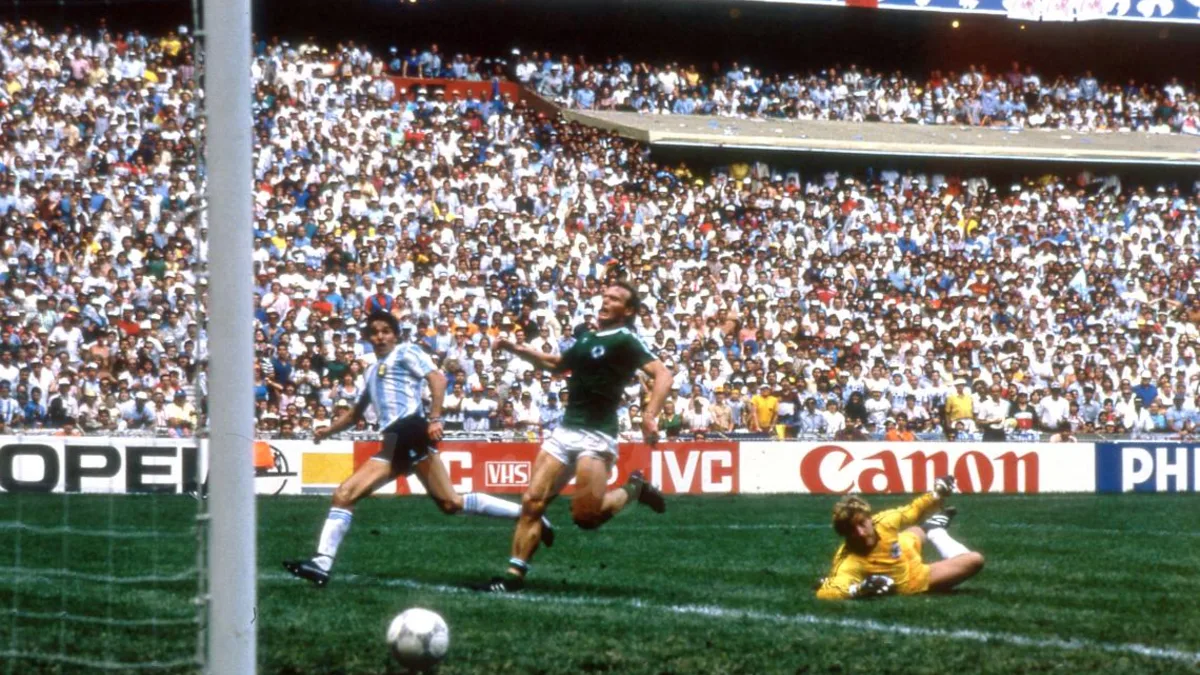
Ask most people what Diego Maradona did at the 1986 World Cup and they will describe four minutes of one match: the punched goal against England, then the run past four defenders that followed it. Both are real, both are extraordinary, and neither is the whole story. Maradona played seven matches at Mexico 1986, and Argentina did not win the tournament because their captain produced one unforgettable quarter-final. They won it because he was the difference in nearly every round, and because with the trophy on the line, in a final he did not score in, he made the pass that decided it.
- Goals
- 5
- Assists
- 5
- Matches played
- 7 of 7
- Argentina's record
- Unbeaten (6 wins, 1 draw)
- Tournament award
- Golden Ball, best player
A team built to get him the ball
Carlos Bilardo's Argentina opened Group A with a 3-1 win over South Korea, drew 1-1 with Italy, then beat Bulgaria 2-0 to finish top of the group. None of those results depended on a single moment from Maradona the way the knockout rounds would, but the shape of the team was already visible: a back three freed Argentina to push an extra man forward, and that extra man's job was to find their captain in space. By the round of 16, that plan was working exactly as intended.
The dummy that beat Uruguay
Argentina's 1-0 win over Uruguay at Estadio Cuauhtemoc in Puebla is remembered far less than what came next, but it shows the range Maradona brought to the tournament beyond finishing. In the 42nd minute, his dummy in midfield sold a defender and opened the space for Sergio Batista to drive forward; Batista laid it off to Jorge Burruchaga, whose deflected cross fell for Pedro Pasculli to score from close range. Maradona never touched the ball in the build-up's final pass, and the goal was his all the same - the kind of contribution the scoresheet does not record.
Four minutes against England, and what got lost around them
The quarter-final at Estadio Azteca on 22 June has its own history, most of it already told elsewhere: the Falklands War four years earlier hanging over the fixture, Maradona rising above Peter Shilton to punch Argentina ahead in the 51st minute, then dribbling from inside his own half past five England players four minutes later for what FIFA's own 2002 online poll later voted the greatest goal in World Cup history. At the post-match press conference he offered the line that outlived the goal itself - "un poco con la cabeza de Maradona y otro poco con la mano de Dios", a little with the head of Maradona and a little with the hand of God.
A little with the head of Maradona and a little with the hand of God.
Diego Maradona, post-match press conference, 22 June 1986
Gary Lineker pulled a goal back for England in the 81st minute and finished the tournament as top scorer with six, winning the Golden Boot to Maradona's Golden Ball. Argentina won 2-1 and moved on. For a full account of the handball itself - the referee who missed it, the version Maradona later admitted to on television, the 2019 documentary where he called it symbolic revenge - that story belongs on its own page. Read the full Hand of God story here. This one is about everything Maradona did in the six other matches, which is where the tournament was actually won.
Two more in four minutes, this time against Belgium
If the England quarter-final is the only match anyone remembers, the semi-final against Belgium at the same Azteca Stadium on 25 June deserves to be remembered nearly as much. Maradona scored twice in another four-minute burst, 52nd to 64th minute, and Argentina won 2-0 without needing anyone else on the scoresheet. The first was a first-time clip over goalkeeper Jean-Marie Pfaff after Burruchaga slid a pass into his path; the second was a run through the middle of the Belgian defense finished low into the corner. In FIFA's 2002 online poll ranking the greatest World Cup goals, that second goal against Belgium finished fourth - behind only his own goal against England, Michael Owen's run against Argentina in 1998, and one other. Two of the top four goals in World Cup history, scored by the same player, in the same World Cup, twelve days apart.
The final: marked out of space, still the difference
West Germany built their final-day plan around stopping one man: Lothar Matthaus was given the job of shadowing Maradona at Estadio Azteca on 29 June, and for most of the first hour it worked well enough that Argentina had to find other ways to attack. Jose Luis Brown headed Argentina ahead in the 23rd minute after goalkeeper Toni Schumacher misjudged a free kick, and Jorge Valdano doubled the lead early in the second half, cutting in from the left and finishing low past the advancing Schumacher - both goals arriving with Maradona kept quiet and Matthaus doing his job. West Germany would not fold: Karl-Heinz Rummenigge pulled one back in the 74th minute, his only goal of the tournament, and Rudi Voller headed the equalizer in the 81st. At 2-2, with West Germany pushing men forward to chase the game, Matthaus stopped shadowing Maradona and joined the attack himself - and the tightest man-marking job of the tournament came apart at exactly the moment Argentina needed it to.
Freed from Matthaus for the first time all match, Maradona did what six other opponents across the tournament had already discovered he could do. In the 84th minute he carried the ball deep into West German territory and slid a defense-splitting pass through for Burruchaga, who ran clear and finished low past Schumacher for what proved the winner. Argentina held on from there. Six yellow cards were shown in the match, a World Cup final record that stood until 2010 - a small measure of how hard West Germany worked to stop him, and how briefly the plan that almost did held up.
What the whole tournament actually adds up to
Five goals. Five assists. Every match played, none missed to injury or suspension, on a team that went the whole way unbeaten. No player before him at a World Cup, not Pele in 1958 and not Paolo Rossi in 1982, had been that central to every stage of a title run - group stage to final, scoring and creating in roughly equal measure, then setting up the winner in the match that mattered most without scoring in it himself. The two goals against England will keep being replayed because they compress an entire career into four minutes. But the tournament that actually won Argentina the trophy ran through seven matches and six other performances most people have never watched.
That is the standard a World Cup final is measured against - not one moment, but a run of them, building to a match where a team that could not be stopped for a month finally had to be won on the day. Forty years on, the 1986 final still sets the bar for what the biggest match in football is supposed to feel like, and it's the closest thing to a blueprint for the kind of finish War of Soccer is built to let anyone recreate the moment the next one is decided.
Frequently asked questions
How many goals and assists did Maradona have at the 1986 World Cup?
Five goals and five assists across all seven of Argentina's matches, a total that won him the Golden Ball as the tournament's best player.
Did Maradona score in the 1986 World Cup final?
No. West Germany assigned Lothar Matthaus to shadow him, and it worked for most of the match - but once Matthaus pushed forward to chase the game at 2-2, Maradona found space to send Jorge Burruchaga through for the winner in the 84th minute of Argentina's 3-2 win.
What did Maradona do in the semi-final against Belgium?
He scored both goals in a 2-0 win, in the 52nd and 64th minutes at Estadio Azteca. His second goal against Belgium was ranked fourth in FIFA's 2002 poll of the greatest World Cup goals, behind only his own goal against England.
Was Argentina's 1986 World Cup run unbeaten?
Yes. Argentina won six of seven matches and drew the other, a 1-1 with Italy in the group stage, finishing the tournament unbeaten.
Who scored West Germany's goals in the 1986 final?
Karl-Heinz Rummenigge in the 74th minute and Rudi Voller in the 81st, pulling West Germany level at 2-2 before Burruchaga's 84th-minute winner.
Sources
- 1986 FIFA World Cup final - Wikipedia
- Argentina v England (1986 FIFA World Cup) - Wikipedia
- 1986 FIFA World Cup - Wikipedia
- The hand of God - Wikipedia
- What is the Hand of God? Why did Diego Maradona's goal in 1986 stand? - ESPN
- Pedro Pasculli - Wikipedia
- Argentina 1 vs. Uruguay 0 in the 1986 World Cup - The Soccer World Cups
- History of the World Cup: 1986 - Maradona puts on a show beating West Germany - AllFootballApp
Comments
Loading comments…
War of Soccer is an independent, unofficial game and website by Nyza Creations LLC. It is not affiliated with, endorsed by, or sponsored by FIFA, any national federation, club, or any player — including Lionel Messi. Naming someone is not a claim to represent them. Team names, competition names and players are referred to descriptively, for identification and commentary only. Historical match data comes from public records — every page lists its sources.