1986 FIFA World Cup Final
1986 World Cup Final: Argentina 3–2 West Germany
- Venue
- Estadio Azteca
- Location
- Mexico City, Mexico
- Date
- Attendance
- 114,600
- Referee
- Romualdo Arppi Filho (Brazil)
Goalscorers
Argentina
- Brown 23'
- Valdano 56'
- Burruchaga 84'
West Germany
- Rummenigge 74'
- Völler 81'
The tournament that belonged to one man
By the time Argentina walked out at the Estadio Azteca on 29 June 1986, the World Cup had stopped being a competition and become a referendum on Diego Maradona. He had knocked Uruguay out, then England, in a quarter-final that gave football both its most notorious goal and its most beautiful one. Then he had beaten Belgium more or less by himself. He would finish the tournament with five goals and five assists, directly involved in ten of Argentina's fourteen. The Golden Ball was a formality.
This was the second World Cup Mexico had not planned to host. Colombia had been awarded the finals and withdrew in 1982, unable to meet FIFA's requirements, and Mexico stepped in to become the first country to stage the tournament twice. Then, in September 1985, an earthquake killed thousands in Mexico City. The stadiums survived. The tournament went ahead, twenty-four teams in the thin air and heavy heat, and it ended back at the ground where Brazil had been crowned sixteen years earlier.
The centre-half who did not have a club
Argentina's opening goal was scored by a man who, months earlier, had been unemployed.
Jose Luis Brown was in the squad as cover for Daniel Passarella, the captain of the 1978 winners. A chronic knee problem had led Deportivo Espanol to release him, and he arrived in Mexico without a club, picked largely because Carlos Bilardo had known him since he was eighteen. Then Passarella went down with severe enterocolitis and never kicked a ball in the tournament. Brown played every single minute of all seven matches instead.
On 23 minutes a free kick was swung in from the right. Toni Schumacher, the West Germany goalkeeper, came and did not get there. Brown arrived and headed Argentina in front.
The referee blew for a free-kick. Burra hit the ball really hard, and with curve... I rushed up, pushing Diego over, and headed the ball.
Jose Luis Brown, quoted by These Football Times
Early in the second half Brown collided with Norbert Eder and dislocated his shoulder. There was no substitution. He hooked his thumb into a hole cut in his shirt to stop the joint moving and played out the World Cup Final one-armed.
We were ahead and we had confidence in him... and I had no one to replace him.
Carlos Bilardo on leaving Brown on the pitch
Two goals in seven minutes, and a coach who was furious anyway
Bilardo's 3-5-2 was the tactical story of Mexico 86. The shape was not his invention, but nobody had made it work at this level before. Against the 4-4-2 that almost every other side in the tournament played, it gave Argentina a spare man at the back, width from the wing-backs, and one free role in the middle for a player who did not need instructions. By 1990 half the world would be copying it.
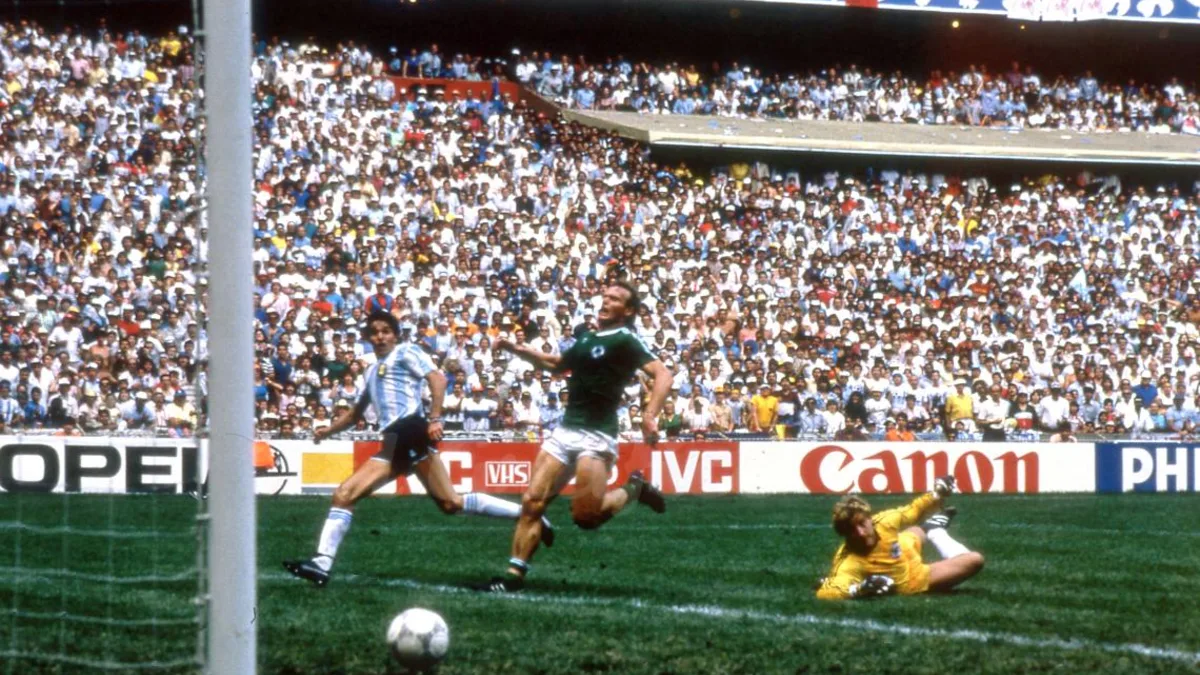
It looked settled when Jorge Valdano cut past the advancing Schumacher and rolled in the second on 56 minutes. Two up in a World Cup Final with half an hour left. West Germany had beaten Morocco 1-0, survived Mexico on penalties and knocked out France 2-0 without ever looking like the best team in the country, let alone the tournament. They now proceeded to score twice in seven minutes, both from corners.
Karl-Heinz Rummenigge, the captain, stabbed one in from close range on 74. Rudi Voller headed the equaliser on 81. The Azteca, 114,600 of it, had watched a final die and come back to life inside ten minutes. Beckenbauer's team had done what German teams did. And Argentina, a goal of a lead evaporated, now had to win it again with a centre-half who could only use one arm.
They scored both goals from corners, and that was unacceptable.
Carlos Bilardo, quoted by FIFA
The pass
Here is the thing everyone forgets about the greatest individual World Cup ever played: Maradona did not score in the final. He barely got a kick. Lothar Matthaus, then 25 and years away from being a Ballon d'Or winner, was assigned to him and followed him everywhere, a man-marking job so complete that it neutralised the best player alive for 84 minutes.
It cost West Germany the World Cup. Matthaus was one of their better footballers and he spent the afternoon walking wherever Maradona walked, which meant Germany won the duel and lost the game. Because with six minutes to go, Maradona collected the ball just inside his own half, surrounded, going nowhere, and played one pass — falling away, barely looking — that removed the entire German defence from the pitch. Jorge Burruchaga ran forty yards onto it and slid it past Schumacher.
I touched the heavens by scoring the deciding goal. We had a fantastic game and went two-up, but they made a comeback. It was me who scored the winner with what was the most joyful goal of my career.
Jorge Burruchaga on the winner, via FIFA
3-2, on 84 minutes. Romualdo Arppi Filho of Brazil, who had already shown six yellow cards — a final record that would stand until 2010 — blew the whistle a few minutes later, and Maradona went up the Azteca steps to lift the trophy in the same stadium where he had beaten England eight days earlier.
What it left behind
1986 is the last World Cup that a single footballer is genuinely credited with winning, and that claim survives scrutiny precisely because of the final. On the day it mattered most, Maradona was smothered, doubled, kicked and marked out of the match, and he still found the one moment that decided it. Greatness is not always ninety minutes. Sometimes it is four seconds.
The rematch came four years later in Rome, and Germany took it 1-0 through a late Andreas Brehme penalty, with Maradona in tears. Argentina and West Germany/Germany have now met in three World Cup Finals — 1986, 1990 and 2014 — the only pairing in the tournament's history to do that. No other two nations have contested more than two.
- Maradona's tournament
- 5 goals, 5 assists
- Golden Ball
- Diego Maradona
- Golden Boot
- Gary Lineker, 6 goals
- Argentina's titles
- 2nd (after 1978)
- Yellow cards in the final
- 6 — a record until 2010
Brown, the man without a club, never really got the career the goal deserved. He died in 2019, aged 62. Forty years on, Argentina go to the 2026 final at MetLife Stadium as holders, with a 39-year-old Lionel Messi playing the last World Cup match of his life — chasing, in his own way, exactly what Maradona found in the 84th minute at the Azteca. You can read every final from 1930 onwards or go straight to the Rome rematch in 1990.
Frequently asked questions
Did Maradona score in the 1986 World Cup Final?
No. Maradona was man-marked by Lothar Matthaus and did not score or take the game by the scruff of the neck as he had against England and Belgium. He instead assisted Jorge Burruchaga's 84th-minute winner with a pass from inside his own half.
Who scored in the 1986 World Cup Final?
Jose Luis Brown (23), Jorge Valdano (56) and Jorge Burruchaga (84) scored for Argentina. Karl-Heinz Rummenigge (74) and Rudi Voller (81) scored for West Germany, both from corners.
Is it true a defender played the final with a dislocated shoulder?
Yes. Jose Luis Brown dislocated his shoulder in a collision with Norbert Eder early in the second half. Bilardo had nobody to replace him, so Brown hooked his thumb into a hole in his shirt to limit the movement and played to the final whistle.
Why were Argentina and West Germany such familiar opponents?
They met in the 1986, 1990 and 2014 World Cup Finals, the only nations ever to contest three finals against each other. Argentina won the first, Germany the next two.
What was the attendance at the 1986 World Cup Final?
114,600 at the Estadio Azteca in Mexico City on 29 June 1986, refereed by Romualdo Arppi Filho of Brazil. It was the second final the Azteca had hosted after Brazil's win over Italy in 1970.
Sources
- List of FIFA World Cup finals — Wikipedia
- 1986 FIFA World Cup final — Wikipedia
- 1986 FIFA World Cup — Wikipedia
- Yes, you scored a goal in a World Cup final: the unexpected legend of Jose Luis Brown — These Football Times
- #WorldCupAtHome: Argentina beat West Germany in Maradona's World Cup — FIFA
- Planet World Cup — 1986 Final: Argentina v West Germany
War of Soccer is an independent, unofficial game and website by Nyza Creations LLC. It is not affiliated with, endorsed by, or sponsored by FIFA, any national federation, club, or any player — including Lionel Messi. Naming someone is not a claim to represent them. Team names, competition names and players are referred to descriptively, for identification and commentary only. Historical match data comes from public records — every page lists its sources.