1982 FIFA World Cup Final
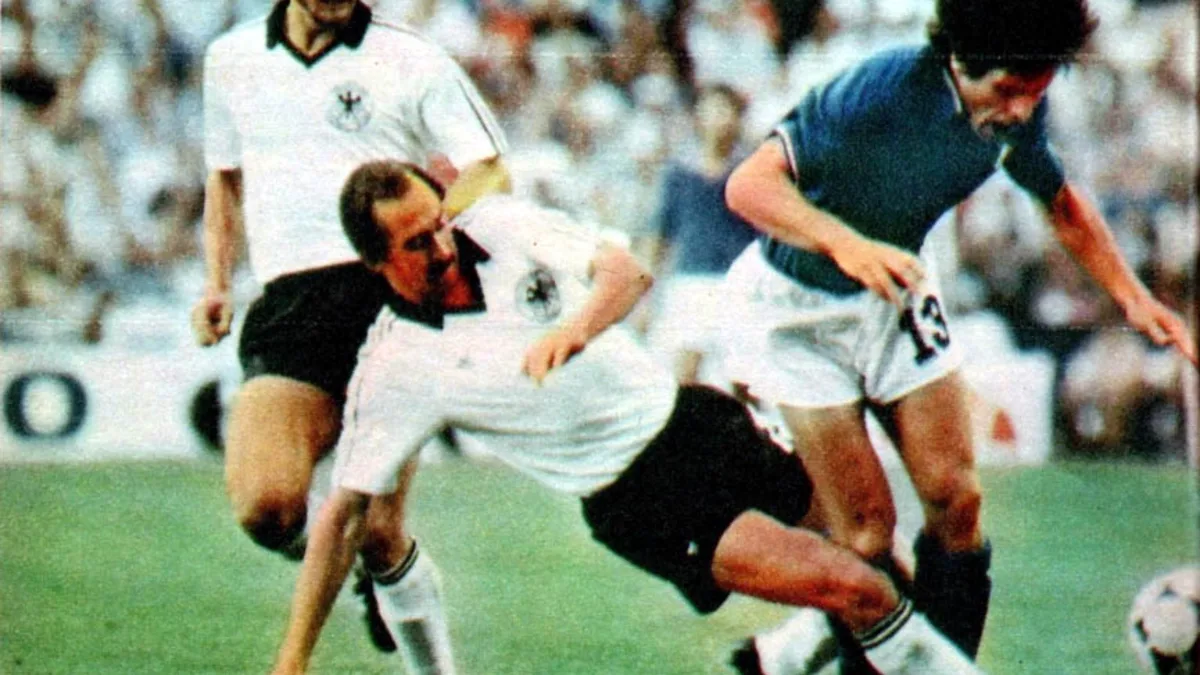
1982 World Cup Final: Italy 3–1 West Germany
- Venue
- Santiago Bernabéu
- Location
- Madrid, Spain
- Date
- Attendance
- 90,000
- Referee
- Arnaldo Cézar Coelho (Brazil)
Goalscorers
Italy
- Rossi 57'
- Tardelli 69'
- Altobelli 81'
West Germany
- Breitner 83'
The team nobody wanted to watch
Champions are supposed to announce themselves. Italy spent the first fortnight of the 1982 World Cup doing the opposite. They drew 0-0 with Poland, 1-1 with Peru and 1-1 with Cameroon, and reached the second round without winning a match — level on points with Cameroon and separated from them only by having scored one goal more. Three games, two goals, no victories. By any honest reading they had no business still being in Spain.
The Italian press said so, loudly. The sharpest criticism was aimed at Enzo Bearzot's insistence on picking a centre-forward who could not score, and at the coach himself for refusing to drop him. Bearzot's answer was to close the doors: the squad cut contact with the media almost entirely, a retreat Italians still call the silenzio stampa. It looked like a sulk. It worked like a weld.
What waited on the other side of that silence was the hardest draw imaginable. To reach the semi-finals Italy had to beat the reigning champions, Argentina, and then Brazil — a Brazil of Sócrates, Zico and Falcão, the most admired team in the world and a side who needed only a draw to go through.
A striker back from two years in the dark
The forward Bearzot would not drop was Paolo Rossi, and to understand why the Italian public had lost patience you have to go back to 1980. Rossi was caught up in Totonero, the betting scandal that tore through Italian football, and was disqualified for three years — later cut to two. He always maintained his innocence and insisted he had been the victim of an injustice. Either way, the sentence was the same: two years without competitive football, at the age the average striker peaks.
Juventus bought him back in 1981 anyway, and his ban expired late enough that he managed just three appearances and one goal at the end of the 1981-82 season before flying to Spain. That was the entire body of evidence Bearzot was betting a World Cup on. Through the group stage Rossi looked exactly like a man who had not played in two years — one much-repeated description had him drifting through games like a ghost wandering aimlessly over the field.
Then, on 5 July at the cramped Estadio Sarrià in Barcelona, he scored three times in one afternoon. Italy 3-2 Brazil. Rossi struck in the 5th minute, the 25th and the 74th; Sócrates and Falcão answered twice and it was not enough. Brazil went home, and Brazilian football went home with them — the defeat is still known there as the Tragédia do Sarrià, and it pushed a generation of Brazilian coaches away from pure attacking football toward something more careful.
We had a hell of a team and played with happiness. Then Rossi had three touches and scored a hat-trick. Football as we know it died on that day.
Sócrates, on Italy 3-2 Brazil, Sarrià, 5 July 1982
Two more from Rossi beat Poland in the semi-final. A man who could not buy a goal in three group games had scored five in two matches.
Madrid, and a penalty into the empty night
West Germany came to the Santiago Bernabéu on 11 July by a road just as strange. They had lost their opening match to Algeria, drew 0-0 with England and beat Spain 2-1 to win a three-team second-round group by a single point, and survived a semi-final against France that finished 3-3 and went to penalties, which they won 5-4. They were not beloved either. They were simply, relentlessly, still there.
Italy lost Francesco Graziani to injury after seven minutes — Alessandro Altobelli came on, and would matter later. And then, in a first half that produced nothing else worth keeping, Italy were given a penalty and Antonio Cabrini put it low and wide of the right-hand post. Forty-five minutes gone, no goals, and the best chance of the match already spent. It remains one of the great what-ifs of final-day nerve: the game could have curdled from there.
It did not, because the second half belonged entirely to Italy. Rossi headed in a bouncing Claudio Gentile cross. Tardelli drove one low and left-footed from the edge of the box. Bruno Conti tore away on the counter and Altobelli — the substitute — finished it. Paul Breitner's late goal was consolation, arriving after the match was gone.
In the stands, Italy's president Sandro Pertini wagged a delighted finger at the television cameras — they can't catch us now — a piece of unguarded joy from a head of state that Italians replay to this day.
The scream
Marco Tardelli's goal made it 2-0. What happened next made it immortal. He wheeled away toward the Italian bench with his fists pumping and his head shaking, mouth open, shouting Gol! Gol!, tears coming, entirely out of control. Italians call it l'urlo di Tardelli — the Tardelli scream — and it is one of the most replayed celebrations in the sport's history.
I was born with that scream inside me. That was just the moment it came out.
Marco Tardelli, to FIFA
He has described the moment as something close to a near-death experience — his whole life running past him, all the way back to being a child kicking a ball, the release of a dream he had carried since then finally landing. It is the rarest thing in televised sport: an adult professional caught completely without a mask on.
What Italy actually won
The trophy was Italy's first in 44 years and their third overall, which drew them level with Brazil as the most successful nation in the tournament's history — a fact made sweeter by whom they had eliminated to get there. Dino Zoff, the captain, was 40 years old and became the oldest player ever to win a World Cup, a record that has survived every tournament since.
Rossi finished with six goals: the Golden Boot as top scorer and the Golden Ball as the best player of the tournament, the latter awarded for the very first time. Two years earlier he had been serving a ban. It is about as complete a redemption arc as football has produced, and the whole of it — first goal of the tournament on 5 July to the trophy on the 11th — took six days.
The wider lesson of 1982 is the one every knockout tournament keeps re-teaching and every pundit keeps forgetting: form before the final barely predicts the final. Italy were the worst team of the group stage and the best team of the fortnight that followed. Nothing in those three draws forecast Rossi's hat-trick against Brazil, and nothing in Rossi's ban forecast Rossi at all. The same warning applies to anyone reading too much into a semi-final on the way to this year's final — the full history of the fixture is mostly a list of times the form guide was wrong.
Eight years earlier, in 1974, West Germany had won a final as the less-loved side and been grudgingly admired for it. In 1982 they met a team that had gone one better: unloved, unbeaten when it counted, and led by a 40-year-old goalkeeper and a striker the country had spent three weeks demanding he drop.
Frequently asked questions
Who won the 1982 World Cup final?
Italy beat West Germany 3-1 at the Santiago Bernabéu in Madrid on 11 July 1982, in front of 90,000 people, with Brazilian referee Arnaldo Cézar Coelho in charge. It was Italy's third World Cup and their first since 1938.
Why was Paolo Rossi banned before the 1982 World Cup?
Rossi was implicated in the 1980 Totonero betting scandal and disqualified for three years, later reduced to two. He always maintained his innocence. His ban ended in time for him to play just three games for Juventus before the tournament — and he still won the Golden Boot and the Golden Ball.
What is the Tardelli scream?
Marco Tardelli's celebration after making it 2-0 in the final: fists pumping, head shaking, tears streaming, shouting Gol! Gol! Known in Italy as l'urlo di Tardelli. He later said he was born with that scream inside him and that was simply the moment it came out.
Did Italy really reach the second round without winning a game?
Yes. They drew all three group matches — 0-0 with Poland, 1-1 with Peru, 1-1 with Cameroon — and went through ahead of Cameroon only because they had scored one more goal. They then beat Argentina, Brazil, Poland and West Germany in a row.
Is Dino Zoff still the oldest player to win a World Cup?
Yes. Zoff was 40 when he captained Italy to the 1982 title, and no older player has won the tournament since.
Sources
War of Soccer is an independent, unofficial game and website by Nyza Creations LLC. It is not affiliated with, endorsed by, or sponsored by FIFA, any national federation, club, or any player — including Lionel Messi. Naming someone is not a claim to represent them. Team names, competition names and players are referred to descriptively, for identification and commentary only. Historical match data comes from public records — every page lists its sources.