1978 FIFA World Cup Final
1978 World Cup Final: Argentina 3–1 Netherlands
- Venue
- Estadio Monumental
- Location
- Buenos Aires, Argentina
- Date
- Attendance
- 71,483
- Referee
- Sergio Gonella (Italy)
Goalscorers
Argentina
- Kempes 38', 105'
- Bertoni 115'
Netherlands
- Nanninga 82'
A tournament that could not only be football
Argentina had waited since 1930 to win a World Cup, and in 1978 they finally did it at home. That should be the whole sentence. It has never been allowed to be, because of who was standing in the directors' box. The tournament was played under the military junta that had seized power just over two years earlier, and the generals understood exactly what a month of football beamed to the world was worth to a government with a reputation to launder. Argentina won, and the men who had taken the country by force stood up and applauded as though the trophy were partly theirs.
A boycott campaign gathered across Europe under the slogan Football yes, torture no. It did not move a single federation. All fifteen visiting teams travelled. The players who might have made the loudest statement mostly made none, and the one absence that echoed longest turned out to have nothing to do with politics at all. Johan Cruyff, who had carried the Netherlands to the 1974 final, did not come. For three decades the assumption was that he had stayed away in protest. In 2008 he told Catalunya Radio the real reason.
You should know that I had problems at the end of my career as a player here and I don't know if you know that someone (put) a rifle at my head and tied me up and tied up my wife in front of the children at our flat in Barcelona.
Johan Cruyff to Catalunya Radio, 2008, on why he missed the 1978 World Cup
Police slept in the Cruyff house for months. His children were driven to school under escort. He went to matches with a bodyguard, and decided there were things worth more than a World Cup. The Netherlands would reach the final without the best player they have ever produced, and lose it, and spend the next fifty years being told they might have won had he boarded the plane.
Six goals, and an argument that never ended
Before Argentina could reach the final they had to solve a piece of arithmetic that has been under suspicion ever since. The 1978 tournament had no semi-finals: two group stages, and the winners of the second-round groups went straight to the final. On 21 June, Brazil beat Poland 3-1 to finish their group on five points with a goal difference of +5. Argentina, playing later that evening against Peru, were on three points and +2 — a win would take them level with Brazil and throw the place in the final onto goal difference. So they knew precisely what they needed. Not a win. A win by four.
Brazil had protested the scheduling in advance, arguing that letting the hosts kick off knowing the target was plainly unfair. FIFA rejected the complaint, citing television and ticketing. Argentina then beat Peru 6-0.
What surrounds the result is circumstantial and will not go away. The British writer David Yallop alleged that Argentine officials offered Peru's delegation a bribe of $50 million and a donation of 35,000 tons of grain; Argentina's Treasury Secretary Juan Alemann acknowledged that donations to Peru were made, while maintaining they were of the kind Argentina made only in humanitarian catastrophes. Minutes before kickoff — according to accounts given years later by Peru players including Juan Carlos Oblitas, Jose Velasquez and German Leguia — Videla walked into the Peruvian dressing room accompanied by Henry Kissinger, the former US Secretary of State, to read out a message about Argentine-Peruvian brotherhood. Velasquez and Leguia have said the team read the visit as a threat. Peru's goalkeeper Ramon Quiroga, who was born in Argentina, has denied everything for the rest of his life.
I did not sell myself. If I'd taken money to go back, I could not walk through Lima today, and I do without any problems.
Ramon Quiroga, Peru goalkeeper, on the 6-0 defeat to Argentina
Nothing has ever been proved. Some Peruvian players concede they were suspicious; others insist the second half was simply a collapse in front of a crowd that would not stop screaming. Both things can be true. It is the permanent asterisk of 1978, and it was hanging over the Monumental four days later.
The blizzard, the cast, and the five-minute wait
Neither finalist had been serene on the way there. Argentina lost to Italy in the first group stage. The Netherlands lost 3-2 to Scotland, survived on goal difference, then remembered themselves and took Austria apart 5-1. They arrived at their second consecutive final as the best team nobody could quite kill off.
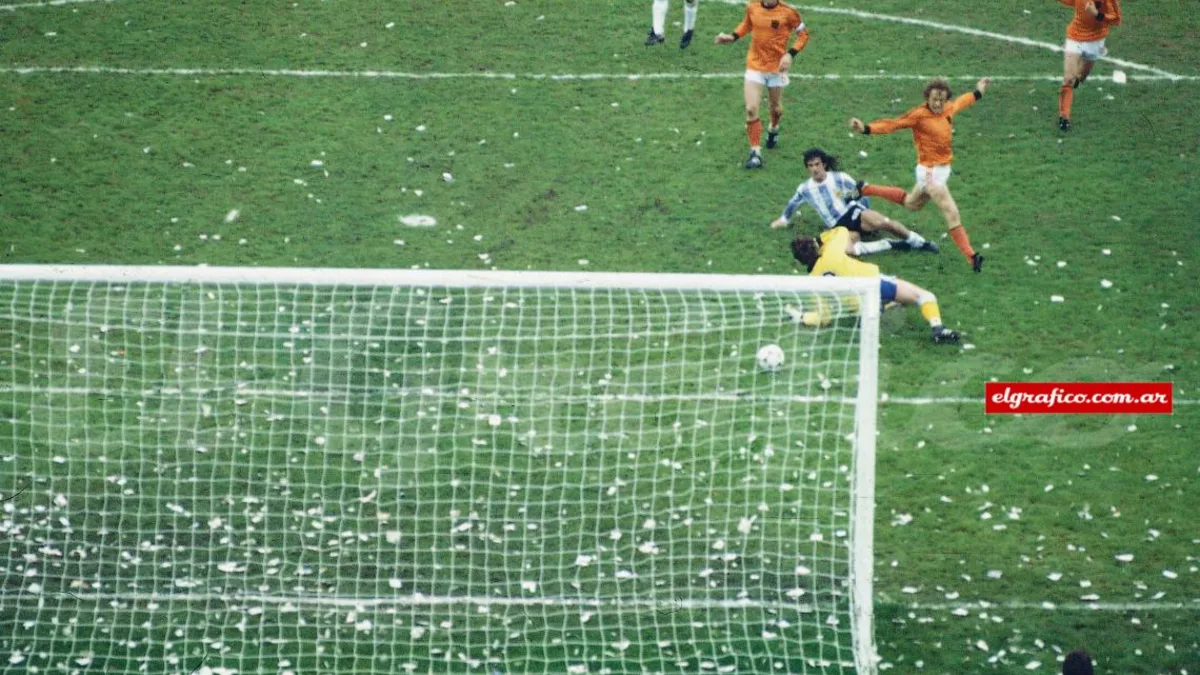
What met them in Buenos Aires was not a football crowd so much as weather. The Monumental was buried in ticker tape, thrown by the fistful until the pitch markings disappeared and the ball came out of the confetti late. Then Argentina simply did not come out. The Dutch stood in it for around five minutes, alone, being conducted at by 71,483 people, before the hosts appeared.
When they did, Argentina objected to the plaster cast on Rene van de Kerkhof's wrist. He had worn it through every previous match of the tournament without a word from anyone. The Italian referee, Sergio Gonella, upheld the objection and demanded extra bandaging. The Netherlands threatened to walk off the pitch and out of the World Cup final altogether. They played, bandaged, furious, and the game they finally kicked off was one they had already been told they would not be allowed to win comfortably.
The ninety minutes that refused to end
Mario Kempes was the reason Argentina were there and he was the reason they stayed. He had come from Valencia with his hair loose and his sleeves down, and he finished the tournament as its top scorer and its best player. He put Argentina ahead before half-time, sliding it under Jan Jongbloed from twelve yards, and for a long time that looked like the whole story.
The Netherlands equalised late through Dick Nanninga, a substitute, who headed in a Van de Kerkhof cross - the same arm, the same wrist, the same cast that half an hour of a World Cup final had been wasted arguing about. Then came the moment the Dutch have never stopped watching. Seconds from the end of normal time Ruud Krol sent a long ball downfield, Rob Rensenbrink got to it, and from a tight angle and under heavy pressure his shot beat Fillol and hit the post. A few centimetres and the Netherlands are world champions and 1978 is a completely different chapter of this sport.
If the trajectory of my shot had been five centimetres different, we would have been world champions.
Rob Rensenbrink on the last minute of the 1978 final
Extra time broke them. Kempes ran into the box and shot; Jongbloed saved it, and the rebound bounced between the two of them - off Kempes's knee, off his foot, off Jongbloed's head - before it crossed the line. A replay angle from behind the goal suggested the last touch might have been Wim Suurbier's, which would have made it an own goal. It was credited to Kempes, and Kempes had earned the benefit of every doubt he was ever given. Ten minutes later he made another long run into the box, was tackled, and the ball ricocheted loose to Daniel Bertoni with a clear sight of goal. The confetti came down for the second time that day.
What Argentina won, and what the Dutch took home
Argentina had their first World Cup, and became the fifth nation to win one as hosts, after Uruguay, Italy, England and West Germany. The football deserved it more than the retelling usually allows: Kempes's six goals were not an accident of scheduling, and a team that beats the Netherlands over 120 minutes has beaten somebody. The country went out into the streets and celebrated something entirely its own, whatever the men in the directors' box believed they were being handed.
The Netherlands refused to attend the post-match ceremony. No podium, no medals collected, no handshake for the generals. It was the second final in four years they had lost to the host nation, and the second time they had gone home as the team everyone would rather have watched. Two finals, two defeats, nothing in the cabinet - the most admired football of its generation, and a museum with a gap in it.
Nothing about 1978 resolves. The trophy is Argentina's and the record book is not in dispute. But the tournament that surrounds it - the boycott that failed, the six goals in the second round, the confetti, the cast, the post - is why this final is still argued about while others from the same era are only remembered. You can read the rest of them, decade by decade, in the full history of the World Cup final.
Forty-eight years later Argentina go into another final, in another country, defending the trophy, with a 39-year-old playing the last World Cup match of his life. Whatever happens against Spain at MetLife on 19 July, it will be settled on the pitch and nowhere else - no arithmetic, no dressing-room visits, no ticker tape thick enough to hide it. That is not nothing. Ask the Dutch.
Frequently asked questions
Why did Johan Cruyff miss the 1978 World Cup?
Not as a political protest, which was assumed for thirty years. In 2008 Cruyff told Catalunya Radio that armed men had broken into his Barcelona flat at the end of 1977, held a rifle to his head and tied up him and his wife in front of their children. Police stayed in the house for three to four months and his children were taken to school under escort. He chose not to travel to Argentina; his spokesman said another reason was that Cruyff did not feel he was at his best.
Was the Argentina 6-0 win over Peru fixed?
It has never been proved. Argentina needed a four-goal win to reach the final on goal difference and won by six, and the surrounding circumstances - Videla visiting Peru's dressing room before kickoff, and later Argentine donations to Peru - keep the suspicion alive. No investigation has established collusion and Peru's players have always denied it.
Why did the Netherlands refuse to collect their medals in 1978?
They boycotted the post-match ceremony in protest at how the final had been conducted - Argentina delaying their arrival on the pitch by around five minutes, and the row over Rene van de Kerkhof's wrist cast, which he had worn all tournament without objection until the final.
How close did the Netherlands come to winning the 1978 final?
One post. With the score level seconds from the end of normal time, Ruud Krol sent a long ball forward to Rob Rensenbrink, whose shot from a tight angle beat Ubaldo Fillol but hit the woodwork. Argentina scored twice in extra time instead. Rensenbrink later said that five centimetres the other way would have made the Netherlands world champions.
Did the 1978 World Cup have semi-finals?
No. It used two group stages: sixteen teams in four groups, with the top two from each going into a second round of two groups. The winners of those two second-round groups went straight to the final, which is why goal difference mattered so much against Peru.
Sources
- List of FIFA World Cup finals — Wikipedia
- 1978 FIFA World Cup final — Wikipedia
- 1978 FIFA World Cup - Wikipedia
- Argentina v Peru (1978 FIFA World Cup) - Wikipedia
- Kidnapping attempt kept Cruyff away from 1978 World Cup - The Irish Times
- Rob Rensenbrink passes away aged 72 - KNVB
- Misery in the Monumental as Dutch miss out again - FIFA
War of Soccer is an independent, unofficial game and website by Nyza Creations LLC. It is not affiliated with, endorsed by, or sponsored by FIFA, any national federation, club, or any player — including Lionel Messi. Naming someone is not a claim to represent them. Team names, competition names and players are referred to descriptively, for identification and commentary only. Historical match data comes from public records — every page lists its sources.