1974 FIFA World Cup Final
1974 World Cup Final: West Germany 2–1 Netherlands
- Venue
- Olympiastadion
- Location
- Munich, West Germany
- Date
- Attendance
- 78,200
- Referee
- Jack Taylor (England)
Goalscorers
West Germany
- Breitner 25' (pen)
- Müller 43'
Netherlands
- Neeskens 2' (pen)
The best team in the world was not the one that won
Some finals are remembered for who lifted the trophy. This one is remembered for who did not. The Netherlands arrived at the Olympiastadion as the most admired football team on earth and left it as the most admired losers in the sport's history — a distinction nobody wants, and one no side since has worn quite so well.
Rinus Michels' team had spent a month redefining what a football team could be. Total Football was less a formation than a licence: every outfield player could take any role depending on where the ball and the space happened to be — a full-back arriving as a winger, a midfielder dropping into the back line, the shape quietly reassembling behind him. The consequence was simple enough that a neutral could see it from the stands. The Dutch mesmerised the crowds, and replaced Brazil — of all teams — as the tournament's crowd pleasers.
The romance rested on something brutal. The Dutch came through their first group unbeaten. Then they went through the second group stage — 1974 had no semi-finals, just two groups whose winners walked straight into the final — by beating Argentina, East Germany and Brazil, scoring eight goals and conceding nothing at all. They reached the final without losing a match, and they have never been closer to winning one.
The hosts nobody was watching
West Germany's route was less beautiful and, as it turned out, more instructive. They were the reigning European champions, and they were beaten 1-0 in their own group by East Germany, Jürgen Sparwasser scoring in the 77th minute of a match that carried more politics than any football fixture should have to. Both German teams advanced regardless.
What the hosts had was a spine. Sepp Maier in goal. Franz Beckenbauer playing sweeper as though he had invented the role, which more or less he had. Paul Breitner overlapping from the back. And Gerd Müller, doing what Gerd Müller did. In the second group stage they saw off Yugoslavia and Sweden, then beat Poland — the tournament's great overachievers, whose Grzegorz Lato finished as top scorer with seven — by a single Müller goal on a pitch that had been half-drowned by a thunderstorm.
| Netherlands | West Germany | |
|---|---|---|
| Manager | Rinus Michels | Helmut Schön |
| Captain | Johan Cruyff | Franz Beckenbauer |
| First group stage | Unbeaten | Lost 1-0 to East Germany |
| Second group stage | Beat Argentina, East Germany, Brazil — 8 scored, 0 conceded | Beat Yugoslavia, Sweden, Poland |
| Record before the final | Unbeaten | One defeat |
Ninety seconds
The final began strangely before it began at all. Ground staff had removed the corner flags for the closing ceremony and then forgotten to put them back, so the biggest match on the planet waited while somebody went and found them.
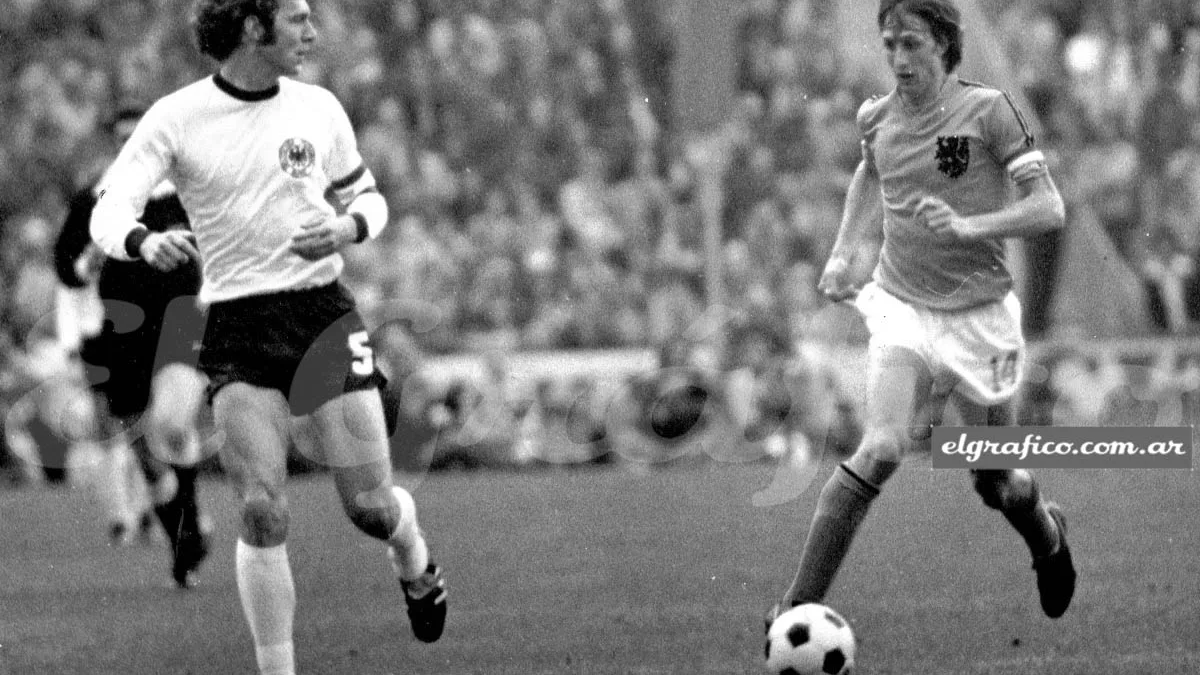
Then the Dutch kicked off and simply kept the ball. It travelled through orange shirts, unhurried, while West Germany chased it. Cruyff eventually collected it near halfway, turned, and ran at the German area alone until Uli Hoeneß brought him down. Jack Taylor — an Englishman, in Munich, in front of 78,200 home supporters, in the first minute of a World Cup final — pointed to the spot. It was the first penalty ever awarded in a final. Johan Neeskens converted it before a West German outfield player had touched the ball, and it remains the fastest goal a World Cup final has ever seen.
And that dream start became the problem. A goal up inside two minutes against the hosts, the Netherlands did not go for the throat. They went for the exhibition — keeping possession, drawing the Germans out, humiliating them politely. Michels' team wanted to prove a point about football. Schön's team wanted to win a football match. Only one of those ambitions is settled by a scoreboard.
How West Germany took it back
Bernd Hölzenbein ran into the Dutch penalty area on 25 minutes and went to ground. The contact has been argued about ever since: some see a foul on him, others see a forward who was already on his way down. Taylor gave it, Breitner took it, and the match was level. More than fifty years on it is still one of the most disputed decisions in World Cup history — and the most pointed verdict on it came from a German.
Müller's winner arrived two minutes before half-time and was everything the Dutch football of that summer was not: scruffy, instinctive, taken with his back to goal in a yard of space nobody else would have found. It was also the last goal he ever scored for West Germany. He retired from international football after the tournament, on that. Cruyff was booked at the interval for telling Taylor exactly what he thought of the afternoon so far.
The second half was the one the Netherlands had promised all month, and it was not enough. They pressed, and Beckenbauer's back line held its shape and grew calmer the longer the game went on. Müller put the ball in the net again and was flagged offside. Hölzenbein went down in the Dutch box once more in the 85th minute; this time Taylor, having been accused all game of favouring the hosts, waved it away. The most beautiful team in the world had the other eighty-eight minutes to score one more goal against opponents they had outplayed, and did not.
What Munich left behind
The Dutch never did win it. They came back four years later and lost the 1978 final to another host nation, which turned a heartbreak into a pattern and a pattern into an identity. Total Football went on to conquer the sport anyway — through Michels, through Cruyff at Barcelona, through everyone who learned from them — which is a strange kind of victory, and the only one on offer.
For West Germany the medals were more literal. Five of them — Maier, Beckenbauer, Wolfgang Overath, Jürgen Grabowski and Horst-Dieter Höttges — became the first players in history to own World Cup medals in all three colours. They were also the first team to lift the new FIFA World Cup Trophy, Brazil having kept the Jules Rimet for good in 1970.
And they left one record that reads oddly well in July 2026. By winning in Munich as the reigning European champions, West Germany did something no one repeated until Spain managed it in 2010 — and Spain are the European champions again, back in a final for the first time since. Whatever happens at MetLife, 1974 is the match that keeps the warning current: the team that plays the best football and the team that wins the World Cup are not required to be the same team.
It is also why the 1974 final is the one people still replay in their heads, on a couch or in a browser. If you want the rest of them, the full history of every World Cup final is here — 1930 to Sunday.
Frequently asked questions
Why are the Netherlands of 1974 called the greatest team never to win the World Cup?
They reached the final without losing a match, and in the second group stage beat Argentina, East Germany and Brazil while scoring eight goals and conceding none. Their Total Football system changed how the sport was played and coached. They just did not win the final, in 1974 or in 1978.
Was Neeskens' penalty really the fastest goal in a World Cup final?
Yes — it is still the fastest goal scored in a men's World Cup final, more than fifty years later. Cruyff was fouled by Uli Hoeneß inside the opening minute and Neeskens converted before any West German outfield player had touched the ball. Timings differ slightly by source: Guinness World Records logs it at 1 minute 30 seconds, Opta at 1 minute 26.
Was the West German penalty a dive?
It has been disputed for over fifty years and there is no settled answer. Bernd Hölzenbein went into the Dutch area on 25 minutes and fell; referee Jack Taylor gave the penalty and Paul Breitner scored it. Some accounts see a clear trip, others argue Hölzenbein was going down before any real contact. Berti Vogts — a West German defender in that match — said in 1997 that the award had been unjustified. Taylor turned down a similar Hölzenbein appeal in the 85th minute.
Why did the 1974 World Cup have no semi-finals?
The tournament used two group stages instead of knockout rounds. The eight surviving teams were split into two second-round groups, and the winner of each group went straight to the final. It is why the Netherlands and West Germany arrived in Munich without either having played a knockout tie.
Why was the kick-off in Munich delayed?
The corner flags had been taken off the pitch for the closing ceremony held before the match and were not put back. The final could not start until they were replaced.
Sources
- List of FIFA World Cup finals — Wikipedia
- 1974 FIFA World Cup final — Wikipedia
- 1974 FIFA World Cup — Wikipedia
- Fastest goal scored in a FIFA World Cup final — Guinness World Records
- World Cups remembered: West Germany 1974 — Sky Sports
- World Cup 1974: When the Dutch replaced Brazil as crowd pleasers — Al Jazeera
War of Soccer is an independent, unofficial game and website by Nyza Creations LLC. It is not affiliated with, endorsed by, or sponsored by FIFA, any national federation, club, or any player — including Lionel Messi. Naming someone is not a claim to represent them. Team names, competition names and players are referred to descriptively, for identification and commentary only. Historical match data comes from public records — every page lists its sources.