1970 FIFA World Cup Final
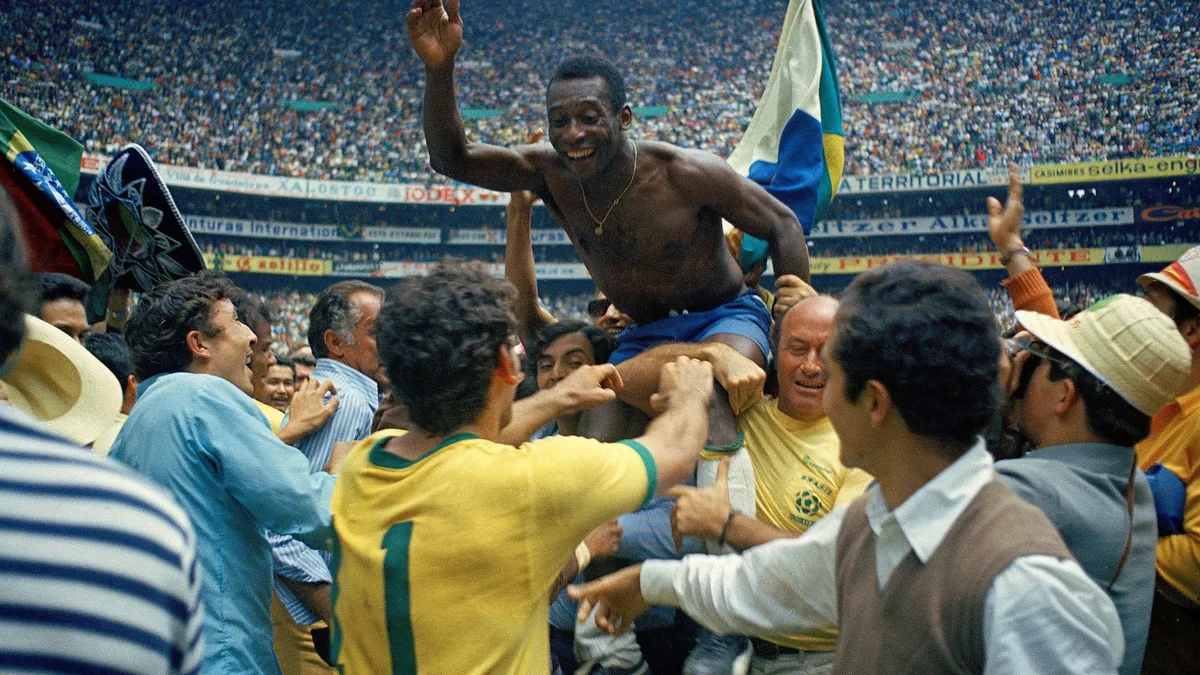
1970 World Cup Final: Brazil 4–1 Italy
- Venue
- Estadio Azteca
- Location
- Mexico City, Mexico
- Date
- Attendance
- 107,412
- Referee
- Rudi Glöckner (East Germany)
Goalscorers
Brazil
- Pelé 18'
- Gérson 66'
- Jairzinho 71'
- Carlos Alberto 86'
Italy
- Boninsegna 37'
The coach who told a dictator no
The team most often called the greatest in football history nearly went to Mexico under a different manager, and that is not a footnote. It is the whole beginning of the story.
João Saldanha was a journalist and a communist who had qualified Brazil for the 1970 finals with a perfect record. He was also, by March 1970, unemployed. The military government of General Emílio Garrastazu Médici had made it known that the President admired the Atlético Mineiro striker Dadá Maravilha and would like to see him in the squad. Saldanha's answer became one of the most quoted lines in Brazilian sport.
The President chooses the ministers, I choose the players.
João Saldanha, on refusing President Médici's request, via Football Makes History
He was sacked on 17 March 1970, replaced by Mário Zagallo, who had won the World Cup as a player in 1958 and 1962. Zagallo inherited essentially the same squad and did the one thing everyone said could not be done: he played all of the creators at once. Pelé, Gérson, Tostão, Rivelino and Jairzinho were all number 10s in their own right. Conventional wisdom said they would trip over one another. Zagallo made them a system.
There is a bitter irony in it that Brazilians still argue about. A dictatorship that jailed and tortured its critics got to drape itself in the flag of a team assembled, in part, by a man it had pushed out. Saldanha, for his part, went back to journalism and commentated on the tournament for TV Globo, celebrating the win without visible grudge.
Two very different roads to the Azteca
Mexico 1970 was a brutal tournament to play in. Every venue sat at least 1,500 metres up on the Mexican plateau, Toluca highest at 2,660, and temperatures regularly pushed past 32C, with many kick-offs moved to noon to suit European television rather than human lungs. It was also the first World Cup broadcast in colour, and though colour sets were still rare across much of the world, that is precisely why this team, in those yellow shirts, became the one the world remembers.
Brazil won all six of their matches and scored 19 goals doing it. They beat Czechoslovakia 4-1, then England 1-0 in a group game remembered above all for Gordon Banks somehow saving a Pelé header, then Romania 3-2, Peru 4-2 in the quarter-final and Uruguay 3-1 in the semi. Jairzinho scored in every single one of those matches, group stage through final, a feat nobody has matched since.
Italy's route was the opposite in every way. They ground through their group with two goalless draws and a single 1-0 win over Sweden, scoring once in three matches. Then they beat Mexico 4-1, and then, on 17 June at the same Estadio Azteca, they played West Germany in a match that has been called the Game of the Century ever since.
It deserves the name. Italy led through Roberto Boninsegna from the 8th minute until the second minute of stoppage time, when Karl-Heinz Schnellinger scored the only goal of his international career to force extra time. What followed was five goals in thirty minutes: Gerd Müller on 94, Tarcisio Burgnich on 98, Gigi Riva on 104, Müller again on 110 and Gianni Rivera on 111 to win it 4-3. It remains the record for goals scored in extra time at a World Cup, and a monument to it stands outside the stadium.
How the final actually turned
For an hour, this was not a coronation. Pelé opened it in the 18th minute, rising to head in Rivelino's cross with the kind of hang time that made photographers famous. But Italy were not there to be spectators, and on 37 minutes a mix-up in the Brazilian defence let Boninsegna in to equalise. Half-time came at 1-1, and the catenaccio was holding.
What broke it was Gérson. On 66 minutes he shaped himself outside the box and drove a powerful shot past Enrico Albertosi. Five minutes later, Gérson's free kick found Pelé, whose header dropped for Jairzinho to bundle in the third, keeping his every-match streak alive in the one match that counted most.
Ferruccio Valcareggi's response to going 3-1 down has haunted Italian football ever since. All tournament he had run the staffetta, the relay: Sandro Mazzola in the first half, Rivera in the second, because he refused to believe the two could play together. In the final, with the game slipping away, Rivera came on in the 84th minute. Six minutes. The man who had scored the winner in the Game of the Century got six minutes of the final, and when the squad flew home to Fiumicino the crowds on the tarmac were not there to congratulate anyone.
The goal that ended the argument
And then, on 86 minutes, Brazil scored the goal that people who do not watch football have still somehow seen.
It started with Clodoaldo, a defensive midfielder, deciding to beat four Italians inside his own half, which is the sort of thing you do when you have entirely stopped being afraid. The ball went left to Rivelino, then long to Jairzinho, who carried it past Giacinto Facchetti and squared it to Pelé on the edge of the area. Pelé did not shoot. He did not even look. He rolled the ball sideways into empty grass, and Carlos Alberto arrived from right-back at full sprint and hit it so cleanly that Albertosi barely moved.
It is the perfect goal because it is not a fluke. It is the whole tournament compressed into fifteen seconds: a defender dribbling like a winger, a winger crossing like a full-back, the best player alive making the pass instead of the shot, and the captain, a right-back, finishing it. If you have ever wondered why football keeps trying to recreate that move, in every era and every 3D football game since, that is why.
What Brazil took home
Rudi Glöckner of East Germany blew the whistle in front of 107,412 people, and Brazil had a third star. Under the rules of the day, a third title meant the Jules Rimet trophy was theirs permanently. They kept it in Rio until 1983, when it was stolen and never recovered, almost certainly melted down for its gold.
The individual footnotes are extraordinary too. Zagallo became the first man to win the World Cup as both player and coach. Pelé finished as the only three-time winner in history, and remains so in 2026. He retired from international football the following year, at the top, which almost nobody manages.
Italy's consolation took twelve years and arrived in 1982, when a similarly maligned squad won it in Spain. Brazil's next came in 1994, and it was won on penalties by a team nobody accused of being beautiful. That gap is the point. 1970 is the rare occasion when the best team was also the most joyful one, and every final since, right through the full history of the fixture, has been measured against a standard set on one Sunday in Mexico City.
Frequently asked questions
What was the score in the 1970 World Cup final?
Brazil beat Italy 4-1 at the Estadio Azteca in Mexico City on 21 June 1970. Pelé scored on 18 minutes, Boninsegna equalised on 37, and Gérson (66), Jairzinho (71) and Carlos Alberto (86) finished it in the second half.
Why did Brazil get to keep the Jules Rimet trophy?
The rules of the era awarded the original trophy permanently to the first nation to win three World Cups. Brazil's 1970 win followed 1958 and 1962. The trophy was stolen from Rio de Janeiro in 1983 and has never been recovered.
Is Carlos Alberto's goal really the greatest of all time?
It is the most celebrated team goal in World Cup history. Clodoaldo beat four Italians in his own half, the move swept left to right through Rivelino, Jairzinho and Pelé, and captain Carlos Alberto arrived from right-back to score. It was Brazil's fourth, on 86 minutes.
Why did Gianni Rivera only play six minutes of the final?
Coach Ferruccio Valcareggi used a staffetta or relay system, alternating Rivera and Sandro Mazzola rather than playing both. In the final he did not bring Rivera on until the 84th minute, with Italy 3-1 down. The decision drew furious criticism in Italy.
Was Pelé the best player of the 1970 World Cup?
He was the tournament's defining figure and the only player to win three World Cups, in 1958, 1962 and 1970. The Golden Boot, however, went to West Germany's Gerd Müller with 10 goals.
Sources
War of Soccer is an independent, unofficial game and website by Nyza Creations LLC. It is not affiliated with, endorsed by, or sponsored by FIFA, any national federation, club, or any player — including Lionel Messi. Naming someone is not a claim to represent them. Team names, competition names and players are referred to descriptively, for identification and commentary only. Historical match data comes from public records — every page lists its sources.