1966 FIFA World Cup Final
1966 World Cup Final: England 4–2 West Germany
- Venue
- Wembley Stadium
- Location
- London, England
- Date
- Attendance
- 96,924
- Referee
- Gottfried Dienst (Switzerland)
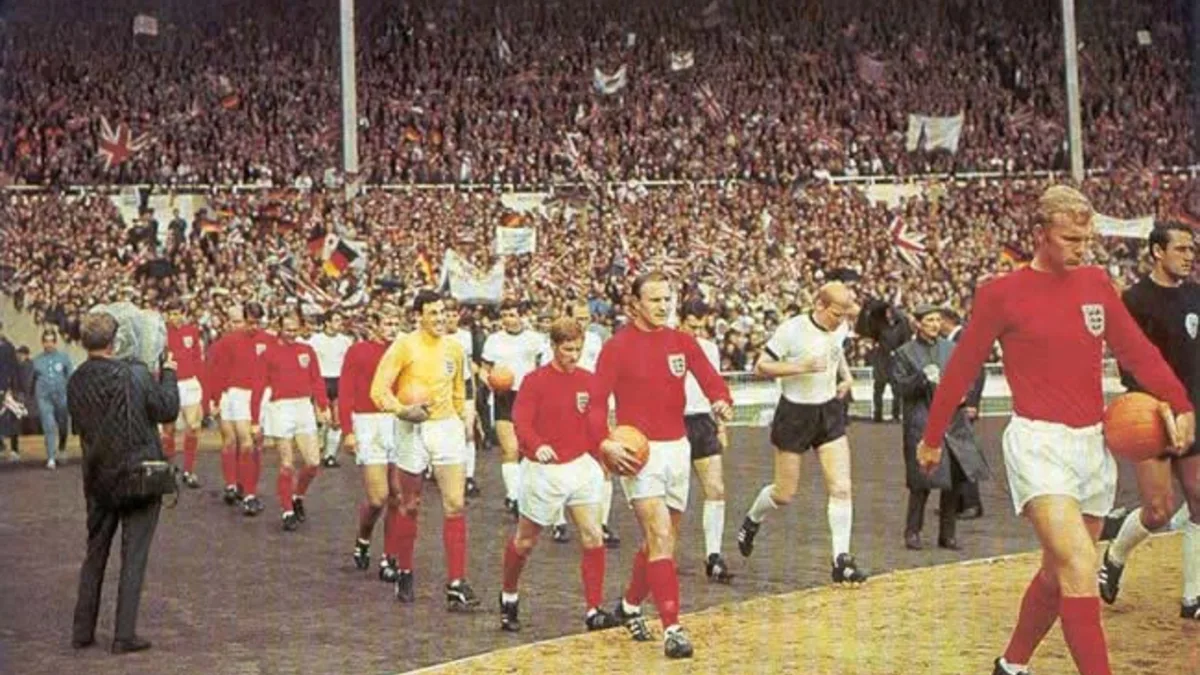
Goalscorers
England
- Hurst 18', 101', 120'
- Peters 78'
West Germany
- Haller 12'
- Weber 89'
The tournament that almost lost its trophy
Four months before a ball was kicked, England did not have a World Cup to give away. On 20 March 1966 the Jules Rimet trophy was stolen from a public exhibition at Westminster Central Hall, and for seven days the country that invented the game could not produce the prize it was about to compete for. Then a collie called Pickles, out with his owner David Corbett in Beulah Hill in south London, started sniffing at a parcel under a hedge. It was the trophy, wrapped in newspaper. The Football Association was sufficiently unnerved that it secretly had a replica made to put on display instead of the original - FIFA had expressly refused permission, so once the tournament was over the fake had to disappear too, and it spent years under its maker's bed. It is the kind of detail that would be rejected from a script, and it set the tone for a tournament that kept refusing to behave.
The football obliged. North Korea, playing their first World Cup, beat Italy 1-0 and became the first nation from outside Europe or the Americas to get out of the first round - the next would be Morocco, twenty years later. In the quarter-final they went 3-0 up on Portugal inside the opening half-hour before Eusébio dragged his side back to win 5-3, scoring four of the goals himself; he finished as the tournament's top scorer with nine and took Portugal to third. England's own quarter-final against Argentina descended into something uglier, with Argentina's captain Antonio Rattín sent off by referee Rudolf Kreitlein for what was recorded as violence of the tongue, and refusing to leave the pitch until police intervened.
It seemed a pity so much Argentinian talent is wasted. Our best football will come against the right type of opposition - a team who come to play football, and not act as animals.
Alf Ramsey after England v Argentina, 1966 quarter-final
It was a remark that poisoned an already sour relationship between the two countries for decades. Meanwhile West Germany arrived at Wembley having dismantled Uruguay 4-0 and edged the Soviet Union 2-1 in the semi-final, a 20-year-old Franz Beckenbauer scoring the winner with a left-foot shot from the edge of the area. England had topped their group without conceding a single goal - while scoring only four.
Ramsey's wingless wonders
Alf Ramsey had won the thing before it started, in a sense, by throwing away the one piece of orthodoxy every English side carried: the winger. Natural wingers of the era were not asked to defend, and Ramsey decided he could not afford passengers. He replaced them with midfielders who could run both ways, producing a narrow, direct shape described at the time as a 4-4-2 and remembered ever since as the wingless wonders.
The effect on opponents was disorientating. Full-backs spent their careers waiting for a winger to come at them down the touchline; against England nobody came, and the danger arrived instead straight through the middle, where Bobby Charlton had been pulled back into an attacking midfield role behind the strikers. It was less a formation than a bet - that fitness and organisation would beat flair over 90 minutes.
In the final, that bet produced a strange stalemate at the heart of the pitch. Both managers had the same idea: Helmut Schön told Beckenbauer to mark Charlton, and Ramsey told Charlton to mark Beckenbauer. The two best footballers on the field spent the afternoon cancelling each other out, each sacrificing his own game to smother the other. The final would be decided by everyone else.
Ninety minutes that would not end
West Germany scored first, and scruffily: Siegfried Held swung in a cross, Ray Wilson misjudged his header and dropped the ball at the feet of Helmut Haller, whose shot squirmed past Jack Charlton and Gordon Banks. England's answer six minutes later was a preview of how the whole day would finish. Wolfgang Overath conceded a free kick, Bobby Moore took it before anyone had set themselves and floated it into the box, and Geoff Hurst - a man who was only in the team because Jimmy Greaves had gashed his leg badly enough to need stitches in the last group game - rose entirely unchallenged to glance it in.
For an hour it stayed level. Then, twelve minutes from time, England won a corner: Alan Ball delivered it, Hurst's shot from the edge of the area deflected off a defender, and Martin Peters put the loose ball away from eight yards. Wembley began saying goodbye. With a minute left, Jack Charlton was penalised for climbing on Uwe Seeler, and Lothar Emmerich blasted the free kick straight into George Cohen in the wall. The rebound fell to Held, whose shot across the face of goal struck Karl-Heinz Schnellinger and spun across England's six-yard box to Wolfgang Weber, who forced it past Banks. Banks spent the rest of his life insisting the ball had come off Schnellinger's arm; the replays show it hit his back. The cruellest equaliser in the history of the fixture was, in the end, a pinball.
What Ramsey did next is the reason his players still talk about him. He would not let them sit down on the turf - a deliberate signal across the halfway line that England were not tired, whatever the Germans could see in their faces.
You've won it once. Now you'll have to go out there and win it again.
Alf Ramsey to his players before extra time, Wembley, 30 July 1966
The goal that has never been settled
Eleven minutes into extra time, Alan Ball crossed, Hurst swivelled and shot from close range, and the ball smashed the underside of the crossbar, bounced down and was cleared. Referee Gottfried Dienst did not know. He went to his linesman, Tofiq Bahramov - an Azerbaijani, and so a Soviet official, a detail West Germany noticed rather quickly given they had knocked the USSR out of the semi-final five days earlier - who signalled a goal. Dienst gave it, and football has been arguing ever since.
The Laws are unforgiving on this point: a goal requires the whole of the ball to pass over the line. England pointed to Bahramov's position, and to Roger Hunt, the closest player to the ball, who wheeled away to celebrate rather than tap in the rebound - the reaction of a man certain of what he had seen. Modern analysis is less certain. Duncan Gillies of the Visual Information Processing Group at Imperial College London, and Ian Reid and Andrew Zisserman of Oxford's Department of Engineering Science - whose 1996 paper Goal-directed Video Metrology reconstructed the shot frame by frame - have both put the same number on it: the ball would have needed to travel a further 18 cm, give or take 4, to fully cross the line.
They think it's all over
The fourth removed the argument. In the last seconds Moore, with spectators already spilling onto the grass, ignored every instinct to hoof it clear and instead picked out Hurst with a long pass over the German defence. Hurst ran and hit it left-footed into the roof of the net - the first hat-trick ever scored in a World Cup final, and the last for 56 years, until Kylian Mbappé matched it for France in 2022. Mbappé finished on the losing side, which leaves Hurst with the narrower, stranger record: the only man to score a hat-trick in a World Cup final and win it.
And here comes Hurst. He's got... some people are on the pitch, they think it's all over. It is now! It's four!
Kenneth Wolstenholme, BBC television commentary
The British television audience peaked at 32.3 million, which still makes it the most-watched broadcast in the United Kingdom's history - a number no drama, funeral or coronation has beaten since.
What 1966 bought, and what it cost
It is still England's only World Cup. That sentence has done more damage to English football than any defeat, because 1966 stopped being a memory and became a measurement - every squad since has been handed it as a debt rather than a gift.
West Germany, meanwhile, treated it as an invoice. Four years later, in the 1970 quarter-final in León, England led 2-0 through Alan Mullery and Martin Peters and lost 3-2 after extra time - Beckenbauer began the comeback, Uwe Seeler levelled it eight minutes from time and Gerd Müller finished it, giving West Germany their first competitive win over England. Eight years after Wembley, Beckenbauer lifted the trophy himself as a captain in the 1974 final. England have not reached a World Cup final since the day they won one. The full ledger is at every World Cup final ever played.
And Hurst's third goal outlived them all. Goal-line technology exists in modern football for one reason: enough people watched a ball hit a crossbar at Wembley in 1966 and could not agree on what they had seen. When Spain and Argentina meet in the 2026 final, a chip in the ball will settle in half a second what two universities needed decades and a computer to estimate. Something was gained. Something was lost too - nobody will ever argue about it in a pub for sixty years.
Sources
- List of FIFA World Cup finals — Wikipedia
- 1966 FIFA World Cup final — Wikipedia
- 1966 FIFA World Cup — Wikipedia
- Geoff Hurst — Wikipedia
- 2022 FIFA World Cup final — Wikipedia
- FIFA World Cup Trophy (Jules Rimet Trophy) — Wikipedia
- 1966 theft of the Jules Rimet Trophy — Wikipedia
- 1966 World Cup final: The story of the game as England beat West Germany — Sports Mole
- Alf Ramsey — Wikiquote
- Tofiq Bahramov — Wikipedia
- 1970 FIFA World Cup — Wikipedia
- Goal-line technology — Wikipedia
War of Soccer is an independent, unofficial game and website by Nyza Creations LLC. It is not affiliated with, endorsed by, or sponsored by FIFA, any national federation, club, or any player — including Lionel Messi. Naming someone is not a claim to represent them. Team names, competition names and players are referred to descriptively, for identification and commentary only. Historical match data comes from public records — every page lists its sources.