History
Hand of God, Goal of the Century: Four Minutes in 1986
In four minutes at Estadio Azteca, Diego Maradona scored the most notorious goal in World Cup history and then, by FIFA's own vote, the greatest one.
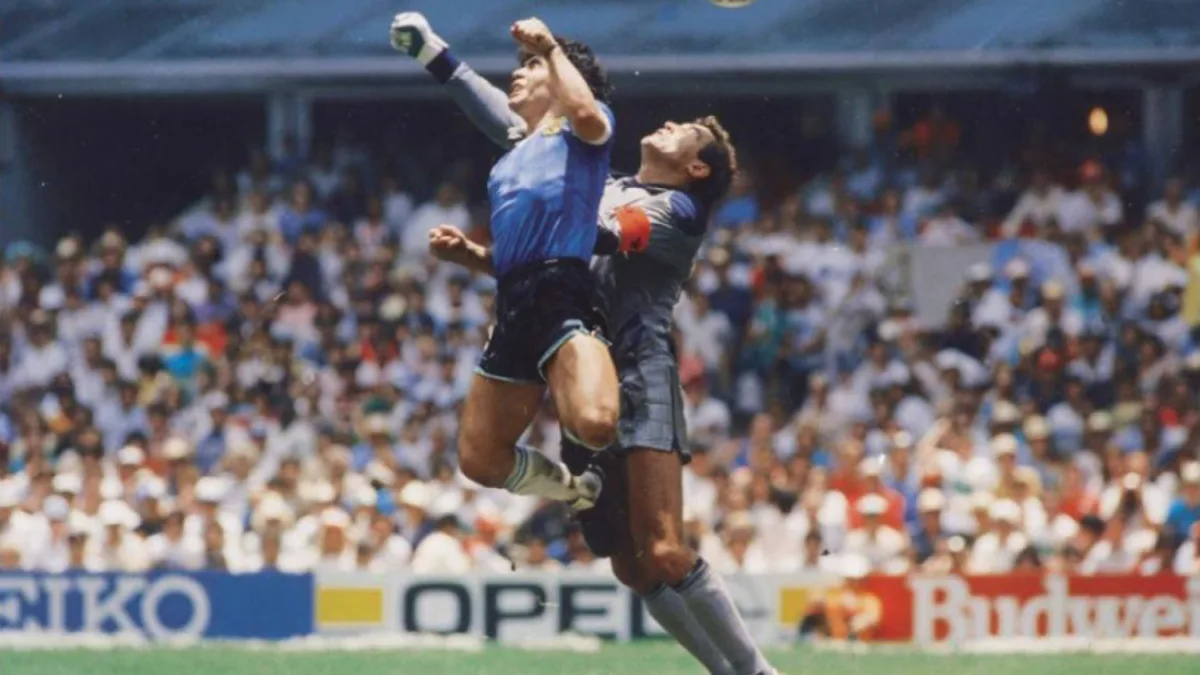
Two goals, four minutes apart, same match, same player, same goalkeeper standing in the way both times. On 22 June 1986, at Estadio Azteca in Mexico City, Diego Maradona scored the most argued-about goal in World Cup history in the 51st minute and, by FIFA's own later vote, the greatest one ever scored at a World Cup in the 55th. Argentina beat England 2-1 in the quarter-final and went on to win the tournament. Nothing else that happened across the other six matches of that Argentina run has stayed as alive as those four minutes.
A match that was never just a match
Argentina and England had not met since the 1982 Falklands War, a ten-week conflict over the South Atlantic islands that killed 255 British and 649 Argentine military personnel. The World Cup draw put the two countries in the same quarter-final four years later, and neither side pretended the fixture was ordinary. Maradona said as much afterward: "Although we had said before the game that football had nothing to do with the Malvinas war, we knew they had killed a lot of Argentine boys there, killed them like little birds. And this was revenge." The match itself was goalless and tense for the first hour, with England's Peter Reid and Steve Hodge shadowing Maradona closely and Argentina struggling to create clean chances. Then, six minutes into the second half, everything changed twice.
The Hand of God
In the 51st minute, Jorge Valdano's misplaced pass was intercepted by England's Steve Hodge, whose attempted clearance looped high back toward his own goalkeeper. Maradona, a foot shorter than Peter Shilton, rose to meet the ball alongside him and punched it with his left fist over the advancing keeper and into the net. Referee Ali Bin Nasser of Tunisia, positioned around 30 yards away with his view partly blocked, later explained what he saw: "The English defender had the ball, sent it back and Maradona was in the air with Peter Shilton, and they were both facing away from me." Bulgarian assistant referee Bogdan Dochev suspected a handball but, under the rules of the time, was not permitted to intervene without being asked - and Bin Nasser did not ask. The goal stood.
A little with the head of Maradona and a little with the hand of God.
Diego Maradona, post-match press conference, 22 June 1986
That line, delivered minutes after the final whistle, is the one that outlived everything else said about the goal. Maradona did not admit to the handball outright for years - not until a 2005 appearance on his own Argentine television program, and later in his autobiography, where he wrote: "Now I can say what I couldn't at that moment, what I defined at that time as The Hand of God. What hand of God? It was the hand of Diego!" Shilton never accepted the apology. Asked about it decades later, he said it had come too late.
Four minutes later: the Goal of the Century
Argentina restarted from the center circle. Within seconds the ball reached Hector Enrique, who played a short pass inside his own half to Maradona. What followed took roughly ten seconds and has been replayed more times than almost any other passage of play in the sport's history. Maradona took the ball facing his own goal, spun away from Peter Reid's first challenge, and drove more than half the length of the pitch - beating Peter Beardsley, Reid again, Terry Butcher twice, and Terry Fenwick - before rounding the advancing Shilton with a feint and rolling the ball into an empty net. Roughly eleven touches, sixty yards, five different England players beaten along the way, none of them able to get a foot to the ball.
Maradona's own description of the moment afterward was almost businesslike: "I made the play to give it to Valdano, but when I got to the area they surrounded me and I had no space." He also singled out England's discipline in the challenge: "I don't think I could have done it against any other team because they all used to knock you down; they are probably the noblest in the world." In 2002, as part of FIFA's centenary celebrations, the governing body ran an online poll asking fans to choose the greatest goal in World Cup history. Maradona's run against England won with 53.6% of the vote, more than double the total for the second-place finisher. FIFA has referred to it as the Goal of the Century ever since.
- Hand of God goal
- 51st minute
- Goal of the Century
- 55th minute
- Gap between the two goals
- 4 minutes
- Players beaten in the second goal
- 5 (Beardsley, Reid, Butcher x2, Fenwick)
- Final score
- Argentina 2-1 England
- Attendance
- 114,580, Estadio Azteca
What happened after
Gary Lineker pulled a goal back for England in the 81st minute, heading in from a John Barnes cross to make it 2-1, and finished the tournament as top scorer with six goals - the Golden Boot to Maradona's Golden Ball. Argentina held on and went through to the semi-final, where Maradona scored twice more against Belgium, and then to the final itself, where his pass set up Jorge Burruchaga's winner in a 3-2 defeat of West Germany. For the full run through that title, including everything Maradona did in the six matches around the England game, the whole 1986 tournament is covered here; the final itself sits in the World Cup final archive.
The two goals kept generating their own smaller stories for decades. Referee Ali Bin Nasser received an Argentina shirt from Maradona in 2015 inscribed "para Ali, mi amigo eterno" - for Ali, my eternal friend. In 2019, in the documentary Maradona, he connected the handball explicitly to the Falklands: "It was a nice feeling like some sort of symbolic revenge against the English." And the shirt Maradona wore that day became the most expensive piece of sports memorabilia ever sold at auction, going for £7.1 million in 2022.
Why the pairing still matters
Most disputed goals fade into footnotes and most wonder goals get remembered on their own. What makes 22 June 1986 different is that the same player produced football's most notorious piece of cheating and its most celebrated moment of skill in the same match, four minutes apart, against the same opponent. It is the clearest single afternoon of evidence for why Maradona divides opinion the way he still does: not because people disagree about what happened, but because both things happened, and both were entirely him. A World Cup final decides who lifts the trophy; afternoons like this one are why some players are remembered long after the trophy is forgotten.
Every men's World Cup final from 1930 to the 2026 final in New Jersey is built from matches exactly like this one - officiating decisions that go one way instead of another, individual moments that outlast the scoreline. War of Soccer launches free the moment this year's final is decided, built by people who think a 3D football game should feel like football actually does: a game of inches and split-second calls, the same as it was at the Azteca in 1986.
Frequently asked questions
What minute was the Hand of God goal scored?
The 51st minute of the 1986 World Cup quarter-final between Argentina and England at Estadio Azteca. Maradona's second goal, the Goal of the Century, followed in the 55th minute - four minutes later.
Did the referee see Maradona handle the ball?
No. Referee Ali Bin Nasser said he was facing away from the incident and did not see the handball. Assistant referee Bogdan Dochev suspected it but, under the rules of the time, could not intervene unless asked, and Bin Nasser did not ask.
Did Maradona ever admit the goal was a handball?
Not immediately. His press-conference line about the hand of God stopped short of a clear admission. He confirmed it outright years later, in a 2005 Argentine TV appearance and in his autobiography, writing that it was 'the hand of Diego,' not God.
How many players did Maradona beat for the Goal of the Century?
Five England outfield players across the run - Peter Beardsley, Peter Reid, Terry Butcher (twice), and Terry Fenwick - before rounding goalkeeper Peter Shilton and finishing into an empty net. It was voted the greatest goal in World Cup history in FIFA's 2002 online poll.
Who won the match, and what happened to Argentina after?
Argentina won 2-1; Gary Lineker scored England's goal in the 81st minute. Argentina went on to beat Belgium in the semi-final and West Germany 3-2 in the final to win the 1986 World Cup.
Sources
Comments
Loading comments…
War of Soccer is an independent, unofficial game and website by Nyza Creations LLC. It is not affiliated with, endorsed by, or sponsored by FIFA, any national federation, club, or any player — including Lionel Messi. Naming someone is not a claim to represent them. Team names, competition names and players are referred to descriptively, for identification and commentary only. Historical match data comes from public records — every page lists its sources.