Heroes
Johan Cruyff Lost the 1974 Final and Changed Football Anyway
Cruyff's Netherlands scored the fastest goal in World Cup final history, then lost anyway. Half a century on, more of modern football traces back to that defeat than to the team that won it.
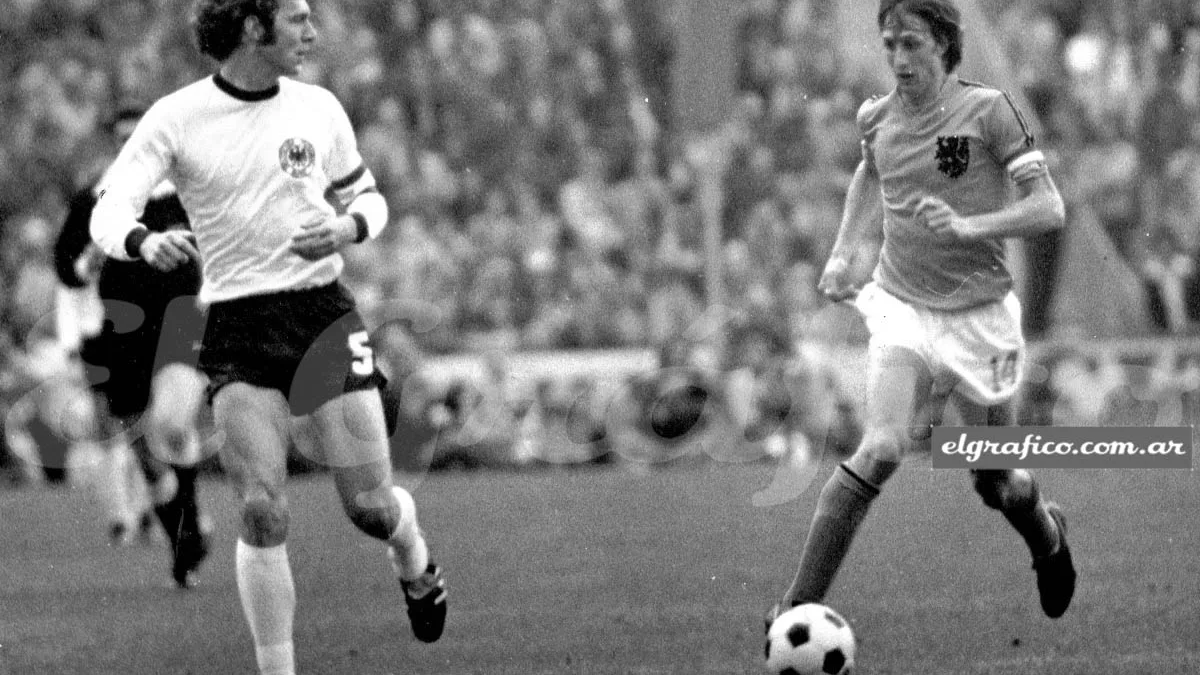
On 7 July 1974, Johan Cruyff played his last World Cup and lost the final. West Germany beat the Netherlands 2-1 at the Olympiastadion in Munich, Franz Beckenbauer lifted the trophy, and Cruyff - 27 years old, already a three-time Ballon d'Or winner and the tournament's best player - never got another shot at it. None of that is in dispute. What's stranger is what happened afterward: five decades on, more of how football is coached, recruited, and played traces back to the team that lost that final than to the one that won it.
- Final result
- West Germany 2-1 Netherlands
- Netherlands' opener
- Neeskens penalty, inside 2 minutes
- Cruyff's Ballon d'Or years
- 1971, 1973, 1974
- Ajax European Cups, same core
- 1971, 1972, 1973
- Attendance, Munich final
- 78,200
Ninety seconds that told you everything
The final's opening act is still one of the most-replayed passages of play from any World Cup final. From kickoff, the Netherlands didn't let West Germany touch the ball. Cruyff picked it up in his own half, drove straight at the German defense, and was scythed down by Uli Hoeness inside the penalty area. Johan Neeskens sent the penalty down the middle. It went in with West Germany yet to make a single touch of the match - a detail repeated so often it's become shorthand for how completely the Dutch appeared to have the sport solved before the tournament had properly started. According to Guinness World Records, Neeskens' penalty, scored 1 minute 30 seconds after kickoff, remains the fastest goal in FIFA World Cup final history.
A team that treated positions as suggestions
What made that opening minute possible wasn't Cruyff alone - it was the system built around him. Rinus Michels had spent the years before 1974 turning Ajax, and then the Dutch national team, into a side where outfield positions were temporary assignments rather than fixed jobs. A full-back could finish a move in the opposition box as long as a midfielder rotated back to cover him; a forward could drop deep to build play as long as someone else pushed on ahead. Ajax won three straight European Cups from 1971 to 1973 running this system with largely the same core of players Cruyff would go on to captain at the World Cup, and the results made believers out of the rest of the sport before the Dutch had played a single game in West Germany. Ajax defender Barry Hulshoff later described how the system actually got built, day to day.
We discussed the whole time. Cruyff always talked about where to run and where to stand, and when not to move.
Barry Hulshoff, Ajax defender
Total Football's most famous individual moment actually arrived earlier in the same tournament, not in the final. In a group-stage match against Sweden at the Westfalenstadion in Dortmund on 19 June - a goalless draw remembered for almost nothing else - Cruyff picked up the ball in the 22nd minute with defender Jan Olsson pressing him tight, feinted a pass, dragged the ball behind his own standing leg, spun 180 degrees, and was gone. Olsson has told the story of that moment for decades since. "I do not understand how he did it," he said. "It was a fantastic sequence." The move still carries Cruyff's name - the Cruyff turn - and coaches still teach it close to exactly as he did it that day.
How a 1-0 lead became a 2-1 loss
Here is the part the highlight reels leave out. After Neeskens' penalty, the Netherlands didn't press for a second goal. For roughly the next twenty minutes they kept the ball among themselves in the German half, stringing passes together less to create chances than to show West Germany, and the watching world, exactly how good they were. It's been described since as arrogant football, and the label has stuck because it fits: a team that could plausibly have killed the game inside the first quarter-hour chose to toy with it instead. West Germany used the time to settle. In the 25th minute, Dutch defender Wim Jansen brought down Bernd Holzenbein in the penalty area - a foul still argued about today, softer by most accounts than the one that had won Cruyff his own penalty - and Paul Breitner scored from the spot. Eighteen minutes later Gerd Muller, ghosting between two defenders in the way he'd built a career on, turned in the winner from close range. West Germany led 2-1 at half-time and never gave it back.
The most influential loser in the sport
Losing a World Cup final doesn't usually buy a team immortality. The Netherlands of 1974 is the exception, filed alongside Hungary's 1954 Golden Team as one of the best sides ever not to win the tournament. What both share is that the football itself became the story people kept telling, independent of the scoreline - an unusual thing for a sport that otherwise remembers almost nothing about its runners-up. Cruyff didn't get to settle the argument on the pitch that day. He spent the rest of his career settling it everywhere else.
He'd already joined Barcelona in 1973 for a world-record transfer fee, and when he returned there as manager in 1988 he rebuilt the club in the same image: positional interchange, a goalkeeper comfortable passing out from the back, a philosophy ahead of a formation. His Barcelona side won four straight league titles and the club's first European Cup in 1992, but the bigger decision he made was institutional - insisting the youth academy, La Masia, recruit and coach on technique and footballing intelligence rather than size. A teenager named Pep Guardiola, undersized by the old standards, became one of the first players promoted under the new rules. Guardiola went on to captain that Barcelona side, then to manage the club himself, and has never been quiet about where the idea came from.
Johan Cruyff painted the chapel. And Barcelona coaches since merely restore or improve it.
Pep Guardiola, quoted by ESPN
- La Masia's recruit-on-technique-not-size philosophy, still Barcelona's academy model today
- Guardiola's positional play at Barcelona, Bayern Munich, and Manchester City
- Spain's 2010 World Cup-winning midfield, built from the academy Cruyff redesigned
- The Cruyff turn, still taught to youth players close to exactly as he first did it in 1974
Why it still runs through 2026
The players Guardiola built his Barcelona teams around - Xavi, Andres Iniesta, a teenage Lionel Messi - were La Masia products raised on Cruyff's insistence that the ball, not the player, should do the work of covering distance. Spain's midfield at the 2010 World Cup came out of that same academy and that same idea, and the possession-heavy approach now shorthanded as tiki-taka is a direct, traceable descendant of what Michels and Cruyff built at Ajax and the Netherlands from 1970 onward. Spain are back in a World Cup final in 2026, for the first time since that 2010 win, still playing recognizably in that lineage. The team that lost in Munich never got its trophy. Everyone who's won one playing that way since has been paying it forward.
There's no rematch for what happened in Munich - Cruyff never reached another World Cup final, and West Germany's trophy has stayed exactly where it landed in 1974. But that final is still the match attacking sides get measured against, and it's part of why War of Soccer exists at all: to let anyone try to write a different ending the moment the next one is decided.
Frequently asked questions
Did Johan Cruyff ever win a World Cup?
No. Cruyff played in one World Cup, in 1974, and lost the final 2-1 to West Germany. He stopped playing for the Dutch national team in 1977 and never appeared in another World Cup.
Why did the Netherlands lose the 1974 World Cup final after scoring first?
After Johan Neeskens' penalty inside the first two minutes, the Netherlands spent roughly the next twenty minutes keeping possession without pushing for a second goal, which let West Germany settle into the match. West Germany equalized through a Paul Breitner penalty in the 25th minute, after a foul by Wim Jansen on Bernd Holzenbein, then took the lead through Gerd Muller in the 43rd minute.
What is the Cruyff turn and where did it come from?
The Cruyff turn is a dribbling move where a player fakes a pass or shot, then drags the ball behind their own standing leg to spin away from a defender. Cruyff first showed it at the 1974 World Cup, in a group-stage match against Sweden on 19 June, beating defender Jan Olsson with it.
How did Cruyff's 1974 team influence Barcelona and Spain's football?
Cruyff joined Barcelona as a player in 1973 and returned as manager in 1988, rebuilding the club's style and insisting its La Masia academy recruit on technique rather than size. That academy produced Pep Guardiola, Xavi, Andres Iniesta, and Lionel Messi, and Spain's tiki-taka approach, including their 2010 World Cup-winning side, grew directly out of it.
Is the 1974 Dutch team considered one of the best to never win a World Cup?
Yes. Alongside Hungary's 1954 Golden Team, the Netherlands' 1974 side is widely regarded as one of the best teams never to win the World Cup, remembered more for its football than its result.
Sources
- 1974 FIFA World Cup final - Wikipedia
- Total Football - Wikipedia
- Johan Cruyff - Wikipedia
- Johan Cruyff's legacy, five years after his death: How he shaped Ajax, Barcelona, world soccer - ESPN
- Fastest goal scored by a football (soccer) player in a FIFA World Cup final - Guinness World Records
- Jan Olsson still laughs at his attempt to defend Cruyff turn - ESPN
- Holland 1974: the legendary failed heroes of the Oranje - These Football Times
- Netherlands 1974 and the Beautiful Team That Lost - Goals Without Borders
Comments
Loading comments…
War of Soccer is an independent, unofficial game and website by Nyza Creations LLC. It is not affiliated with, endorsed by, or sponsored by FIFA, any national federation, club, or any player — including Lionel Messi. Naming someone is not a claim to represent them. Team names, competition names and players are referred to descriptively, for identification and commentary only. Historical match data comes from public records — every page lists its sources.