Heroes
Geoff Hurst's Hat-Trick: The Only One By a World Cup Winner
Geoff Hurst scored three goals for England in the 1966 final at Wembley. One of them has never stopped being argued about.
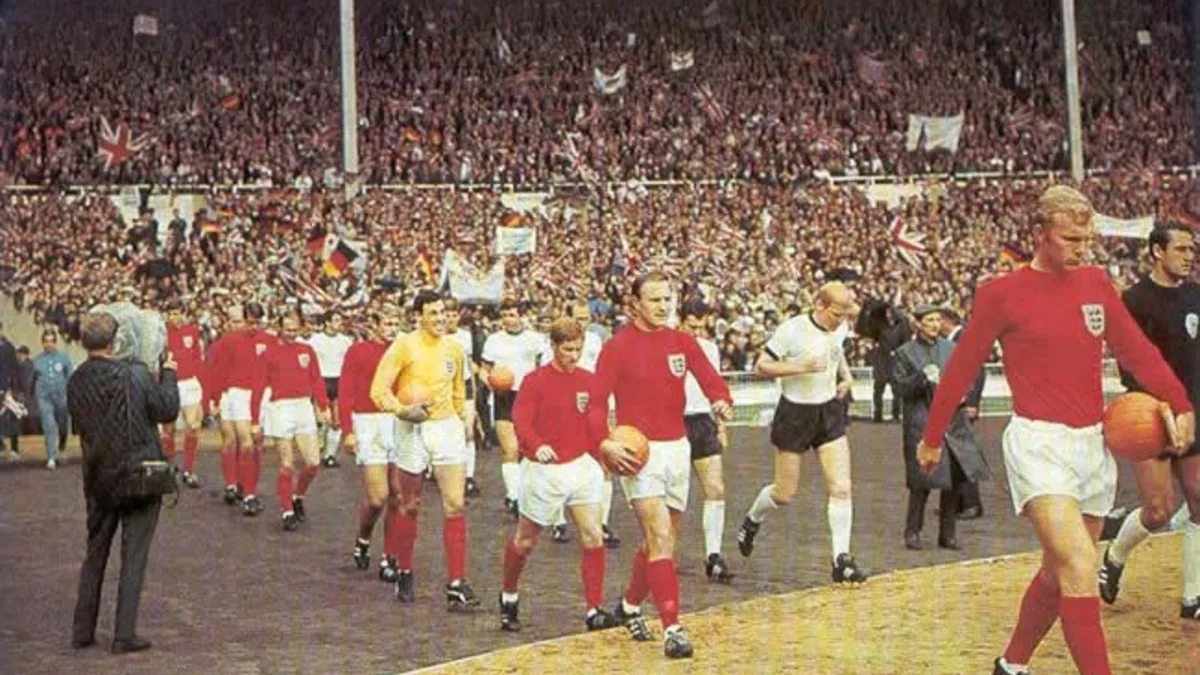
On 30 July 1966, at Wembley Stadium in front of 96,924 people, Geoff Hurst scored three goals as England beat West Germany 4-2 after extra time to win their only World Cup. Fifty-six years passed before anyone matched him. Kylian Mbappe scored three in the 2022 final in Qatar - and still finished on the losing side, beaten by Argentina on penalties. Hurst's team won. That is the distinction that actually matters: Geoff Hurst remains the only man to score a hat-trick in a World Cup final and lift the trophy.
The match itself was extraordinary before Hurst ever got involved. West Germany led through Helmut Haller in the 12th minute, Hurst equalised six minutes later, Martin Peters put England ahead in the 78th, and West Germany's Wolfgang Weber forced extra time with an equaliser in the 89th - deep enough that England's players had barely processed the lead being taken from them before the whistle went for another half hour of football. Hurst then scored twice more, in the 101st and 120th minutes, to finish the game 4-2 and complete the only hat-trick ever scored in a men's World Cup final by a player on the winning team.
Goal one: the equaliser
Hurst's first goal, in the 18th minute, was a header from a Bobby Moore free kick, struck cleanly enough that there has never been a single argument about it. It mattered enormously at the time - it cancelled out Haller's early strike and reset the match - but history has been almost entirely uninterested in it, because of what came 83 minutes later.
Goal two: the goal that still is not settled
Score tied at 2-2, 11 minutes into extra time. Alan Ball crossed from the right, Hurst controlled it on the turn and hit a shot that struck the underside of the crossbar, bounced down, and was cleared by a West German defender. Swiss referee Gottfried Dienst was not sure it had crossed the line. He turned to his linesman - Tofiq Bahramov, from Soviet Azerbaijan - who signalled that it had. Dienst awarded the goal. England led 3-2.
That is the moment English football culture still calls the ghost goal, and Germany has never fully accepted it. West Germany's own goalkeeper that day, Hans Tilkowski, and his defenders maintained for the rest of their lives that the ball never fully crossed the line - the exact opposite of what the linesman ruled.
I will tell anyone connected with world football: that ball was at least one metre over the line - full stop.
Geoff Hurst, FIFA interview
Hurst has held that position for six decades, though he has also been honest about the limits of his own view of it: he fell over as he struck the shot, and by his own account did not see where the ball actually landed. His stronger evidence, he has said, is that his teammate Roger Hunt - standing right on top of the loose ball, in perfect position to force it in himself if there was any doubt - instead wheeled away celebrating and shouted that it was a goal.
Tofiq Bahramov, the linesman, gave his own account in his memoirs, and it is a strange one: he wrote that he believed the ball had rebounded not off the crossbar into the goalmouth and back out, but off the net behind the goal line - which would make the question of exactly how far it bounced back out irrelevant, because in his version it had already been inside. It is not an account that matches the video, but it tells you that even the man who awarded the goal was constructing his own certainty around it after the fact.
That is not the only analysis to reach the same rough conclusion. Separate researchers at Imperial College London and the University of Oxford, working independently, put the shortfall at roughly 18 centimetres, give or take 4 - a bigger gap than the three-inch minimum but pointing the same direction. A 2021 computer reconstruction produced with former defender Jamie Carragher went the other way, concluding the ball had in fact crossed. There has never been a single frame of footage clear enough to end the argument outright: in the Oxford researchers' own account, the goalkeeper's body blocks the ball from one of the two surviving camera angles at the critical moment, forcing them to estimate its position from the other. Sixty years of forensic effort, and the game's most famous disputed goal remains exactly that: disputed. Nobody has ever seriously suggested overturning the result - it could not be, this far after the fact - but it is the single biggest reason every major tournament now plays with goal-line technology, so no final is ever decided by a linesman's raised flag again.
Goals three and four: settling it beyond argument
Martin Peters had actually put England 2-1 up in the 78th minute of normal time, before Wolfgang Weber's 89th-minute equaliser forced extra time in the first place - so by the time Hurst's disputed goal made it 3-2, West Germany still had a full half of extra time to find another equaliser, and they pushed for one. It did not come. In the 120th minute, with West Germany committed forward and spread thin chasing the game, Bobby Moore picked out a long ball from deep in England's own half, and Hurst ran onto it and drove a shot into the top corner of Hans Tilkowski's net. There was no controversy in that one at all, and it happened to coincide with one of the most famous lines in football broadcasting.
And here comes Hurst. He's got... some people are on the pitch, they think it's all over. It is now! It's four!
Kenneth Wolstenholme, BBC commentary, 30 July 1966
Fans had already started spilling onto the Wembley pitch before Hurst even struck the ball, assuming the final whistle was seconds away - which is what gives the line its shape. It has been repeated so often since that "they think it's all over" has become a stock English phrase for any contest presumed settled before it actually is.
Why the hat-trick stood alone for 56 years
World Cup finals are usually settled 1-0 or 2-1. Teams that reach a final are, almost by definition, the two best defensive units left in the tournament, playing the single match of the year they are least willing to take risks in. Three goals from one player in that context requires the match to break open completely - which, in every final played between 1966 and 2022, simply did not happen again for anyone. Pele, Maradona, Zidane, Ronaldo - none of the sport's greatest ever scored more than two in a final. It took Kylian Mbappe, coming from 2-0 down with roughly 10 minutes left against Argentina in 2022, scoring twice in quick succession to force extra time and then converting a second penalty to make it 3-3, to finally match Hurst's total. But France lost that final on penalties, which is exactly why the record books still separate the two men: one hat-trick won a World Cup, and the other did not.
- Final score
- England 4-2 West Germany (a.e.t.)
- Hurst's goals
- 18', 101', 120'
- Attendance
- 96,924, Wembley Stadium
- Referee
- Gottfried Dienst (Switzerland)
- Years as the only final hat-trick
- 56 (1966 to 2022)
What happened to Hurst
Hurst stayed at West Ham United until 1972, scoring 180 goals in 411 appearances and winning the FA Cup and European Cup Winners' Cup with the club before the World Cup final ever happened. He won 49 caps for England between 1966 and 1972. He was knighted in 1998, more than three decades after Wembley. After Sir Bobby Charlton's death in October 2023, Hurst became the last surviving member of that England starting eleven - the only man left who was actually on the pitch for both the goal everyone agrees on and the one nobody has ever fully settled.
Sixty years on, Hurst's is still the only hat-trick in World Cup final history scored by the team that lifted the trophy - and still the one final goal nobody has ever been able to prove either way. That is a rare double for one man to hold: the record and the mystery, in the same match, on the same afternoon. World Cup Final history has thrown up bigger scorelines since, but nothing else quite like it.
Frequently asked questions
Did Geoff Hurst's controversial goal actually cross the line?
It has never been settled. Geoff Hurst insists it did, and cited teammate Roger Hunt's reaction as evidence. West Germany's goalkeeper Hans Tilkowski always maintained it did not. A University of Oxford projective-geometry study concluded the ball fell short by at least a few inches; a separate 2021 computer analysis reached the opposite conclusion. No camera angle from 1966 shows the moment clearly enough to prove it either way.
Is Geoff Hurst still the only player to score a hat-trick in a World Cup final?
No. Kylian Mbappe scored a hat-trick for France in the 2022 final against Argentina, 56 years after Hurst. The difference is the result: Hurst's England won the match, while Mbappe's France lost the 2022 final on penalties. Hurst remains the only player to score a World Cup final hat-trick on the winning side.
Who was the linesman who allowed Hurst's disputed goal?
Tofiq Bahramov, an Azerbaijani official representing the Soviet Union. He signalled to referee Gottfried Dienst that the ball had crossed the line, and the goal was given. Azerbaijan later renamed its national stadium the Tofiq Bahramov Republican Stadium in his honour.
What is the famous commentary line from Hurst's fourth goal?
BBC commentator Kenneth Wolstenholme said, as fans began running onto the Wembley pitch believing the match was already over: "Some people are on the pitch, they think it's all over. It is now!" - just as Hurst scored his third goal of the match, England's fourth of the game.
How many goals did Geoff Hurst score for West Ham and England?
Hurst scored 180 goals in 411 appearances for West Ham United between 1958 and 1972, and 24 goals in 49 caps for England between 1966 and 1972.
Sources
- 1966 FIFA World Cup final - Wikipedia
- Geoff Hurst: The ball was at least one metre over the line - FIFA
- Hurst: It was at least one metre over the line - Inside FIFA
- Tofiq Bahramov - Wikipedia
- World Cup '66 goal analysis - Ian Reid / Andrew Zisserman, University of Oxford
- Geoff Hurst - Wikipedia
- 2022 FIFA World Cup final - Wikipedia
Comments
Loading comments…
War of Soccer is an independent, unofficial game and website by Nyza Creations LLC. It is not affiliated with, endorsed by, or sponsored by FIFA, any national federation, club, or any player — including Lionel Messi. Naming someone is not a claim to represent them. Team names, competition names and players are referred to descriptively, for identification and commentary only. Historical match data comes from public records — every page lists its sources.