History
The 1966 Ghost Goal: What Goal-Line Technology Says Now
Geoff Hurst's disputed 1966 final goal has never been proven either way. Modern goal-line technology would answer it instantly - and the real reason it exists has nothing to do with Hurst.
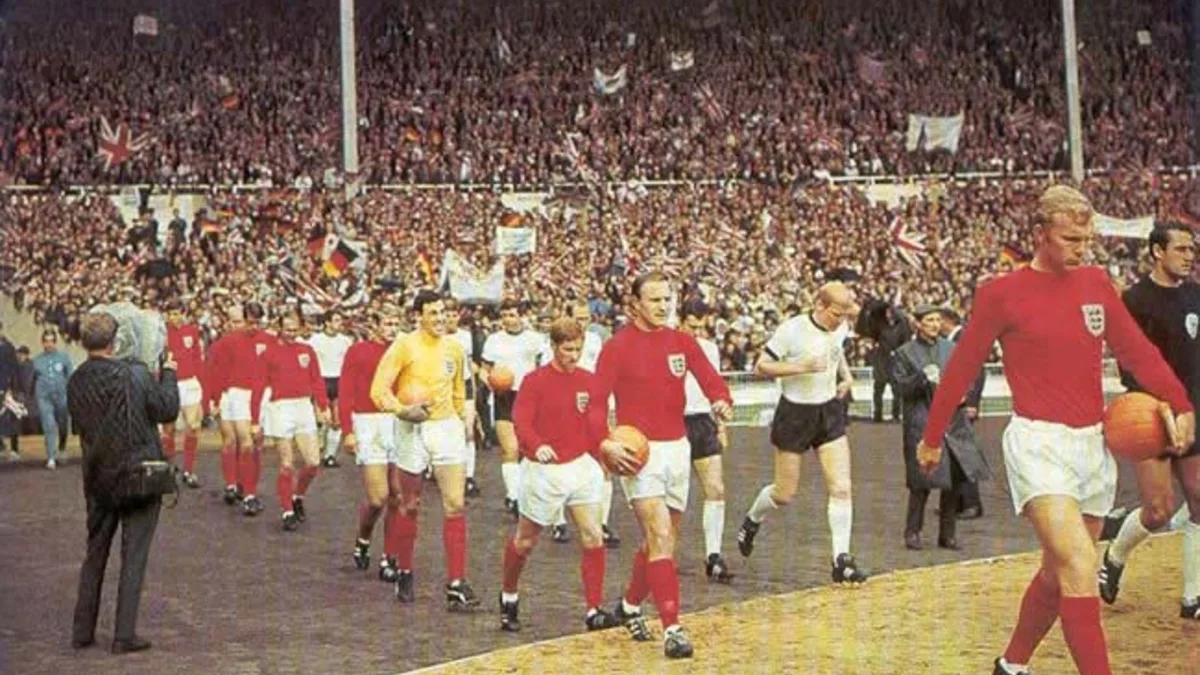
Wembley, the 101st minute of extra time, score tied at 2-2. Alan Ball crosses from the right, Geoff Hurst controls it on the turn and rifles a shot that cracks against the underside of the crossbar, drops down onto or near the goal line, and is hacked clear by a West German defender. Referee Gottfried Dienst, whose view is partially blocked, is not sure what he has just seen. He turns to his linesman, Tofiq Bahramov of the Soviet Union, who signals that the ball crossed. Dienst awards the goal. England go 3-2 up, and fourteen minutes later Hurst adds a fourth to win the 1966 final 4-2 after extra time. Sixty years on, nobody has ever proven Bahramov was right. Nobody has ever proven he was wrong, either.
A decision with no way to check
There was no video review available to Dienst in 1966 - not because the technology to film it didn't exist, television cameras were rolling, but because nothing in the Laws of the Game allowed a goal decision to be reversed once given. The moment Bahramov's flag went up and Dienst pointed to the centre circle, the goal stood, permanently, regardless of what any camera eventually showed. That is the part of the story that tends to get lost: it isn't that the officials got it wrong. It's that in 1966 there was no mechanism to ever find out, one way or the other, in the moment it actually mattered.
What the forensic science actually found
Decades later, researchers tried anyway. Ian Reid and Andrew Zisserman at the University of Oxford, working from surviving newsreel footage shot from two fixed camera angles, used projective geometry to reconstruct a plan view of the goalmouth and track the ball frame by frame. Duncan Gillies at Imperial College London ran an independent reconstruction. Both concluded the ball fell short of the line by roughly 18 centimetres, give or take 4, when it hit the ground and was cleared.
The goal that actually built goal-line technology - and it wasn't this one
It's tempting to assume Hurst's disputed goal is the reason football eventually built machines to answer this kind of question. It isn't, at least not directly. Goal-line technology exists because of a goal that went the other way. Frank Lampard's shot for England against Germany at the 2010 World Cup in South Africa struck the underside of the bar, bounced down clearly over the line by two or three feet, and was waved away by the officiating crew with no review available. England, already trailing, lost that last-16 match 4-1. The reaction was loud enough that IFAB, football's law-making body, formally approved goal-line technology two years later, in July 2012.
It was first used competitively at the 2012 Club World Cup, tested again at the 2013 Confederations Cup, and made its senior World Cup debut in Brazil in 2014 - the first goal it confirmed came during France's opening group match against Honduras, on 15 June 2014. Lampard has since said he has no regrets about the moment that cost England a game, because it is the direct reason the technology exists at all. Hurst's goal, the far more famous of the two, changed nothing about how football is officiated. Lampard's, the one almost nobody outside England still talks about, changed everything.
How the technology actually decides
FIFA-approved systems work one of two ways. Camera-based systems - the Hawk-Eye approach familiar from cricket and tennis - use multiple high-speed cameras, up to 14 in FIFA's own installations, mounted on the stadium roof or catwalk with several trained on each goalmouth, to triangulate the ball's exact position in three-dimensional space many times a second. Magnetic-field systems take the opposite approach: they run a low-power magnetic field around the goal frame and put a sensor inside the ball itself, so the ball effectively reports its own position rather than being tracked from outside. Either way, the instant the system determines the whole of the ball has passed over the whole of the line, an encrypted signal reaches the referee's watch - a vibration and a flashing confirmation - in under a second. There is no ambiguity in the output. It is a yes or a no, never a probability.
| 1966 | Today | |
|---|---|---|
| Who decides | A linesman's eyesight, one look, from the touchline | Multiple fixed high-speed cameras or an in-ball sensor |
| Time to a decision | Immediate and final, no review possible | Under one second, automated |
| Margin for error | Never independently confirmed either way | None claimed within the system's certified tolerance |
| When it changed | N/A | Approved 2012, first used at a World Cup in 2014 |
What it would say about Hurst's shot - and what it's doing right now
Run Hurst's shot through that system and the argument ends instantly, correctly, and forever, whichever way it falls - because the system isn't estimating from two grainy angles decades after the fact, it's measuring in real time from multiple fixed points built for exactly this question. That is the real difference between 1966 and now. Officials haven't gotten better at judging the goal line. Football simply stopped asking them to.
Every World Cup since 2014 has been played with goal-line technology in place, and 2026 layers more around it: semi-automated offside tracking that turns each player into a 3D avatar to catch fine offside calls, a connected match ball - the Trionda - carrying a sensor that samples its own motion 500 times a second and streams it to the video review room, and, new for this tournament, referees wearing body cameras and explaining major reviews to the crowd inside the stadium. None of it touches the 1966 scoreline, which stands regardless of what anyone now believes about that bounce. What it means is that the 2026 final will never need its own forensic reconstruction sixty years from now - not because the shots will be any less violent or the margins any less tight, but because 'did it cross the line' stopped being a judgement call in 2014. It became a coordinate check instead, the same kind War of Soccer runs on its own ball every frame - and coordinate checks, unlike a linesman forty yards away with one look and no replay, don't leave anything to argue about decades later.
- Disputed goal
- Hurst, 101' - made it England 3-2 West Germany
- Oxford/Imperial estimate
- Ball fell roughly 18cm (plus or minus 4) short
- Goal-line tech approved by IFAB
- July 2012
- First World Cup use
- 15 June 2014, France's opener v Honduras
- Referee notification time today
- Under 1 second
Frequently asked questions
Did Geoff Hurst's 1966 World Cup final goal actually cross the line?
It has never been proven either way. University of Oxford and Imperial College London researchers who reconstructed the ball's path from newsreel footage concluded it fell roughly 18 centimetres short of the line; a separate 2021 computer analysis involving Jamie Carragher concluded it crossed. No surviving camera angle from 1966 is clear enough to settle it outright.
What actually caused FIFA to introduce goal-line technology?
Not the 1966 final. It was Frank Lampard's disallowed goal for England against Germany at the 2010 World Cup, which clearly crossed the line but was not given because no video review was available. IFAB approved goal-line technology in July 2012, and it made its World Cup debut in 2014.
How does goal-line technology actually work?
FIFA-approved systems use one of two methods: multiple high-speed cameras, up to 14 in FIFA's own installations, that triangulate the ball's position in three-dimensional space, or a magnetic-field system with a sensor built into the ball itself. Either way, once the whole ball passes the whole line, an encrypted signal reaches the referee's watch in under a second.
When was goal-line technology first used at a World Cup?
At the 2014 World Cup in Brazil. The first goal it confirmed came during France's group-stage match against Honduras on 15 June 2014.
Is goal-line technology used at the 2026 World Cup?
Yes, alongside semi-automated offside tracking and a connected match ball, the Trionda, that streams its own motion data to the video review room 500 times a second.
Sources
Comments
Loading comments…
War of Soccer is an independent, unofficial game and website by Nyza Creations LLC. It is not affiliated with, endorsed by, or sponsored by FIFA, any national federation, club, or any player — including Lionel Messi. Naming someone is not a claim to represent them. Team names, competition names and players are referred to descriptively, for identification and commentary only. Historical match data comes from public records — every page lists its sources.