Heroes
Mario Gotze's 113th-Minute Goal, and What Came After
Mario Gotze scored the only goal of the 2014 World Cup final as a substitute, deep into extra time. The four years that followed were nothing like the goal itself.
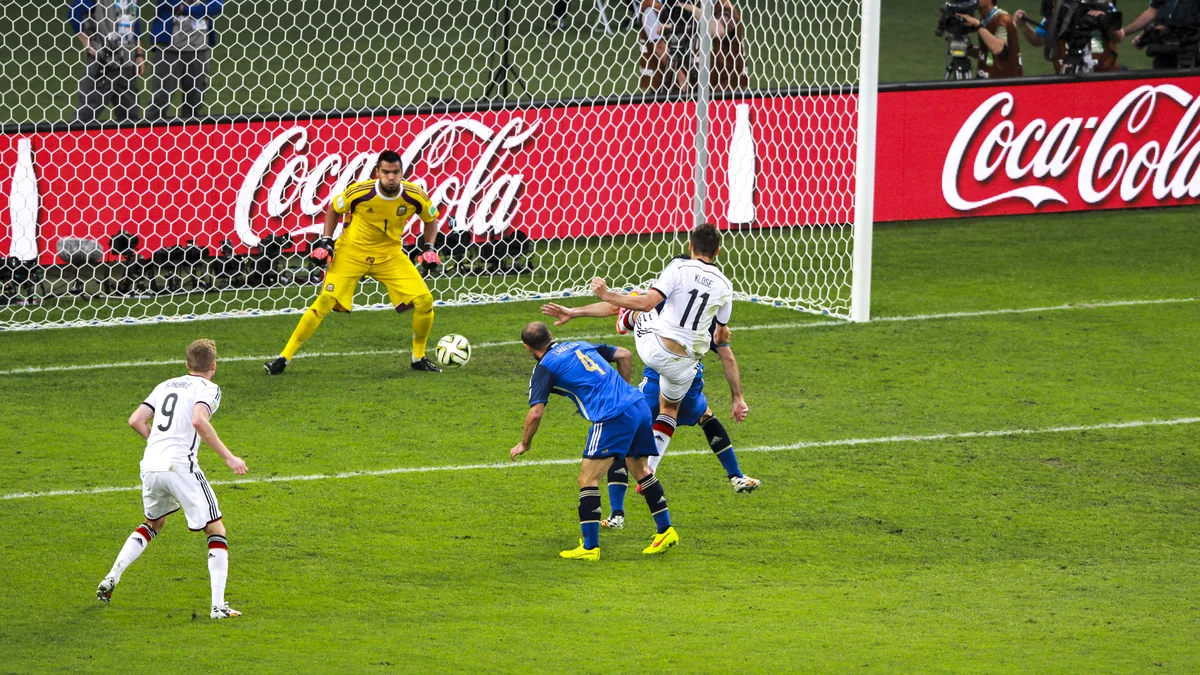
Joachim Low had two attacking options left on his bench in the second half of extra time at the Maracana, and he chose the one whose season had barely mattered. Mario Gotze had started only twice for Germany in the whole tournament. He was 22, three weeks removed from being an afterthought in Bayern Munich's title-winning squad, and he was about to become the answer to a question nobody had thought to ask: what happens to the World Cup's most famous impact substitute once the party ends.
The 88th minute
Gotze replaced Miroslav Klose in the 88th minute of a final that was still goalless, West Germany's record World Cup scorer making way for a player who had come through the same Dortmund academy a generation later. As he sent Gotze on, Low delivered the line that would follow both men for years afterward. Speaking at the post-match press conference, Low said he had told Gotze to "show to the world he is better than Messi and to decide the World Cup." Gotze's own memory of the moment is hazier than the sentence's afterlife suggests. "Maybe he did say that, but to be fair, in the moment, you have so many thoughts," he said later. "You're in the zone."
The goal
Germany 1, Argentina 0 after extra time - the scoreline gives no sense of how long the match had gone before it broke. In the 113th minute, Andre Schurrle beat two defenders down the left and drove a low cross into the box. Gotze took it on his chest, let it drop, and volleyed left-footed past Sergio Romero from close range. It was the latest winning goal in a World Cup final since Andres Iniesta's 116th-minute strike had beaten the Netherlands four years earlier, and it made Germany world champions for the fourth time, at the Maracana, in the country that had lost a semi-final 7-1 to them three days before this final was even set.
- Score
- Germany 1-0 Argentina (a.e.t.)
- Subbed on
- 88th minute, for Miroslav Klose
- Goal
- 113th minute, assist by Andre Schurrle
- Minutes played
- Roughly 32, including extra time
- Venue
- Maracana Stadium, Rio de Janeiro
- Attendance
- 74,738
- Referee
- Nicola Rizzoli (Italy)
Gotze was named man of the match for a final in which he had touched the ball for barely half an hour. It is the shortest possible summary of what made the moment so extraordinary and, in hindsight, so hard to live up to: almost none of the match belonged to him, and all of the outcome did.
A sentence that followed him for four years
Low's line about Messi was meant as a private jolt of belief, not a public standard. It became both. Four years later, with Gotze's career stalled by injury and form, Low admitted the comparison had done real damage. "He was always measured against it, and scoring the decisive goal might have become a burden for him," Low said in 2018, adding that repeating the quote publicly afterward "did not help Mario during the next few months." Gotze, for his part, has been characteristically measured about the whole arc of it. "A lot changed in that moment," he reflected years later. "If I could go back and tell myself how everything would play out, it would be better."
He was always measured against it, and scoring the decisive goal might have become a burden for him.
Joachim Low, 2018, on the Messi comparison
Bayern, home again, and a body that stopped cooperating
Gotze had already joined Bayern Munich the year before the final, a 37 million euro move that made him Germany's most expensive player at the time. He won three Bundesliga titles there between 2013 and 2016, plus a Club World Cup and a UEFA Super Cup, but he spent much of it as a squad option behind Thomas Muller, Arjen Robben and Franck Ribery rather than the transformative creator Dortmund fans remembered. In 2016 he went home, signing a four-year deal back at Borussia Dortmund. It did not fix things. In early 2017, Dortmund confirmed Gotze had been diagnosed with myopathy, a metabolic muscle disorder that had likely been the underlying cause of a string of soft-tissue injuries stretching back years. He was sidelined for roughly five months. The club's chief executive, Hans-Joachim Watzke, was blunt about the outlook: "This is not going to be a short-term thing."
The disorder cost him more than game time. In May 2018, Low left Gotze out of Germany's squad for the World Cup in Russia - the tournament immediately after the one he had won almost single-handedly. Low's explanation was plain rather than dramatic: "It wasn't his season," he said, adding that Gotze "did not have the form." The scorer of the goal that won Germany's fourth World Cup did not go to the fifth.
The second career
Gotze's rebuild happened away from the Bundesliga's biggest stages. He left Dortmund in 2020 for PSV Eindhoven on a free transfer, and in the Netherlands he found something closer to his old rhythm, winning the KNVB Cup and the Johan Cruyff Shield. In 2022 he moved to Eintracht Frankfurt, and it is there that the second half of his career has actually taken hold: Frankfurt extended his contract in 2023 and then again in April 2026, tying him to the club through 2028, by which point he will be 35. He retired from international football in March 2023, playing the second half of a friendly against Peru as his farewell, closing a Germany career that began in 2010 and never produced a second World Cup appearance after 2014.
None of that reads like a fairy tale, and Gotze has never pretended otherwise. "The standard I had for my first five or six seasons was amazing," he said, looking back. "It was almost impossible to keep that level for the next ten years." What he did keep, permanently, is the goal itself - 113 minutes into the biggest match in the sport, from a player who had been an afterthought twenty-five minutes earlier. The 2014 final is remembered as cleanly as any final in the competition's history precisely because the ending was that improbable: not a favorite finishing the job, but a substitute deciding it. It is the same category of moment War of Soccer is built to let anyone replay the instant the 2026 final produces its own.
Why the moment still holds up
Extra-time winners are rare enough on their own. A late substitute scoring one, in a final, off a chested control and a first-time volley, is rarer still - and the four hard years that followed for Gotze are a reminder of what that kind of night can cost as well as give. The goal did not stop being real when his club career stalled. If anything, the years afterward make it more remarkable: a 22-year-old, sent on with an impossible instruction ringing in his ears, did exactly what he was asked to do, once, when it mattered more than it would ever matter again.
Frequently asked questions
What minute did Mario Gotze score in the 2014 World Cup final?
The 113th minute, in the second period of extra time, giving Germany a 1-0 win over Argentina.
What minute was Gotze substituted on?
The 88th minute of normal time, replacing Miroslav Klose.
Who assisted Gotze's winning goal?
Andre Schurrle, who beat two defenders down the left before crossing for Gotze to chest down and volley home.
Did Mario Gotze play at the 2018 World Cup?
No. Joachim Low left him out of Germany's squad, citing lack of match form after a metabolic disorder, myopathy, had disrupted his 2016-17 season at Borussia Dortmund.
Where does Mario Gotze play now?
Eintracht Frankfurt, where his contract runs through 2028. He retired from international football with Germany in March 2023.
Sources
- 2014 FIFA World Cup final - Wikipedia
- Mario Gotze - Wikipedia
- 'Messi comparison was a burden for Gotze' - Low regrets famous World Cup quote - Goal.com
- First winning goal scored by a substitute in a football (soccer) FIFA World Cup Final - Guinness World Records
- Germany icon Mario Gotze on his 2014 World Cup-winning goal against Argentina - Yahoo Sports
- Borussia Dortmund's Mario Gotze out for unspecified period with metabolism problem - Sky Sports
- Germany World Cup squad omits Mario Gotze as Joachim Low signs new contract - ESPN
Comments
Loading comments…
War of Soccer is an independent, unofficial game and website by Nyza Creations LLC. It is not affiliated with, endorsed by, or sponsored by FIFA, any national federation, club, or any player — including Lionel Messi. Naming someone is not a claim to represent them. Team names, competition names and players are referred to descriptively, for identification and commentary only. Historical match data comes from public records — every page lists its sources.