2014 FIFA World Cup Final
2014 World Cup Final: Germany 1–0 Argentina
- Venue
- Maracanã Stadium
- Location
- Rio de Janeiro, Brazil
- Date
- Attendance
- 74,738
- Referee
- Nicola Rizzoli (Italy)
Goalscorers
Germany
- Götze 113'
A rebuild that started with a humiliation
The team that walked out at the Maracana on 13 July 2014 had been under construction since the summer of 2000. That June, Germany went to the European Championship and finished bottom of their group with a single point, behind Portugal, Romania and England. It was, in the phrase that stuck, a national embarrassment. The response was not a new manager. It was a new country.
In February 2001 the Bundesliga made youth academies compulsory. Not encouraged - compulsory, a condition of the licence to play in the league at all, eventually extended to all 36 clubs in the top two divisions. Each academy needed full-time coaches, proper facilities, a medical department and a partnership with local schools. Between 2001 and 2011 German professional clubs put roughly 500 million euros into it, with the DFB adding around 9.5 million a year and opening hundreds of youth centres serving tens of thousands of children.
By 2014 the graduates had names: Neuer, Hummels, Muller, Ozil, Schurrle, Gotze. Joachim Low, who had been Jurgen Klinsmann's assistant before taking the job in 2006, was explicit afterwards about what the trophy actually represented - not a good month in Brazil, but the last step of a decade-long project he had inherited rather than invented.
We'd not made this ultimate step before, but champions do what they will do. This team has developed a spirit which is unbelievable.
Joachim Low, after the 2014 World Cup final
Germany reached the final having topped Group G, then survived Algeria in extra time, beaten France 1-0, and done the thing in Belo Horizonte that nobody has stopped talking about since: 7-1 against the host nation in a World Cup semi-final. It meant that Brazil's own stadium, on Brazil's own final night, had no Brazilian to cheer for and two choices it disliked in different ways.
Argentina got there the hard way, on purpose
Argentina's route looked nothing like Germany's. Alejandro Sabella's side won all three group games, then ground out 1-0 against Switzerland in extra time, 1-0 against Belgium, and beat the Netherlands 4-2 on penalties after a semi-final that produced almost nothing. It was not the football Argentina's public wanted. It was, arguably, the only football that was going to get a team carrying Lionel Messi to a final.
Messi was 27. Argentina had not been in a World Cup final for 24 years, and had not won one since 1986. The two nations had met six times previously at World Cups, and the two most famous were finals: Argentina 3-2 in 1986, then West Germany 1-0 in 1990, a match Germany won from the penalty spot in a game so bitter it produced the first red cards in a final. Germany had also knocked Argentina out in the quarter-finals of both 2006 and 2010, the second time 4-0. The scoreboard of the rivalry was not neutral. Argentina were, in a real sense, playing an argument as much as a team.
Germany's night began badly before it began at all. Sami Khedira pulled up injured in the warm-up. Christoph Kramer, 23 years old and barely capped, started a World Cup final instead.
The chances that decide a life
This is the part of the 2014 final that gets forgotten, because the ending was so clean. For 90 minutes Argentina were the better team at creating the moment that would have ended it.
On 21 minutes Toni Kroos miscued a header back towards his own goal and Gonzalo Higuain was suddenly alone, running at Manuel Neuer with a World Cup in front of him. He dragged it wide. On 30 minutes he put the ball in the net from an Ezequiel Lavezzi cross and was flagged offside. Two minutes later Kramer, who had taken a blow to the head early on and played on visibly unwell, was withdrawn - a substitution that would help push football's concussion protocols into public argument, and one that put Andre Schurrle on the pitch. Remember that.
Just before half-time Benedikt Howedes met a Kroos corner and headed against the post. After the break Messi went through on Neuer and slid his shot wide of the far post. On 56 minutes Neuer came out and flattened Higuain in the act of challenging for a high ball; Nicola Rizzoli gave nothing, and Argentina have never entirely let it go. On 71 Schurrle arrived in the box with only Sergio Romero to beat and could not control the ball.
- Clear one-on-one chances missed
- Higuain (21'), Messi (48'), Schurrle (71')
- Germany's semi-final
- 7-1 v Brazil, in Brazil
- Argentina's knockout goals before the final
- 2 in 300+ minutes of open play
- Global TV audience
- Around 1.013 billion
Extra time was where Argentina emptied. Rodrigo Palacio lobbed Neuer and watched it drift wide after a Mats Hummels error. Then nothing. Sabella's men had spent a month defending brilliantly and it had cost exactly what it always costs.
Ninety-eight minutes of nothing, then Mario Gotze
On 88 minutes Low took off Miroslav Klose - the last appearance of the World Cup's all-time leading scorer - and sent on Mario Gotze, 22 years old. What he said as Gotze went past him became one of the most quoted instructions in the sport's history, and Low has since said he regrets it.
I said to him, show to the world you are better than Messi.
Joachim Low, on his instruction to Mario Gotze before sending him on
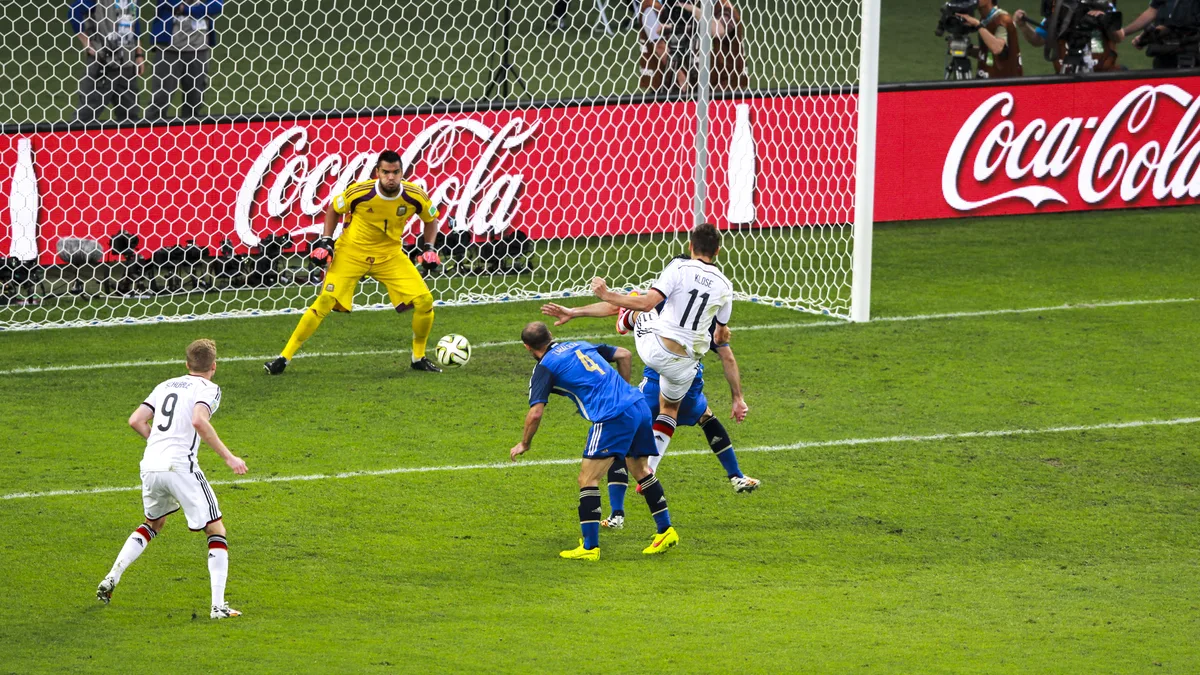
In the 113th minute Schurrle - the man on the pitch only because Kramer's head had been rattled - beat two defenders on the left and crossed. Gotze, running, took the ball on his chest and volleyed it left-footed past Romero in what was effectively a single motion. It is the only goal in this match and it is close to a perfect one: a substitute's touch, a substitute's finish, no time to think about any of it.
You score the goal and you don't really know what's happening. It hasn't been a simple tournament, or year, for me and I owe a lot to my family and my girlfriend who always believed in me. But a dream became reality here.
Mario Gotze, named man of the match
Sabella's summary was shorter and worse to read. His players, he said, had been warriors, and had not taken their chances: "we only had to last another five minutes or so to reach penalties. The pain is immense."
What the Maracana settled, and what it did not
Germany became world champions for the fourth time and the first as a reunified country. They also became the first European nation ever to win a World Cup staged in the Americas, and the third European winner in a row after Italy in 2006 and Spain in 2010. Dilma Rousseff handed the trophy to Philipp Lahm in the stadium where Brazil's tournament had already died.
Then came the strangest presentation in modern World Cup history. Messi was given the Golden Ball as the tournament's best player, minutes after losing the final, and walked up to collect it looking like a man being sentenced. Sepp Blatter said he was "a little bit surprised" and later called the decision incorrect outright. Diego Maradona was blunter: "I could see that he didn't want to go up and collect it." Messi's own verdict needs no interpretation.
In these moments, the prize doesn't interest me at all. We wanted to take home the trophy and enjoy it with all the people in Argentina. It's very painful to lose in the manner that we did because we were so close to penalties.
Lionel Messi, after receiving the 2014 Golden Ball
The two halves of that night aged in opposite directions. Germany's machine, so total in July 2014, went out in the group stage as holders four years later. Gotze - told to be better than Messi and, for one touch, undeniably was - never became the player that sentence promised, which is why Low apologised for saying it. Argentina, meanwhile, kept the wound and eventually used it: they lost the Copa America finals of 2015 and 2016, and then, in 2022, won the World Cup in Qatar with Messi at 35.
Which is the last thing worth saying about 13 July 2014. It looked at the time like the end of Messi's argument. It was the middle of it. He is 39 now and about to play a third final, and if you want to understand why a nation still holds its breath every time he shapes to shoot, the road from 1930 to now runs straight through a chest control in Rio that belonged to somebody else.
Frequently asked questions
Who scored the winning goal in the 2014 World Cup final?
Mario Gotze, in the 113th minute of extra time. He had come on as an 88th-minute substitute for Miroslav Klose, and finished an Andre Schurrle cross by controlling it on his chest and volleying left-footed past Sergio Romero. Gotze was named man of the match.
Why did Lionel Messi win the Golden Ball in 2014 if Argentina lost?
FIFA's technical committee selected him as the tournament's best player, largely on his decisive group-stage goals. The choice was immediately contested: Sepp Blatter said he was surprised and later called it incorrect, and Diego Maradona argued Messi did not want to collect it. Messi said the award did not interest him.
What happened with Christoph Kramer in the 2014 final?
Kramer only started because Sami Khedira was injured in the warm-up. He took a heavy blow to the head early on, continued playing while visibly affected, and was substituted on 32 minutes. The incident became a reference point in the debate over football's concussion protocols. His replacement, Andre Schurrle, later assisted the winning goal.
Was Germany's 2014 win really the result of a long-term plan?
Largely, yes. After Germany finished bottom of their group at Euro 2000, the Bundesliga made youth academies a licensing requirement from 2001 and clubs invested roughly 500 million euros in youth development over the following decade. Fourteen of the 23 players in the 2014 squad were 25 or younger and products of that system.
Had a European team ever won a World Cup in the Americas before 2014?
No. Germany's win at the Maracana was the first by a European nation at a World Cup staged in the Americas. It was also the third consecutive European title, after Italy in 2006 and Spain in 2010.
Sources
- List of FIFA World Cup finals — Wikipedia
- 2014 FIFA World Cup final — Wikipedia
- Gotze goal hands Germany World Cup — ESPN match report
- How Germany went from Euro 2000 'disaster' to World Cup champions — The42
- Blatter and Maradona surprised by Messi's Golden Ball award — Sky Sports
- Low told Gotze to outshine Messi — Sports Mole
War of Soccer is an independent, unofficial game and website by Nyza Creations LLC. It is not affiliated with, endorsed by, or sponsored by FIFA, any national federation, club, or any player — including Lionel Messi. Naming someone is not a claim to represent them. Team names, competition names and players are referred to descriptively, for identification and commentary only. Historical match data comes from public records — every page lists its sources.