2010 FIFA World Cup Final
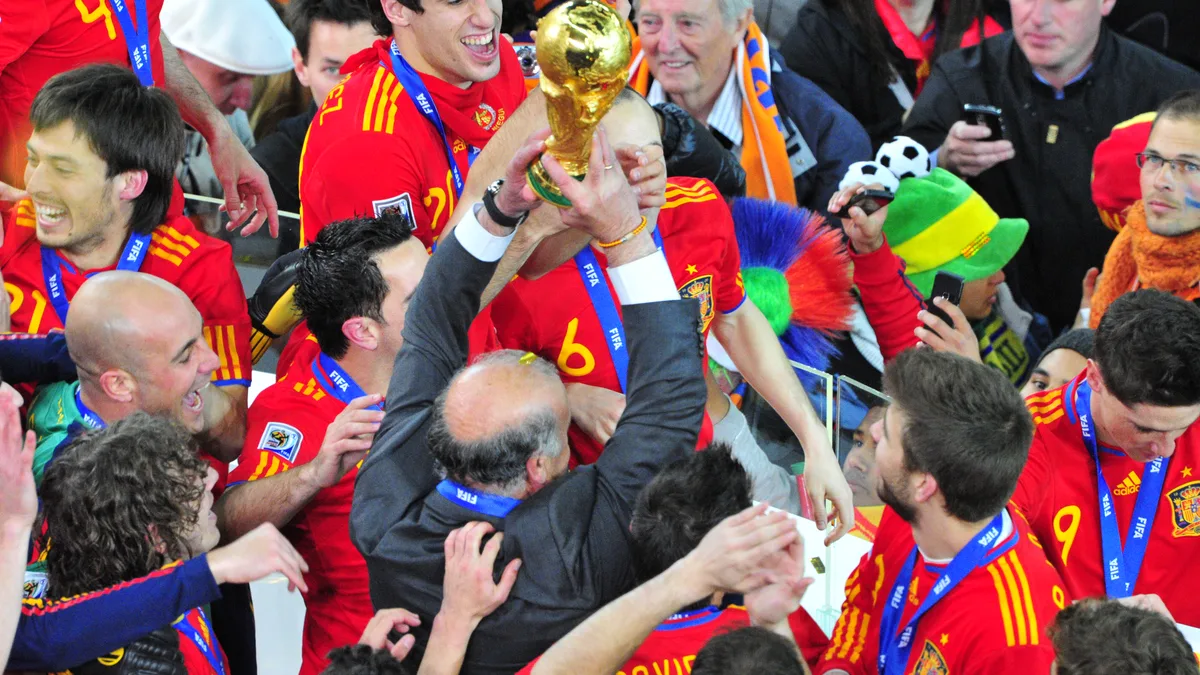
2010 World Cup Final: Spain 1–0 Netherlands
- Venue
- Soccer City
- Location
- Johannesburg, South Africa
- Date
- Attendance
- 84,490
- Referee
- Howard Webb (England)
Goalscorers
Spain
- Iniesta 116'
Two Teams Carrying Different Kinds of Nothing
Before 11 July 2010, Spain had never played in a World Cup final. Their best finish in eighty years of trying was fourth place in 1950, and that came in a round-robin that did not even stage a final. Four quarter-final exits, in 1934, 1986, 1994 and 2002, had hardened into a national genre: the gifted side that leaves early, usually narrowly, usually to someone they were better than.
The Netherlands carried the opposite burden. They had been here twice and lost twice. 1974 gave the world Total Football and gave West Germany the trophy. 1978 ended 3-1 to Argentina after extra time in Buenos Aires. The Dutch had spent thirty-six years as football's most admired losers, the team everyone borrowed ideas from and nobody had to fear in July.
So Soccer City hosted something unusual: a final in which both teams' entire history argued they were about to lose it. One of those arguments had to break.
The Dutch Decided Not to Play the Dutch Way
Bert van Marwijk's Netherlands had won every match on the road to the final, including a 2-1 quarter-final against Brazil and a 3-2 semi-final against Uruguay. They were not a bad football team. They had simply arrived at a conclusion that offended their own inheritance: you cannot out-pass this Spain. Nobody could. Xavi, Iniesta and Busquets had just passed Germany off the pitch in the semi-final. So the Dutch would not try to pass. They would try to interrupt.
The method announced itself in the 28th minute. Nigel de Jong contested a high ball with Xabi Alonso and planted his studs into Alonso's chest. It is one of the most replayed fouls in the history of the fixture, and it is remembered less for its violence than for what followed it: referee Howard Webb, poorly placed, produced a yellow card. Sergio Busquets protested that it should have been the game's first dismissal. He was right, and the referee has since agreed with him.
Having seen it again from my armchair, I would red-card him. The trouble in the actual game was that I had a poor view of that particular incident.
Howard Webb, on the De Jong challenge on Xabi Alonso
The card that was not shown set the temperature for everything after it. Webb finished the night having booked fourteen players, nine of them Dutch and five Spanish. The previous record for a World Cup final was six, set in 1986. He more than doubled it. The Netherlands committed 28 fouls; Spain committed 19. The most watched football match on earth had turned into an argument.
The harshest verdict came from inside the Dutch cathedral itself. Johan Cruyff, the man whose 1974 side had made the Netherlands worth admiring in the first place, said his country had played in a very dirty fashion, and called the performance ugly, vulgar and anti-football. Franz Beckenbauer, watching from the other side of that old rivalry, described a final lacking flow, full of protests, with a referee who never had an overview of it.
The Ninety Minutes of Nothing, and the Chances Inside It
For all the fouling, the final was not actually goalless because it was empty. It was goalless because two goalkeepers refused to let it be anything else.
In the 62nd minute Wesley Sneijder released Arjen Robben clean through, one-on-one with Iker Casillas, the exact scenario the entire Dutch plan had been built to manufacture. Robben tried to flick the ball over him into the corner. The shot lacked height, and Casillas got enough on it to turn it behind for a corner. In the 83rd Robben beat Carles Puyol and tried to take the ball around Casillas instead; the goalkeeper went low and took it off his foot before he could. Spain's captain won the World Cup twice in twenty-one minutes without touching the ball with his hands in any way anyone would call orthodox.
Spain had their own version. Jesus Navas put David Villa in four yards from goal, and Maarten Stekelenburg parried it behind, a moment the Guardian's minute-by-minute summarised in three words that have outlived the match report.
Amazing save, terrible miss.
Scott Murray, The Guardian minute-by-minute
Extra time opened with Cesc Fabregas through on Stekelenburg after a pass from Iniesta, and the Dutch keeper claimed that too. Then, in the 109th minute, John Heitinga took his second yellow card of the night, having been booked on 57, and the Netherlands finished the World Cup final with ten men.
The 116th Minute
It came from a loose ball, which is the correct ending for a match that had been fought over rather than played. Fabregas retrieved it and slid it to Iniesta, alone in space on the right-hand side of the penalty area. Iniesta took one touch with his right foot and struck the half-volley with the same foot, past Stekelenburg, into the left corner. Four minutes of football remained in the tournament.
What he did next is the part Spain remembers as clearly as the goal. Iniesta pulled off his shirt to reveal an undershirt reading Dani Jarque siempre con nosotros - Dani Jarque, always with us. Jarque had been Espanyol's captain, a contemporary of Iniesta's through the Spanish ranks. He had died of a heart attack in a hotel room on a pre-season tour in August 2009, aged 26. Iniesta had carried the message through a World Cup on the chance he would need it, and was booked for showing it - one of Webb's fourteen cautions, and comfortably the least cynical act any of them punished. He gave the shirt to Espanyol that November; it hangs at their stadium beside a mural of Jarque.
What a Single Goal Bought
- Spain's goals, whole tournament
- 8 in 7 matches
- Previous record low for a winner
- 11 (Italy 1938, England 1966, Brazil 1994)
- Knockout results
- 1-0, 1-0, 1-0, 1-0
- Bookings in the final
- 14 (previous record 6)
Spain won the World Cup scoring eight goals in seven games, the fewest of any champion in the tournament's history, three below a record previously shared by Italy in 1938, England in 1966 and Brazil in 1994. They won all four knockout rounds, against Portugal, Paraguay, Germany and the Netherlands, by exactly 1-0. They became the first team to lose their opening match and still lift the trophy, and the first European nation to win a World Cup outside Europe, in the first tournament Africa had ever hosted.
That is the paradox the 2010 final left behind. The side remembered as the most beautiful of its generation actually won its World Cup by the narrowest margins available, in the most cynical showpiece ever staged, decided in the 116th minute of the last match. Tiki-taka's monument is a 1-0 in a game with fourteen bookings. The romance was real, but it was not comfortable, and anyone who tells you Spain strolled through South Africa did not watch Robben in the 62nd minute.
Sixteen years on it reads differently again. Spain are back in a final for the first time since that night in Johannesburg, against an Argentina side defending the trophy they took from France in 2022, with Lionel Messi playing the last World Cup match of his life either way. Two of the three men who decided 2010 - Iniesta and Casillas - are long retired. The lesson of Soccer City stands anyway: finals are not won by the better idea, they are won by whoever is still standing in the 116th minute. You can read the rest of them in our full history of every World Cup final, or, once 2026 is settled, go and try to score one yourself in War of Soccer.
Frequently asked questions
Who scored in the 2010 World Cup final?
Andres Iniesta, in the 116th minute of extra time, from a Cesc Fabregas pass. It was the only goal of the match and won Spain their first World Cup.
Why did Iniesta take his shirt off after scoring?
To show an undershirt reading 'Dani Jarque siempre con nosotros' - a tribute to the Espanyol captain and his contemporary, who had died of a heart attack aged 26 in August 2009. Iniesta was booked for the celebration and later donated the shirt to Espanyol.
How many cards were shown in the 2010 World Cup final?
Fourteen yellow cards - nine to the Netherlands and five to Spain - plus one red, when John Heitinga received his second booking in the 109th minute. Fourteen is a World Cup final record; the previous high was six, in 1986.
Should Nigel de Jong have been sent off for the kick on Xabi Alonso?
Referee Howard Webb showed only a yellow card in the 28th minute, but has since said that with a clear view he would have shown red. He has explained that he was poorly placed for the incident.
Was 2010 really Spain's first World Cup?
Yes. Before 2010 Spain's best finish was fourth in 1950, with quarter-final exits in 1934, 1986, 1994 and 2002. They had never reached a final.
Sources
War of Soccer is an independent, unofficial game and website by Nyza Creations LLC. It is not affiliated with, endorsed by, or sponsored by FIFA, any national federation, club, or any player — including Lionel Messi. Naming someone is not a claim to represent them. Team names, competition names and players are referred to descriptively, for identification and commentary only. Historical match data comes from public records — every page lists its sources.