2006 FIFA World Cup Final
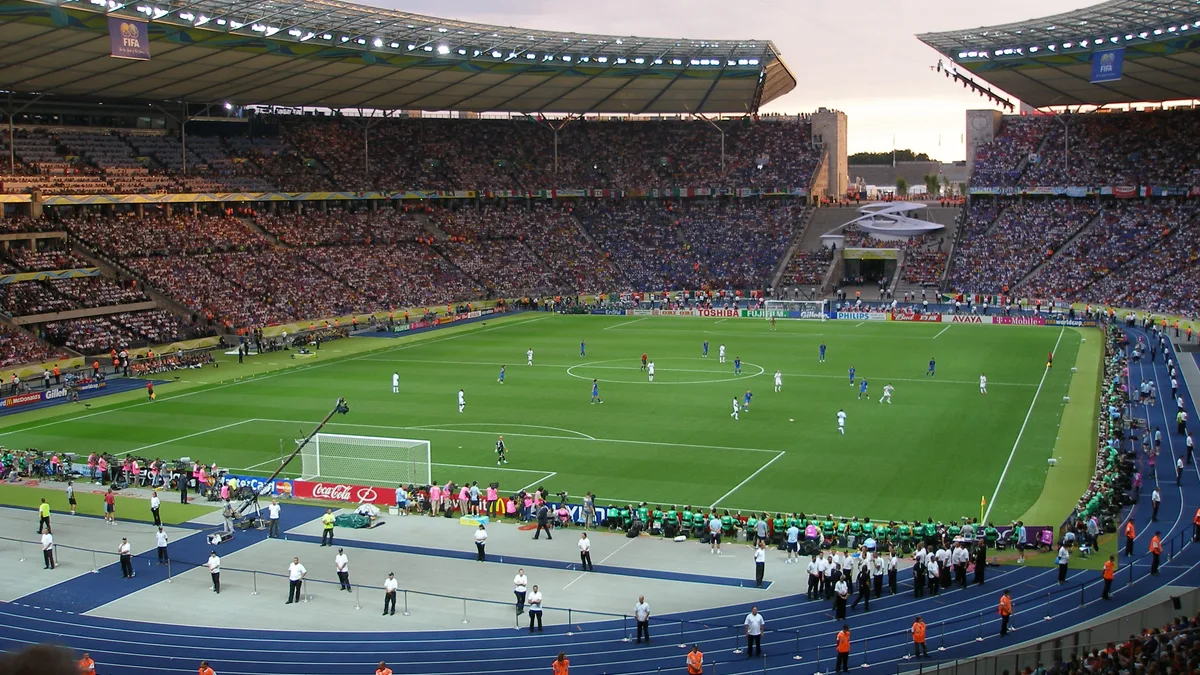
2006 World Cup Final: Italy 1–1 France
- Venue
- Olympiastadion
- Location
- Berlin, Germany
- Date
- Attendance
- 69,000
- Referee
- Horacio Elizondo (Argentina)
Goalscorers
Italy
- Materazzi 19'
France
- Zidane 7' (pen)
Two Teams Who Arrived in Berlin Already Broken
The 2006 final is remembered for about eleven seconds in the 110th minute. That is unfair to nearly everyone who played in it, and it is also unavoidable. But to understand why the Olympiastadion felt the way it did that night, you have to know what both squads carried through the door.
Italy arrived as a team whose domestic league was being dismantled behind their backs. In May 2006, weeks before a ball was kicked in Germany, prosecutors investigating Juventus released wiretaps of general manager Luciano Moggi arranging for favourable referees to be appointed to his club's matches. The scandal that became Calciopoli swallowed Juventus, Milan, Lazio, Fiorentina, Arezzo and Reggina. Marcello Lippi had managed Juventus. His spine was Juventus: Buffon, Cannavaro, Del Piero, Zambrotta, Camoranesi. They spent the tournament reading morning papers that speculated on whether the club paying their wages would exist in September.
France arrived as something stranger: a team already written off that had declined to go quietly. They stumbled out of Group G with one win, drawing 0-0 with Switzerland and 1-1 with South Korea, beating only Togo. Then they eliminated Spain 3-1, Brazil 1-0 and Portugal 1-0 in successive rounds. Zinedine Zidane, who had retired from international football in 2004 and been talked back into it, played the last month of his career like a man settling an argument with the world.
Seven Minutes, Nineteen Minutes
The final broke open faster than the estimated 715 million people watching could settle. Inside seven minutes Marco Materazzi hauled down Florent Malouda in the box, and Zidane walked up to answer. What he did next was the most arrogant act of his career and possibly the most beautiful: a Panenka, chipped straight down the middle in a World Cup final, that kissed the underside of the crossbar, bounced down over the line and spun back out. A goal decided by a centimetre, taken by a man who had decided he did not need the centimetres.
Twelve minutes later the game handed the ball back. Andrea Pirlo swung in a corner from the right and Materazzi, the man who had conceded the penalty, rose to head Italy level. Materazzi was only on the pitch at all because Alessandro Nesta had broken down earlier in the tournament. The understudy conceded the opener and scored the equaliser inside nineteen minutes, and he was not finished writing his part.
After that the match settled into something heavy and unresolved. Luca Toni hit the bar with a header on 35 minutes and had another header ruled out for offside on 62. France took control of long stretches of the second half without turning it into anything. Ninety minutes ended level. It stayed level.
The 110th Minute
Extra time is where the final became the thing everyone remembers. On 104 minutes Zidane met a cross and put a header on a trajectory that would have won France the World Cup and closed his career with a monument. Buffon got a hand to it and turned it over the bar. It is one of the great saves in the history of the fixture and almost nobody talks about it, because of what happened six minutes later.
Zidane and Materazzi exchanged words walking away from the box. Zidane turned and drove his head into Materazzi's chest. Referee Horacio Elizondo had not seen it; fourth official Luis Medina Cantalejo had, and told him. The red card came out. Zidane walked down the tunnel past the trophy, which is the image that survives everything else about this match.
I replied that I'd rather have his sister than his shirt.
Marco Materazzi, on what he said to Zidane, interview with AS, 2020
My words were stupid but did not deserve that reaction.
Marco Materazzi, interview with AS, 2020
Zidane has never offered a clean apology and has never pretended it was anything other than what it was. He has been consistent about the mechanism, if not the excuse.
If you look at the fourteen red cards I had in my career, twelve of them were a result of provocation. This isn't justification, this isn't an excuse, but my passion, temper and blood made me react.
Zinedine Zidane, on the headbutt
Because he had already retired, FIFA could not suspend him. He was sentenced to three days of community service with children instead. And the day after he was sent off in a World Cup final, he was awarded the Golden Ball as the best player of the tournament. Both of those things are true, and the tournament has never quite reconciled them.
The Shootout Italy Were Not Supposed to Win
Italy's relationship with penalty shootouts before Berlin was a national wound. They had been eliminated on penalties in 1990, 1994 and 1998, and the 1994 miss belonged to Roberto Baggio in a final. So the shape of the ending was, for Italians, the least likely part of the night.
It was also the calmest. Pirlo, Materazzi, Daniele De Rossi and Alessandro Del Piero scored without visible difficulty. Sylvain Wiltord, Eric Abidal and Willy Sagnol scored for France. David Trezeguet hit the crossbar; the ball came down on the line and stayed out. Fabio Grosso, a left-back, walked up with the World Cup on his foot and put it away.
Grosso was the tournament's most improbable protagonist. He won the penalty that beat Australia in the last minute of the round of 16, then curled in the 119th-minute goal that broke Germany's Sommermärchen in the Dortmund semi-final, screaming "Non ci credo!" - I don't believe it - as he ran. Two weeks later he ended Italy's shootout curse.
- Italy's route
- Ghana 2-0, USA 1-1, Czech Rep 2-0, Australia 1-0, Ukraine 3-0, Germany 2-0 (aet)
- France's route
- Switzerland 0-0, South Korea 1-1, Togo 2-0, Spain 3-1, Brazil 1-0, Portugal 1-0
- Man of the match
- Andrea Pirlo
- Golden Ball
- Zinedine Zidane
- Silver Ball
- Fabio Cannavaro
- Golden Glove
- Gianluigi Buffon
- Golden Boot
- Miroslav Klose (5 goals)
What Berlin Left Behind
Italy's fourth star was their first since 1982, and it moved them one clear of Germany on the all-time list. Fabio Cannavaro, a centre-back, won the Ballon d'Or on the strength of it and remains the only defender ever named FIFA World Player of the Year, which tells you exactly what that defence was. Then the players went home to the wreckage: Juventus were relegated to Serie B and stripped of a title, Milan, Fiorentina and Lazio docked points. World champions reported for pre-season in the second division. Serie A did not recover its standing in Europe for well over a decade.
France's loss was heavier than a loss. Their 1998 side had won a World Cup on home soil and a European Championship after it, and 2006 was the last act of that generation - one that ended with its greatest player walking off before the end. Trezeguet's miss was the second time a shootout in a major final had turned on him, and the first had gone his way.
The strange thing about the 2006 final is that Italy won it with a performance of real control and are barely credited for it, because the story belongs to the man who lost. Both truths are load-bearing. You can trace how often a final refuses to be settled in ninety minutes through the full history of World Cup finals - Berlin was the second decided from the spot, and it remains the only one in which the tournament's best player was sent off before he could take one.
Twenty years on, the fixture reconvenes at MetLife Stadium on 19 July 2026 with Spain and Argentina, and another 39-year-old playing the last World Cup match of his career. Berlin is the reason nobody will assume they know how that ends.
Frequently asked questions
Why did Zidane headbutt Materazzi in the 2006 World Cup final?
Materazzi has said since that after Zidane offered him his shirt, he replied that he would rather have Zidane's sister, and has admitted his words were stupid. Zidane turned and headbutted him in the chest in the 110th minute and was sent off by Horacio Elizondo after the fourth official flagged it.
Did Zidane still win the Golden Ball after being sent off?
Yes. He was awarded the FIFA World Cup Golden Ball as the tournament's best player the day after the final, despite the red card. Fabio Cannavaro took the Silver Ball and Gianluigi Buffon the Golden Glove.
Who missed the penalty in the 2006 World Cup final shootout?
David Trezeguet was the only player to miss. His kick struck the underside of the crossbar and came down on the line rather than over it. Fabio Grosso then scored Italy's fifth to win it 5-3.
Was Italy's 2006 win affected by the Calciopoli scandal?
The scandal broke in May 2006, weeks before the tournament, and implicated Juventus, Milan, Lazio, Fiorentina, Arezzo and Reggina. Many of Italy's squad played for those clubs. The punishments landed in July, days after the final, and Juventus were relegated to Serie B.
How many goals did Italy concede at the 2006 World Cup?
Two, in seven matches. One was an own goal in the 1-1 group draw with the United States; the other was Zidane's seventh-minute penalty in the final. Gianluigi Buffon won the Golden Glove.
Sources
- List of FIFA World Cup finals — Wikipedia
- 2006 FIFA World Cup final — Wikipedia
- 2006 FIFA World Cup — Wikipedia
- Calciopoli — Wikipedia
- Zinedine Zidane — Wikipedia
- Marco Materazzi — Wikipedia
- Fabio Grosso — Wikipedia
- Fabio Cannavaro — Wikipedia
- Cristian Zaccardo — Wikipedia
- Why did Zidane headbutt Materazzi? Reasons for France star's World Cup 2006 meltdown explained — Goal
War of Soccer is an independent, unofficial game and website by Nyza Creations LLC. It is not affiliated with, endorsed by, or sponsored by FIFA, any national federation, club, or any player — including Lionel Messi. Naming someone is not a claim to represent them. Team names, competition names and players are referred to descriptively, for identification and commentary only. Historical match data comes from public records — every page lists its sources.