2018 FIFA World Cup Final
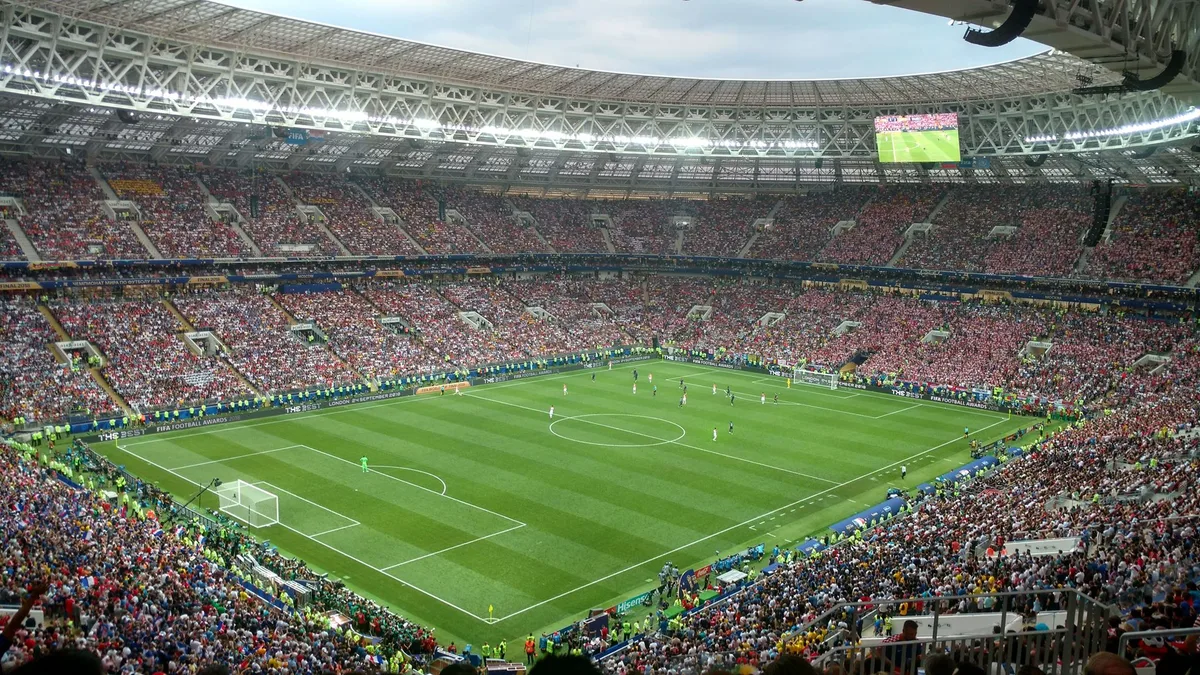
2018 World Cup Final: France 4–2 Croatia
- Venue
- Luzhniki Stadium
- Location
- Moscow, Russia
- Date
- Attendance
- 78,011
- Referee
- Néstor Pitana (Argentina)
Goalscorers
France
- Mandžukić 18' (o.g)
- Griezmann 38' (pen)
- Pogba 59'
- Mbappé 65'
Croatia
- Perišić 28'
- Mandžukić 69'
The smallest country still standing
Croatia had been an independent football nation for twenty-six years when they walked out at the Luzhniki. They were admitted to FIFA in 1992, reached their first World Cup in 1998 and finished third in it. Two decades later a country of roughly 4.2 million people had reached a final. Only Uruguay, in 1950, had ever done that from a smaller population.
They had taken the hardest road available. Denmark in the last 16: 1-1, extra time, won on penalties. Russia in the quarter-final, in a stadium that wanted them gone: 2-2, extra time, won on penalties. England in the semi-final: 2-1, extra time, from a goal down. Three knockout ties, three times through 120 minutes, and each of the three won from behind - the first team in the history of the tournament to do that.
France had walked. Argentina were beaten 4-3 in a last-16 tie that announced Kylian Mbappé to people who had somehow missed him, then Uruguay 2-0, then Belgium 1-0 in a semi-final France controlled by refusing to chase it. Didier Deschamps had been mocked at home for exactly this: a squad of extravagant talent set up to be hard to beat rather than beautiful to watch. The final would be the argument's last word.
Two firsts inside twenty minutes
The opening goal was the whole final in miniature. Marcelo Brozović caught Antoine Griezmann around thirty yards out - a soft foul that a good deal of the watching world thought Griezmann had helped along. Griezmann took the free kick himself, hung it into the six-yard box, and Mario Mandžukić got there first and glanced it past his own goalkeeper. In eighty-eight years of World Cup finals, nobody had ever scored an own goal in one.
Croatia levelled it on 28 minutes and did it properly. Perišić was fouled forty yards out, Luka Modrić floated the free kick to the far post, Šime Vrsaljko headed it back across the face of goal, and Ivan Perišić took a touch to shift the ball onto his left foot and drove it low into the corner. It was the better goal by some distance, and for ten minutes it looked like the beginning of something.
Instead it produced the moment the match is still argued about. France won a corner in the 38th minute, Blaise Matuidi got his head to it, and the ball struck Perišić's raised arm as he jumped. Néstor Pitana let play continue, then stopped it, then walked to the monitor. It was the first time a World Cup final had been paused for a video review, and the first penalty ever awarded in a final by VAR. Griezmann put it low to the goalkeeper's left.
You don't give a penalty like that in a World Cup final.
Zlatko Dalić, Croatia manager, speaking after the final
The pundits split and never really came back together. Alan Shearer called it ridiculous, arguing there was nothing deliberate about it. Chris Waddle took the other side: Perišić had stopped the ball going through with his hand, and that was that. Both readings survive a hundred replays, which is roughly the point - VAR arrived promising to end arguments and instead relocated them.
Sixty-one per cent of the ball and none of the trophy
Look only at the shape of the match and Croatia won it comfortably.
- Possession
- Croatia 61% - France 39%
- Shots
- Croatia 15 - France 8
- Shots on target
- Croatia 3 - France 6
- Corners
- Croatia 6 - France 2
- Goals
- Croatia 2 - France 4
Croatia had more of the ball, more territory, more corners and nearly twice as many attempts, and lost by two goals. France had eight shots all afternoon. Six were on target. Four went in. That is not luck so much as a design: Deschamps built a team that was content to let you have the ball in the places where having it does not matter, and lethal in the six seconds after they took it back.
The two goals that settled it came inside six minutes and both were made by counter-attack. On 59 minutes Paul Pogba's first effort was blocked; he took the rebound on his weaker left foot and bent it inside the far post from twenty yards. On 65, Mbappé took a pass on the edge of the box, opened his body and passed it low into the corner with the outside of his boot as though the occasion had not occurred to him. He was nineteen. Only Pelé, in 1958, had scored in a World Cup final as a teenager.
Mandžukić, twice, at both ends
At 4-1 the final had one last strange gift. Hugo Lloris, with the game long won, tried to dribble around Mandžukić inside his own six-yard box rather than clear it. Mandžukić did not oblige. He closed the goalkeeper down, blocked the attempted pass and poked the loose ball into the empty net on 69 minutes.
It made Mandžukić the first player ever to score for both teams in a World Cup final - a record that required, in the same afternoon, the worst luck and the sharpest instinct on the pitch. It also gave Croatia twenty-one minutes to find one more goal. They pressed, and Modrić kept running, and nothing came. The legs that had carried them through three periods of extra time finally sent their apologies.
What Moscow left behind
The rain arrived at exactly the wrong moment, sheeting down on the medal ceremony while Vladimir Putin stood under an umbrella and Kolinda Grabar-Kitarović and Emmanuel Macron did not. Earlier, four people linked to the protest group Pussy Riot - three women and one man, dressed in police uniforms - had run onto the pitch in the second half, briefly halting the final while they demanded the release of Russia's political prisoners.
Luka Modrić was given the Golden Ball as the tournament's best player and collected it looking like a man being handed a receipt. Griezmann was man of the match. Mbappé was best young player. And Deschamps, who had lifted the trophy as France's captain in 1998, became the third man to win a World Cup as both player and manager, joining Mario Zagallo and Franz Beckenbauer - and only the second, after Beckenbauer, to have done it wearing the armband first. If you want the other half of that story, it is twenty years earlier at the Stade de France.
Six goals made it the highest-scoring final since 1966, and the first since 2002 to be settled inside ninety minutes without extra time or penalties. Yet the reason people still replay it is not the scoreline. It is that the losing team played the better football, and the record book has no column for that. Two days later Croatia went home to roughly half a million people in the streets of Zagreb - more than a tenth of the entire country - for a bus parade that should have taken forty minutes and took six hours. That is the column the record book is missing.
We are not world champions, but we are runners-up. You understood that we did our best.
Zlatko Dalić to the crowd in Zagreb, two days after the final
Finals rarely reward the team that deserves them. Read them in sequence in the full history of World Cup finals and 2018 stops looking like an injustice and starts looking like a genre - the same story Hungary were told in 1954, in a different accent.
Frequently asked questions
Why was France awarded a penalty in the 2018 World Cup final?
In the 38th minute a Blaise Matuidi header from a corner struck Ivan Perišić's raised arm. Referee Néstor Pitana initially played on, then reviewed the incident on the pitchside monitor and awarded a penalty - the first ever given in a World Cup final after a VAR review. Antoine Griezmann scored it. Croatia manager Zlatko Dalić said afterwards that you do not give a penalty like that in a World Cup final, and pundits split sharply over it.
How did Croatia lose the 2018 final while dominating possession?
Croatia had 61 per cent of the ball, 15 shots to France's 8 and 6 corners to France's 2. But they put only 3 shots on target. France put 6 of their 8 on target and scored 4. Deschamps' side were built to concede possession in harmless areas and strike on the counter-attack, which is exactly how Pogba's and Mbappé's goals arrived.
What records were set in the 2018 World Cup final?
Mario Mandžukić's 18th-minute own goal was the first own goal ever scored in a World Cup final, and his 69th-minute strike made him the first player to score for both teams in one. It was the first final to feature a VAR-awarded penalty, the highest-scoring final since 1966, and Kylian Mbappé became only the second teenager after Pelé to score in a final.
Who won the Golden Ball in 2018 and why did a losing player get it?
Luka Modrić won it. He had carried Croatia through three consecutive knockout ties that went to extra time - Denmark and Russia on penalties, England in extra time - and was comfortably the tournament's outstanding player. The Golden Ball goes to the best player of the World Cup, not to the winning side, and losing finalists have taken it before.
Was 2018 Didier Deschamps' first World Cup?
Not as a winner. He captained France to their first World Cup in 1998 on home soil, then managed them to their second in 2018. That made him the third man to win the trophy as both player and manager, after Mario Zagallo and Franz Beckenbauer, and the second after Beckenbauer to do it as captain first.
Sources
- List of FIFA World Cup finals — Wikipedia
- 2018 FIFA World Cup final — Wikipedia
- 2018 FIFA World Cup - Wikipedia
- Croatia at the FIFA World Cup - Wikipedia
- Didier Deschamps Becomes Third to Win World Cup as Player and Manager - Sports Illustrated
- 'This is our gold': Croatian team gets massive welcome home - Al Jazeera
- Pussy Riot invade pitch during World Cup final - Euronews
War of Soccer is an independent, unofficial game and website by Nyza Creations LLC. It is not affiliated with, endorsed by, or sponsored by FIFA, any national federation, club, or any player — including Lionel Messi. Naming someone is not a claim to represent them. Team names, competition names and players are referred to descriptively, for identification and commentary only. Historical match data comes from public records — every page lists its sources.