1930 FIFA World Cup Final
1930 World Cup Final: Uruguay 4–2 Argentina
- Venue
- Estadio Centenario
- Location
- Montevideo, Uruguay
- Date
- Attendance
- 68,346
- Referee
- John Langenus (Belgium)
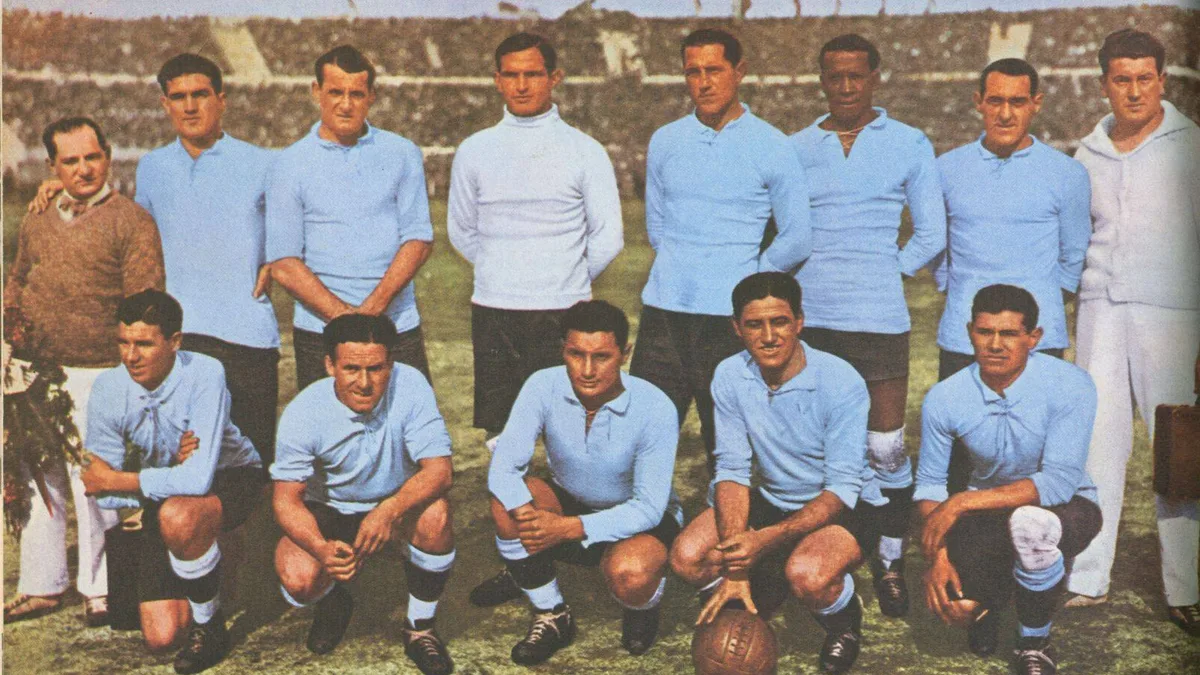
Goalscorers
Uruguay
- Dorado 12'
- Cea 57'
- Iriarte 68'
- Castro 89'
Argentina
- Peucelle 20'
- Stábile 37'
The tournament almost nobody came to
It is easy, now, to talk about the first World Cup as though it were an obvious idea. It was not. Thirteen teams entered — seven from South America, four from Europe, two from North America — and that number is not a sign of enthusiasm. It is what was left after everyone else said no. There were no qualifiers, because there was nothing to qualify for: FIFA simply invited its member nations and waited to see who would answer.
Most of Europe did not. This was 1930, the Great Depression was biting, and accepting meant a sea crossing and roughly two months away from a job you might not have when you returned. Japan and Siam withdrew. Egypt, delayed a day by a storm in the Mediterranean, reached the quayside to find their ship had already sailed, and went home without kicking a ball. Two months before the tournament began, not one European nation had officially entered; it took FIFA president Jules Rimet and the Uruguayan diplomat Enrique Buero leaning personally on federations to produce four — Belgium, France, Romania and Yugoslavia.
Belgium, France and Romania sailed on the SS Conte Verde, which collected them port by port with Rimet and the trophy itself on board, picked up the Brazilian squad in Rio on 29 June, and docked in Montevideo on 4 July. Yugoslavia had left it late enough that the Conte Verde was full, and made their own way on the Florida out of Marseille — the same ship Egypt missed.
Fifteen days to get there and 15 days to come back.
Lucien Laurent, France forward and scorer of the first World Cup goal
Uruguay had earned the hosting rights the hard way. They were Olympic champions in 1924 and again in 1928, which in the era before the World Cup made them, functionally, world champions. And 1930 was the centenary of their first constitution. The country built the Estadio Centenario to mark it — Rimet called the ground a temple of football — but a rainy winter and a rushed schedule meant the stadium was not ready until five days into its own tournament.
Two countries, one river, two footballs
Uruguay and Argentina both won their semi-finals 6-1, which meant the final was the fixture the continent had been circling all along: a rematch of the 1928 Olympic final in Amsterdam, which Uruguay had won 2-1 after a replay. Across the Río de la Plata these were not distant rivals. They were neighbours, and the game had the temperature of a family argument conducted in front of the world.
Argentine supporters crossed the river under the slogan Victoria o muerte — victory or death. The ten boats set aside for them were laughably inadequate; anything that floated was pressed into service, and an estimated 10,000 to 15,000 made the attempt. Montevideo's port was so overwhelmed, and the river so thick with fog, that many never made landfall before kick-off, let alone reached the stadium. Those who did were searched at the docks and relieved of any weapons. The gates opened at eight in the morning, some six hours before kick-off. By noon the ground was full.
Then there was the ball. The two teams could not agree on whose to use, and the disagreement was not vanity: Argentina's ball was smaller and lighter, Uruguay's larger and heavier, and each suited the team that brought it. FIFA intervened with the only compromise available — Argentina's ball for the first half, Uruguay's for the second — and John Langenus, the Belgian referee, walked out carrying both. It sounds like farce. It is one of the most consequential decisions in the history of the competition.
The pressure on the players was worse than anything the officials faced. Argentina's centre-half Luis Monti — the hardest man on the pitch, and the tournament's most feared — was the target of a threat his family have repeated ever since.
At half time, when Argentina were leading 2-1, they said that if Argentina didn't lose, they would kill my grandmother and my aunt.
Lorena Monti, granddaughter of Luis Monti, speaking to the FIFA Museum
The half-time that decided it
Read the goal times and the shape is obvious, but the shape is not the story. Uruguay led inside a quarter of an hour through Pablo Dorado and then, for the rest of the half, could not hold the ball. Playing with Argentina's ball — lighter, and unfamiliar — the hosts visibly struggled, and Argentina were the better team. Carlos Peucelle beat Enrique Ballestrero with a shot struck hard enough that no goalkeeper of the era was stopping it, and Guillermo Stábile, who would finish as the tournament's top scorer with eight goals, made it 2-1 before the break. Argentina went in ahead and, by most accounts, deserved to be.
Uruguay's ball came out for the second half and the match inverted. It is tempting to call that coincidence. The people who were there did not. The hosts took hold of the tempo, Pedro Cea levelled just before the hour, Santos Iriarte put them back in front, and the game was gone from Argentina long before the final goal went in. Monti, according to his own account, played the second half with something like 300 Uruguayan soldiers ranged along the touchline with bayonets raised.
The fourth goal, in the 89th minute, belongs to a man who should not have been on a football pitch at all by the standards of his time. Héctor Castro lost his right forearm to an electric saw at thirteen. They called him El Manco — the one-armed. He scored the last goal of the first World Cup final, and the reason he is not merely a curiosity is that nobody who watched him thought he was one.
- Teams entered
- 13
- Semi-final scores
- Both 6-1
- Top scorer
- Guillermo Stábile, 8 goals
- Uruguay manager
- Alberto Suppici, aged 31
What Montevideo left behind
The next day was declared a national holiday in Uruguay. In Buenos Aires, a mob threw stones at the Uruguayan consulate, and the two countries briefly suspended diplomatic relations. All of it is the same fact: this was never only a football match, and the World Cup learned on day one that it would carry politics whether it wanted to or not.
Alberto Suppici was 31 when he won it and still holds the record as the youngest manager to win a World Cup — no one under 35 has done it since, and the record looks safer every year. Luis Monti, remarkably, would play in the next final too, in 1934, for Italy: to this day the only man to contest World Cup finals for two different nations, and by his family's telling, threatened before the first of them. Francisco Varallo, Argentina's inside-right that afternoon, was the last survivor of the match. He died in 2010, aged 100, having lived long enough to see the tournament become the largest event on earth.
What 1930 established is the template every final since has followed, including the 1950 final that broke Brazil in the same corner of South America twenty years later, and the one being played in New Jersey this July. A final is not the best football of a tournament. It is the most compressed. It is two countries deciding that ninety minutes should be allowed to mean something disproportionate, and then discovering that it does. You can trace the whole line from Montevideo forward through the history of the World Cup final.
Uruguay, population under two million, had won the world. They would do it again in 1950, and they remain the least populous nation ever to win a World Cup. Their shirt carries four stars for it — two for the World Cups, two for the Olympic titles of 1924 and 1928. FIFA asked them to remove the Olympic pair in 2021 and then, in 2023, published a definitive endorsement of all four. It is an argument Uruguay have never stopped making, and they were already making it before the first ball was kicked in Montevideo.
Frequently asked questions
Why did the 1930 World Cup final use two different balls?
Uruguay and Argentina could not agree on whose ball to use. Argentina's was smaller and lighter, Uruguay's larger and heavier, and each favoured the style of the team that supplied it. FIFA intervened with a compromise: Argentina's ball in the first half, Uruguay's in the second. Argentina led 2-1 with their own ball; Uruguay scored three times with theirs to win 4-2.
Why did so few European teams enter the first World Cup?
The tournament fell in the Great Depression and required a transatlantic sea voyage of around two weeks each way, meaning roughly two months away from work. Only Belgium, France, Romania and Yugoslavia made the trip, and only after FIFA president Jules Rimet and Uruguayan diplomat Enrique Buero personally intervened — two months before kick-off, no European nation had entered at all. Thirteen teams took part in total.
Who scored the goals in the 1930 World Cup final?
Pablo Dorado opened the scoring on 12 minutes. Carlos Peucelle equalised on 20 and Guillermo Stábile put Argentina 2-1 up on 37. After the break Pedro Cea levelled on 57, Santos Iriarte made it 3-2 on 68, and Héctor Castro sealed it on 89. Castro had lost his right forearm in an accident aged 13 and was nicknamed El Manco — the one-armed.
Why did Uruguay host the first World Cup?
Uruguay had won Olympic football gold in both 1924 and 1928, making them the de facto world champions of the pre-World Cup era, and 1930 marked the centenary of their first constitution. They built the Estadio Centenario for the occasion, though rain and a rushed schedule meant it was not ready until five days into the tournament.
Was Luis Monti really threatened before the 1930 final?
His family have said so consistently. Monti's granddaughter Lorena told the FIFA Museum that at half-time, with Argentina 2-1 up, Monti was told her grandmother and aunt would be killed if Argentina did not lose. Monti went on to play in the 1934 final for Italy — to date the only man to appear in World Cup finals for two different nations.
Sources
- List of FIFA World Cup finals — Wikipedia
- 1930 FIFA World Cup final — Wikipedia
- 1930 FIFA World Cup — Wikipedia
- John Langenus — Wikipedia
- The legendary Luis Monti — FIFA Museum
- Lucien Laurent, the first World Cup goalscorer — FIFA
- Héctor Castro — Wikipedia
- Alberto Suppici — Wikipedia
- Francisco Varallo — Wikipedia
- Four stars above Uruguay's football crest — Wikipedia
War of Soccer is an independent, unofficial game and website by Nyza Creations LLC. It is not affiliated with, endorsed by, or sponsored by FIFA, any national federation, club, or any player — including Lionel Messi. Naming someone is not a claim to represent them. Team names, competition names and players are referred to descriptively, for identification and commentary only. Historical match data comes from public records — every page lists its sources.