1950 FIFA World Cup Final
1950 World Cup Final: Uruguay 2–1 Brazil
- Venue
- Maracanã Stadium
- Location
- Rio de Janeiro, Brazil
- Attendance
- 173,850
The final that was never a final
Every list of World Cup finals carries a line for 1950, and every line is a small lie. FIFA staged no knockout final that year. There were no semi-finals to reach it, no bracket to climb, no trophy waiting on a plinth beside the touchline. The 1950 tournament ended with a group — four teams, Brazil, Uruguay, Sweden and Spain, playing each other once, the title going to whoever finished top of the table.
That Uruguay's 2-1 win over Brazil at the Maracanã on 16 July 1950 decided the championship was an accident of the schedule, not a design. The last round of fixtures simply happened to pair the only two sides who could still win, on the same afternoon that Sweden were beating Spain 3-1 at the Pacaembu in São Paulo. The match settled the title because of where the standings sat, not because anyone had built a final for it to be.
Brazil needed a draw, and everybody knew it
This is the detail the myth erases, and it is the one that explains the day. Brazil went into the last round a point clear. They had not merely qualified from the final group, they had savaged it: 7-1 against Sweden, 6-1 against Spain, thirteen goals in two matches. Uruguay had scraped through, drawing 2-2 with Spain and edging Sweden 3-2. A draw would have crowned Brazil. Only defeat could stop them.
| Team | Pld | W | D | L | GF | GA | Pts |
|---|---|---|---|---|---|---|---|
| Uruguay | 3 | 2 | 1 | 0 | 7 | 5 | 5 |
| Brazil | 3 | 2 | 0 | 1 | 14 | 4 | 4 |
| Sweden | 3 | 1 | 0 | 2 | 6 | 11 | 2 |
| Spain | 3 | 0 | 1 | 2 | 4 | 11 | 1 |
So Brazil did not prepare for a contest. They prepared for a coronation. Gazeta Esportiva in São Paulo and O Mundo in Rio both proclaimed victory the day before the game was played. Twenty-two gold medals were struck with the Brazilian players' names already imprinted on them. A victory song, Brasil Os Vencedores — Brazil the Victors — was composed and rehearsed, ready to be played at the final whistle. And Ângelo Mendes de Moraes, the mayor of Rio, stood in front of the squad before kick-off, inside a stadium officially counted at 173,850 and plausibly beyond 200,000 once the gatecrashers were counted, and addressed them as the winners of a tournament that had not yet finished.
You, players, who in less than a few hours will be hailed as champions by millions of compatriots! You, who have no rivals in the entire hemisphere! You, who will overcome any other competitor! You, who I already salute as victors!
Ângelo Mendes de Moraes, mayor of Rio de Janeiro, to the Brazil squad before kick-off
Uruguay's captain Obdulio Varela is the axis the whole story turns on. The team had been told, in effect, to lose politely. Varela's answer, in the dressing room, was to refuse the premise outright.
Boys, outsiders are just stick dolls. Let's start the show.
Obdulio Varela, Uruguay captain, in the dressing room before kick-off
Forty-seven minutes of the expected, then Ghiggia
For a while the script held. Brazil pressed and Uruguay survived to half-time, which was itself an achievement given what had happened to Sweden and Spain. Two minutes into the second half Friaça scored, and the Maracanã became the loudest place on earth. It should have been over: Brazil now needed only to not lose, and they were winning.
Varela's next act was the coldest piece of game management the tournament had seen. He picked the ball out of the net, carried it to the referee George Reader, and disputed the goal for offside — drawing the argument out, going so far as to demand that Reader, an Englishman, hear him through an interpreter. There was no VAR to consult and no chance the goal would be overturned. The point was the clock. By the time play restarted, the noise had cooled and Uruguay had stopped drowning.
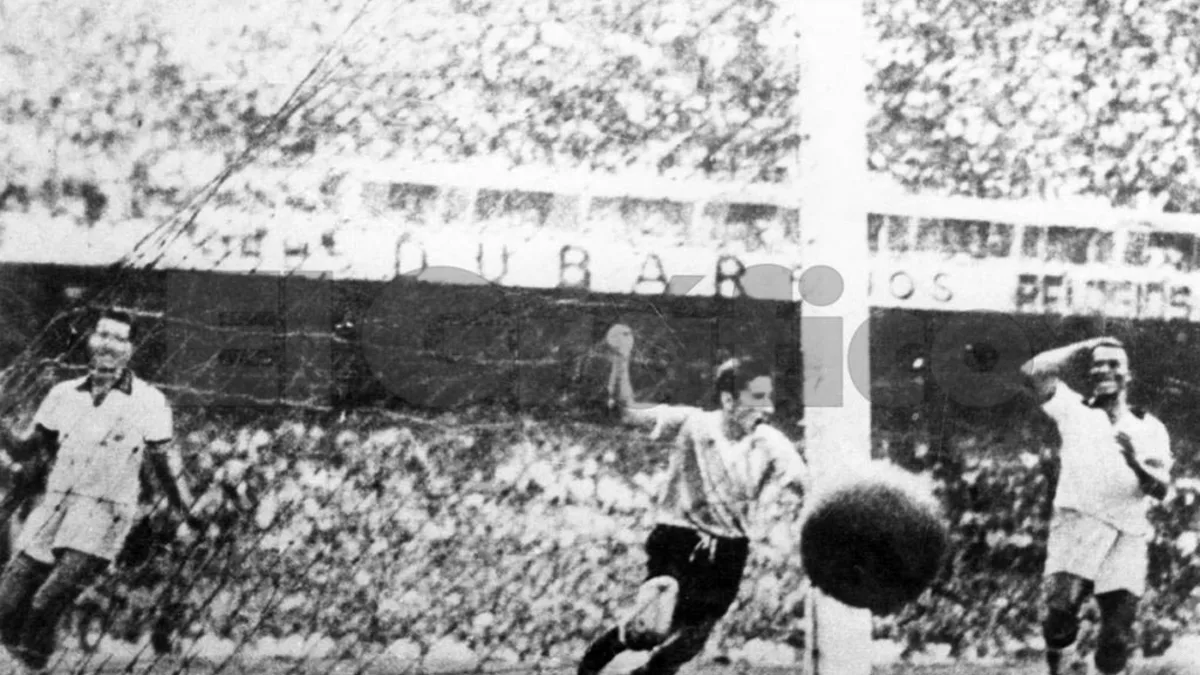
Juan Alberto Schiaffino equalised on 66 minutes. A draw still made Brazil champions, so the stadium recovered. Then, with eleven minutes left, Alcides Ghiggia went down the right past Bigode, and Moacir Barbosa in the Brazil goal read a cross that never came. Ghiggia shot instead, low and near. Barbosa dived a moment too late, the ball rolled under him and in at the post, and he spent the rest of his life inside that moment.
What followed is the most famous silence in football. A six-figure crowd stopped making noise all at once, and did not start again.
It was the first time in my life that I heard something that wasn't noise.
Juan Alberto Schiaffino, who scored Uruguay's first goal, speaking years later
The men who carried it afterwards
Uruguay went home to celebrations in which eight people died. Brazil went into something closer to mourning, and then into blame. Four players — Augusto, Juvenal, Bigode and Chico — never appeared for Brazil again. The white shirts with blue collars that Brazil had worn were judged unpatriotic by the country's own sports federation, and in September 1953 the newspaper Correio da Manhã ran a competition to replace them, on the rule that the new design had to carry the colours of the national flag. It was won by a teenage illustrator named Aldyr Garcia Schlee — born in Jaguarão, a town on the Brazil–Uruguay border — who drew a yellow shirt trimmed in green. Brazil first wore it in March 1954. The most recognisable kit in world sport exists because of a defeat, and was drawn by a boy from the frontier of the country that inflicted it.
The cruellest sentence was Barbosa's. A goalkeeper beaten by one shot in one match was made to answer for a nation for fifty years. In 1963 he was given the Maracanã's old wooden goalposts and burned them. Thirty years after that, the Brazilian federation's president Ricardo Teixeira blocked him from commentating on an international. He died in 2000, aged 79, having said what remains the bleakest line any footballer has produced about his own sport.
The maximum punishment in Brazil is 30 years' imprisonment, but I have been paying, for something I am not even responsible for, by now, for 50 years.
Moacir Barbosa, 2000
Why the Maracanazo still sets the price
Ronaldo George Helal, a sociologist at Rio de Janeiro State University, makes the point that the thing 1950 wounded had barely finished being built: until the 1930s, he argues, there was no settled concept in Brazil of what the Brazilian nation even was. The defeat landed on a country still deciding what it was, which is why it outlived everyone in it — and why Helal measures the distance travelled since by how differently Brazil took the 7-1 semi-final humiliation by Germany in 2014.
In 1950 it was a tragedy; in 2014 it was a satire that became a meme, because people didn't take it so seriously any more.
Ronaldo George Helal, sociologist, Rio de Janeiro State University
A nine-year-old Pelé heard the match on the radio, watched his father cry, and promised him he would win a World Cup to make up for it. He did, in 1958 — and even that carried the mark. Sweden won the draw to wear yellow in the final, and when white was proposed instead, Brazil's players were visibly frightened by the idea, remembering 1950. So the staff went out and bought twenty-two blue shirts and sewed the badge on themselves. Brazil won their first World Cup in a colour they had bought that week, because they could not bear to wear the one they had lost in.
Uruguay's part is flattened too. The underdog framing suits the legend, but Uruguay were champions of the first World Cup in 1930 and double Olympic champions before that. They were not a small country that got lucky. They were a football superpower that everyone had agreed to stop counting because the arithmetic said a draw would do.
Ghiggia, the last surviving player from the match, died on 16 July 2015 — exactly 65 years to the day after he scored. The record he left behind is stranger than the legend built on top of it: Brazil did not lose a final in 1950, because there was no final to lose. They lost a group match they only needed to draw, in front of a crowd already holding the medals, and football has been telling the story wrong ever since because the wrong version is easier to tell.
Sources
- List of FIFA World Cup finals — Wikipedia
- Uruguay v Brazil (1950 FIFA World Cup) — Wikipedia
- 1950 FIFA World Cup final round — Wikipedia
- Moacir Barbosa — Wikipedia
- 70 years on from the 'Maracanazo,' Brazil and Uruguay cannot forget — Buenos Aires Times
- The origins of Brazil's national jersey and its changing symbolism 70 years later — Global Voices
- Aldyr Garcia Schlee — Wikipedia
- 1958 FIFA World Cup final — Wikipedia
War of Soccer is an independent, unofficial game and website by Nyza Creations LLC. It is not affiliated with, endorsed by, or sponsored by FIFA, any national federation, club, or any player — including Lionel Messi. Naming someone is not a claim to represent them. Team names, competition names and players are referred to descriptively, for identification and commentary only. Historical match data comes from public records — every page lists its sources.