1958 FIFA World Cup Final
1958 World Cup Final: Brazil 5–2 Sweden
- Venue
- Råsunda Stadium
- Location
- Solna, Sweden
- Date
- Attendance
- 49,737
- Referee
- Maurice Guigue (France)
Goalscorers
Brazil
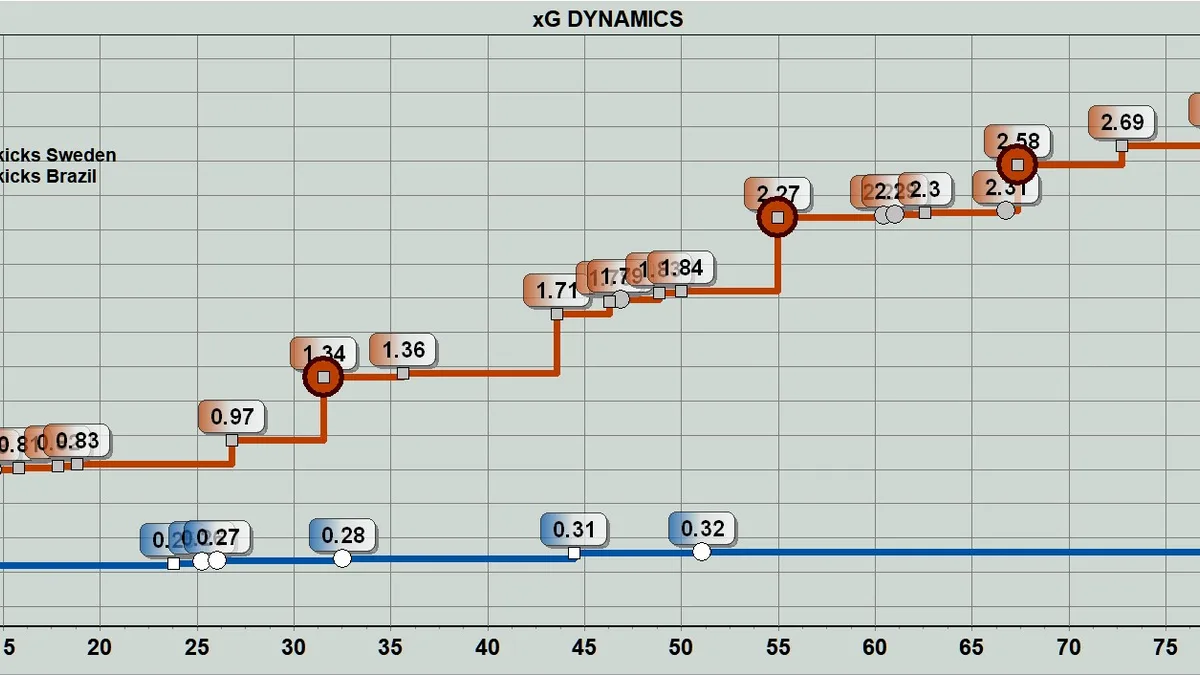
- Vavá 9', 32'
- Pelé 55', 90'
- Zagallo 68'
Sweden
- Liedholm 4'
- Simonsson 80'
The country that had to win
Brazil did not arrive in Sweden as favourites so much as prisoners. Eight years earlier they had lost the 1950 deciding match to Uruguay in their own Maracanã, in front of a crowd that has never been properly counted and a nation that never quite got over it. The white shirts they wore that day were retired in disgrace. The defeat was treated less as a bad afternoon than as evidence of some national flaw.
So 1958 was approached like an engineering problem. Nothing was left to atmosphere. The team doctor, Hilton Gosling, was sent to Sweden with a brief that included choosing the squad's hotel — weighing its distance from the match stadiums, the quality of the training pitches, even the local climate. The squad travelled with a doctor, a dentist, a fitness coach and — most famously — a psychologist, João Carvalhaes, who had come to football from training the São Paulo federation's referees and who moonlighted as a boxing writer under the pen name João do Ringue. Carvalhaes ran his tests and filed his report. Pelé, he concluded, was "obviously infantile" and lacked the necessary fighting spirit. Garrincha scored so poorly that, the story goes, he would not have been hired as a São Paulo bus driver.
Feola's other inheritance was a shape. Brazil came to Sweden playing a 4-2-4: four defenders at a time when most of Europe still used three, two midfielders asked to cover an absurd amount of ground, and four forwards strung across the pitch. It was not invented in 1958, but this was the tournament where it was shown to the world and won.
Sweden were not a fairy tale
It is tempting to file the hosts under plucky. They were nothing of the sort. For most of a decade Sweden had refused to select players who turned professional abroad — a rule that cost them their best generation at the 1950 World Cup, the Milan trio of Gunnar Gren, Gunnar Nordahl and Nils Liedholm known as Gre-No-Li. On the eve of their own World Cup, the ban was lifted. The exiles came home: Liedholm, Gren, Kurt Hamrin, Lennart Skoglund, Bengt Gustavsson, Arne Selmosson. Only Nordahl, by then finished with international football, was missing.
Their coach was an Englishman almost nobody in England had heard of. George Raynor had been a physical training instructor running an Iraq XI during the war, had managed Juventus and Lazio, and would later end up at Skegness Town in the English non-league. He had already taken Sweden to Olympic gold in 1948 and third place at the 1950 World Cup. In 1958 he beat Hungary, the Soviet Union and, in the semi-final, the reigning world champions West Germany 3-1.
Raynor also had a theory about Brazil, and he was not shy about it.
Brazil would panic all over the show.
George Raynor, Sweden manager, on what would happen if Sweden scored first in the final
Four minutes, and a theory dies
He got his test almost immediately. Liedholm — 35 years old, unhurried, the most composed man in Solna — worked his way into the box and finished. Sweden led inside four minutes. Råsunda went up. Raynor's theory had roughly five minutes to live.
What followed was not panic but its opposite: Brazil simply started playing down the right, where Garrincha was, and Sweden had no answer to him at all. Both of Vavá's first-half goals arrived the same way — Garrincha beating his man on the outside and pulling the ball back across the six-yard box. It was less a comeback than a demonstration of a solved problem, repeated twice to be sure everyone had seen it.
Ten minutes into the second half came the goal that is the whole reason this match is still watched. From a Nílton Santos cross, Pelé took the ball on his chest inside a crowded penalty area with his back to goal, lifted it over the defender behind him, went round the other side and volleyed it past Kalle Svensson before it landed. He was 17. Zagallo followed up his own corner to make it four. Agne Simonsson pulled one back with ten minutes left. Then, in the last minute, Pelé flicked the ball backwards to Zagallo as if the occasion were a training exercise, waited for the cross to come back, and headed the fifth.
After Pelé scored the fifth goal I didn't want to mark him anymore. I just wanted to applaud him.
Sigvard Parling, Sweden, on the 1958 final
The blue shirts and the borrowed flag
Brazil did not even play the most important match in their history in their own colours. Both teams wore yellow; a draw was held to decide who would change, and Sweden won it. White was unthinkable — that was 1950, and the squad would not touch it. So a search party was sent into Stockholm to buy 22 plain blue shirts, and the badges and numbers were hurriedly stitched on. The most famous team in football won its first World Cup in an improvised kit bought off a shop shelf.
The finish was stranger and better than the football. Instead of celebrating at the hosts' expense, the Brazilians took a Swedish flag and carried it around Råsunda on their lap of honour. Captain Hilderaldo Bellini raised the trophy over his head for the photographers. And Pelé, having just rewritten his sport at 17, cried.
What 1958 actually changed
The result did more than fill a trophy cabinet. It converted Brazil from a talented country into an idea — the notion that football could be won by playing beautifully rather than in spite of it. That idea ran directly into 1962 and then into the 1970 side in Mexico, still the most admired team ever assembled. Mário Zagallo scored in this final and coached Brazil to that one, the first man to win the World Cup as both player and coach.
- Brazil's first title
- 1958 — two more followed by 1970
- Formation shown to the world
- 4-2-4, the ancestor of 4-4-2 and 4-3-3
- Sweden's best ever finish
- Runners-up — still unmatched
- First final between continents
- Europe v South America
For Sweden it remains the high-water mark, and a peculiar distinction: they are still the only host nation to reach a World Cup final and lose it. Raynor went home to England, where nobody offered him a job worth the name. He ended up at Skegness Town. The first Englishman to take a team to a World Cup final was, in his own country, a forgotten man.
Sixty-eight years later the 2026 final puts Spain against Argentina at MetLife Stadium, with a 39-year-old Messi playing his last World Cup — another tournament that will be remembered for one player as much as one team. The 4-2-4 that Feola sent out in Solna is still, in mutated form, the skeleton of nearly every attacking shape anyone plays today, including ours. You can read every final from 1930 onwards here.
Frequently asked questions
Why did Brazil wear blue in the 1958 World Cup final?
Brazil and Sweden both wore yellow, and a draw decided that Brazil had to change. White was rejected because it was the kit worn in the traumatic 1950 defeat to Uruguay, so staff were sent into Stockholm to buy 22 plain blue shirts, with the badges and numbers stitched on before kick-off.
How old was Pelé in the 1958 World Cup final?
He was 17 years and 249 days old on 29 June 1958. He remains the youngest player ever to score in a World Cup final, and he scored twice — in the 55th minute and again in the 90th.
Did Brazil's psychologist really say Pelé shouldn't play?
Yes. João Carvalhaes, the psychologist travelling with the squad, judged Pelé "obviously infantile" and lacking the necessary fighting spirit, and rated Garrincha poorly too. Vicente Feola ignored the report — "You may be right. The thing is, you don't know anything about football" — and picked them both.
Has any host nation lost a World Cup final since Sweden in 1958?
No. Sweden are still the only host country to reach the World Cup final and lose it. 1958 was also the only time a World Cup held in Europe was won by a non-European nation.
Who was Sweden's coach in 1958?
George Raynor, an Englishman who had previously won Olympic gold with Sweden in 1948 and managed Juventus and Lazio. He predicted Brazil would panic if Sweden scored first. Sweden scored after four minutes and Brazil did not panic.
Sources
- List of FIFA World Cup finals — Wikipedia
- 1958 FIFA World Cup final — Wikipedia
- 1958 FIFA World Cup — Wikipedia
- George Raynor — Wikipedia
- The birth of Brazil at World Cup 1958 — These Football Times
- How Pelé, at just 17, dominated the 1958 World Cup final — These Football Times
- World Cup: 60 years on, Pelé's 1958 debut still the greatest tournament ever — The Conversation
- George Raynor: the unknown English manager who led Sweden to the 1958 final — The Set Pieces
- Brazil's 1958 World Cup Blueprint — The Botafogo Star
- 1958 FIFA World Cup Final: Brazil v Sweden — Planet World Cup
- Oldest player to score in a FIFA World Cup Final — Guinness World Records
- History of the first football psychologist (João Carvalhaes) — Alberto Cei
- World Cup's Greatest Goals: Pelé (1958, Brazil vs. Sweden) — ESPN
War of Soccer is an independent, unofficial game and website by Nyza Creations LLC. It is not affiliated with, endorsed by, or sponsored by FIFA, any national federation, club, or any player — including Lionel Messi. Naming someone is not a claim to represent them. Team names, competition names and players are referred to descriptively, for identification and commentary only. Historical match data comes from public records — every page lists its sources.