1938 FIFA World Cup Final
1938 World Cup Final: Italy 4–2 Hungary
- Venue
- Stade Olympique de Colombes
- Location
- Colombes, France
- Date
- Attendance
- 45,000
- Referee
- Georges Capdeville (France)
Goalscorers
Italy
- Colaussi 6', 35'
- Piola 16', 82'
Hungary
- Titkos 8'
- G. Sárosi 70'
A tournament with holes in it
You can read the shape of Europe in 1938 from the list of teams that were not in France. Spain could not come: the country was tearing itself apart in civil war. Austria had qualified and then ceased to exist, absorbed by Nazi Germany in the Anschluss of March 1938, its withdrawal filed as an administrative note. Some Austrian players were folded into the German squad. Matthias Sindelar, the finest of them, would not go. Uruguay and Argentina stayed away for reasons of their own, still nursing grievances about how the game was being run from Europe.
What was left was a straight knockout - lose once and go home, with replays if a match finished level - across eighteen games watched by 375,700 people. Germany, stitched together from two nations that did not want to be one team, were knocked out in a replay by Switzerland in front of a bottle-throwing Paris crowd. The German coach Sepp Herberger blamed the five Austrians he had been made to pick. The football was not separate from the politics. It never got the chance to be.
Pozzo's Italy, and the black shirt
Italy arrived as holders and as a political object. They were the champions of 1934, won at home under a regime that had understood before almost anyone what a World Cup was worth as propaganda. Vittorio Pozzo, still in charge, was not a fascist ideologue - he was an obsessive tactician who had learned his football in England and built the Metodo, a 2-3-2-3 that traded some of the attacking width of the old pyramid for a centre-half who sat, and for counters that arrived fast and straight.
France did not want them. When the squad reached Marseille for their opening tie against Norway, roughly 3,000 French and Italian protesters were held back by mounted police. Pozzo had his players hold the fascist salute into the noise, and remembered exactly what came back.
At the salute we predictably met with a solemn and deafening barrage of whistles, insults and remarks.
Vittorio Pozzo, on Italy's arrival at the 1938 World Cup, quoted in The Irish Times
In the quarter-final against the hosts, both sides wore blue, so a draw was held to decide who would change. Italy lost it - and then declined to reach for their usual white change shirt. They came out in maglia nera - all black, the colour of the regime, with the Fascio Littorio stitched on the left breast. The shirt was not new; it had been worn before, from a 1935 friendly against these same opponents to the Berlin Olympics of 1936. But this was the only time it ever appeared at a World Cup, and nobody in the ground was in any doubt about what it meant. They won 3-1 anyway. Then they beat Brazil 2-1 in the semi-final, played without Leonidas, the tournament's top scorer with seven goals. The story that Brazil arrogantly rested him for a final they never reached has been told for decades; the duller account, and the one the records support, is that he was injured.
Hungary: the best football, the wrong decade
Hungary came to Colombes having scored thirteen goals and conceded one - 6-0 against the Dutch East Indies, 2-0 against Switzerland, 5-1 against Sweden. Károly Dietz's side played the technical, short-passing, elegantly precise game that Central Europe had been refining for a decade, and which would eventually be perfected by the Magical Magyars of the 1950s. Their captain György Sárosi was a centre-forward with a doctorate in law. Gyula Zsengellér, Pál Titkos and the winger Ferenc Sas gave them a forward line that could take almost anyone apart.
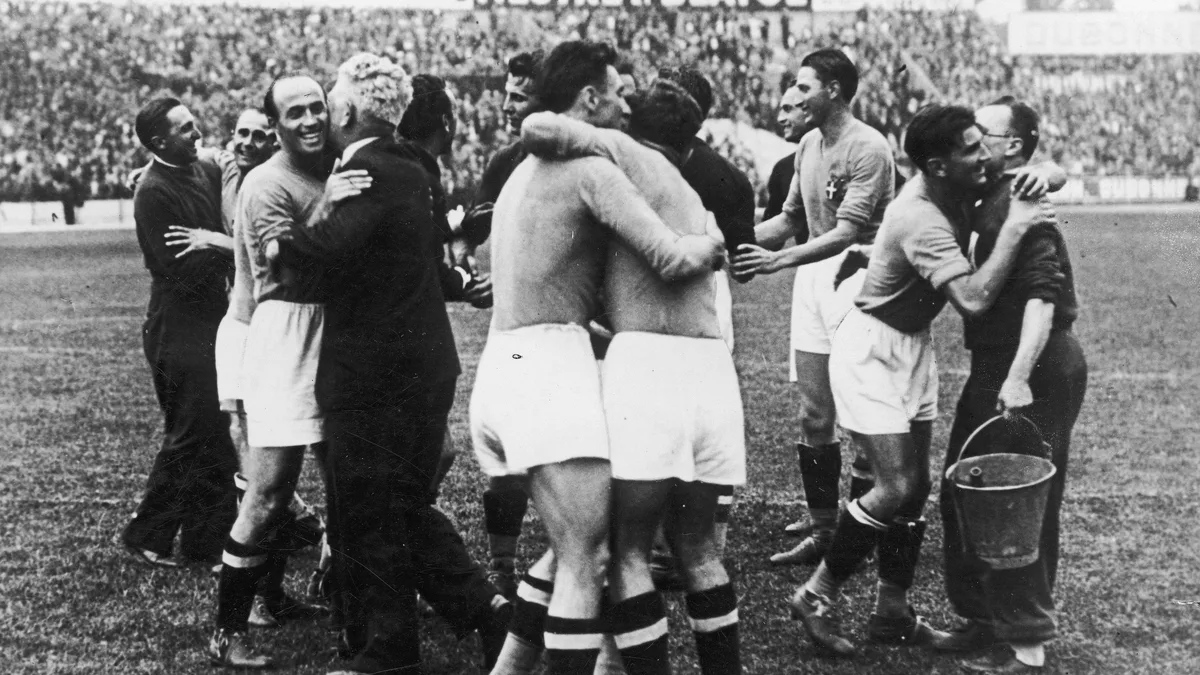
Almost anyone. FIFA's own account of the final frames it as a collision between "Hungary's technical and elegantly precise brand of football and Italy's faster and more direct style" - and on 19 June 1938, in front of 45,000 at the Stade Olympique de Colombes with the Frenchman Georges Capdeville refereeing, directness won.
Ninety minutes at Colombes
Italy did not build slowly. Colaussi was in behind inside six minutes, punishing loose Hungarian defending, and the game looked settled before it had started. Two minutes later it was not: Titkos levelled almost immediately, and for a moment Hungary had the thing they wanted, a match played at their tempo.
It lasted eight minutes. Piola restored the lead on the quarter-hour, and from there Meazza - the captain, the great orchestrator, the man whose shorts had famously fallen down as he converted the winning penalty in the semi-final - took the game by the collar and directed it. Ten minutes before the interval Colaussi arrived unmarked for his second. Half-time: 3-1, and Hungary's problem was not that they were being outplayed so much as that every Italian attack seemed to end in the net.
Sárosi pulled one back with twenty minutes left, which is the point at which a lesser Italy might have panicked. Instead Piola settled it with eight minutes to go - a volley struck cleanly enough that FIFA still calls it classy nearly ninety years on. Piola scored 364 goals in competitive football, more than any other Italian player, and he still holds the Serie A scoring record with 274. He never got another World Cup to play in.
- Italy's route
- Norway 2-1 (aet), France 3-1, Brazil 2-1
- Hungary's route
- Dutch East Indies 6-0, Switzerland 2-0, Sweden 5-1
- Tournament attendance
- 375,700 across 18 matches
- Next World Cup
- 1950 - twelve years later
The telegram that probably never existed
The most repeated story about this match is that Mussolini wired the team before kick-off with two words: Vincere o morire - win or die. It is in books, documentaries and a great many articles published this month. It is almost certainly not true. No such telegram has ever been produced, and Pietro Rava, Italy's left-back that afternoon and the last surviving player from the match - he died in 2006, aged 90 - was asked about it directly in 2001.
No, no, no, that's not true. He sent a telegram wishing us well, but no never 'win or die'.
Pietro Rava, Italy left-back in the 1938 final, interviewed in 2001
What is documented is duller and, in its way, worse. Each Italian player went home with an 8,000 Lire win bonus - roughly three months' wages - and a fascist Gold Medal, handed over by Mussolini at the Palazzo Venezia. The regime did not need to threaten anyone. It simply took the trophy and used it.
What 1938 left behind
Pozzo remains the only man to have won two World Cups as a manager, and he did it with two substantially different teams - a record that has now stood for eighty-eight years and looks unlikely to fall. Italy became the first side to win the trophy away from home. And then the tournament simply stopped. The Jules Rimet trophy spent the war in hiding - the Italian official Ottorino Barassi pulled it out of a Roman bank vault and kept it in a shoebox under his bed, then moved it on to relatives in Foggia - and by the time anyone played for it again in 1950, half the men who had contested this final had lived through something that made a football match look very small.
There is a straight line from Colombes to what came after, though. Hungary lost the argument in 1938 and went away and won it: the passing game Sárosi's side played in Paris became the Magyars of 1953, who became Ajax and Barcelona and most of what we now think of as good football. Italy won the match. Hungary won the century. Both stories are worth reading next to the 1934 final, where this Italian team was assembled, and 1950, the first tournament of the world that came after. The full list of finals is the shortest way to see how strange this gap in the middle really is.
It is easy, in 2026, to treat a World Cup final as a self-contained sporting event - ninety minutes, a trophy, a parade. 1938 is the reminder that it never has been. The teams walk out carrying whatever their countries are carrying that summer.
Frequently asked questions
Who won the 1938 World Cup final?
Italy beat Hungary 4-2 at the Stade Olympique de Colombes on 19 June 1938, in front of 45,000 people, with Gino Colaussi and Silvio Piola each scoring twice. It made Italy the first team to win the World Cup outside their own country.
Did Mussolini really send Italy a 'win or die' telegram before the 1938 final?
Almost certainly not. No such telegram has ever been found, and Pietro Rava, Italy's left-back in the final, denied it flatly in a 2001 interview, saying Mussolini sent only a message wishing the team well. The story is repeated constantly but rests on no evidence.
Why did Italy wear black shirts at the 1938 World Cup?
Both teams' first-choice shirts were blue, so a draw decided that Italy had to change - and instead of their usual white, they wore an all-black kit bearing the Fascio Littorio. The black shirt was not invented for the occasion: Italy had first worn it in a 1935 friendly against France and again at the 1936 Berlin Olympics. But the 1938 quarter-final was the only time it was worn at a World Cup, and it was read at the time as a pointed answer to the anti-fascist protests that had followed the team since Marseille.
Which countries were missing from the 1938 World Cup?
Spain was absent because of its civil war, Austria had qualified but was annexed by Nazi Germany in March 1938 and withdrew, and Uruguay and Argentina both declined to travel. The tournament was a straight knockout with fifteen teams.
Why was there no World Cup between 1938 and 1950?
The Second World War. The 1942 and 1946 tournaments were never held, and the Jules Rimet trophy was hidden away in Italy for the duration. The World Cup did not resume until Brazil hosted in 1950 - a twelve-year gap, still the longest in the competition's history.
Sources
- List of FIFA World Cup finals — Wikipedia
- 1938 FIFA World Cup final — Wikipedia
- 1938 FIFA World Cup - Wikipedia
- Double joy for Pozzo's Italy - FIFA
- World Cup moments: Mussolini's black shirts retain crown in 1938 - The Irish Times
- World Cup History: 1938 - ESPN
- Antal Szabó - Wikipedia
- World Cup Classics - Italy, 1938 - Museum of Jerseys
- Silvio Piola - Wikipedia
- Pietro Rava - Wikipedia
War of Soccer is an independent, unofficial game and website by Nyza Creations LLC. It is not affiliated with, endorsed by, or sponsored by FIFA, any national federation, club, or any player — including Lionel Messi. Naming someone is not a claim to represent them. Team names, competition names and players are referred to descriptively, for identification and commentary only. Historical match data comes from public records — every page lists its sources.