1934 FIFA World Cup Final
1934 World Cup Final: Italy 2–1 Czechoslovakia
- Venue
- Stadio Nazionale PNF
- Location
- Rome, Italy
- Date
- Attendance
- 55,000
- Referee
- Ivan Eklind (Sweden)
Goalscorers
Italy
- Orsi 81'
- Schiavio 95'
Czechoslovakia
- Puč 71'
The World Cup that was built as a stage
The second World Cup was not simply hosted by Italy. It was commissioned by it. Benito Mussolini's government understood before almost anyone else that a football tournament could be a national advertisement, and it spent accordingly: eight stadiums across eight cities pressed into service, more than 300,000 posters distributed, over a million stamps printed with World Cup images, even a cigarette brand named for the competition — Campionato del Mondo. The football was real. So was the intent behind it.
The field that assembled in Italy was shaped as much by grievance as by merit. Uruguay, champions in 1930, refused to defend the trophy at all — few European nations had bothered to make the boat trip to Montevideo four years earlier, and Uruguay returned the insult in kind. It remains the only time a reigning champion has declined to turn up. Thirty-two nations entered, sixteen came through qualifying, and the tournament proper was a straight knockout from the first whistle: lose once and sail home. Italy, uniquely in the history of the competition, had to qualify despite being the hosts.
Two very different ideas of a national team
Vittorio Pozzo's Italy was a side assembled with a bureaucrat's eye as much as a coach's. Alongside the home-grown players came the oriundi — South Americans of Italian descent, granted citizenship and pulled into the blue shirt. Raimundo Orsi, Enrique Guaita, Attilio Demaría and Luis Monti had all been born in Argentina; Anfilogino Guarisi had been born in Brazil. One of them would score the goal that levelled the final; another had already scored the only goal that got Italy there.
Monti was the strangest case of all. He had lined up in the 1930 final in Montevideo for Argentina and lost. Four years later he lined up in the final in Rome for Italy and won — the distinction of playing in two World Cup finals for two different national teams belongs to him alone among that generation. Whatever else the oriundi policy was, it worked.
Czechoslovakia arrived with something closer to a club side. Built around the Prague axis of Sparta and Slavia, they had František Plánička in goal — a goalkeeper good enough to be spoken of in the same breath as any of his era — and Antonín Puč on the left. They had beaten Romania, then edged Switzerland, then dismantled Germany. Nobody had expected them within touching distance of the trophy. They got closer than anyone outside Prague thought possible.
- Italy's route
- USA 7-1, Spain 1-1 (1-0 replay), Austria 1-0
- Czechoslovakia's route
- Romania 2-1, Switzerland 3-2, Germany 3-1
- Format
- Straight knockout, 16 teams, replays if drawn
- Reigning champions
- Uruguay — did not enter
Forty degrees, and ten minutes that turned a final
Rome on 10 June 1934 was close to 40°C. Players in heavy cotton and boots like workwear were asked to run for two hours in it. For an hour and ten minutes the final was a stalemate of attrition rather than a showpiece — and then Czechoslovakia broke it. Puč scored, and with under twenty minutes left the second World Cup was heading out of Italy, out of Rome, and away from the men who had paid for the stage.
They held it for ten minutes. Orsi's equaliser was the goal of the tournament and, by every honest account, something close to an accident: a shot that swerved viciously and late, beyond a goalkeeper as good as Plánička, into a net it had no business finding. The best evidence for how freakish it was arrived the next day. Press photographers, who had missed the moment, asked Orsi to come back to the ground and recreate it for the cameras. He stood on the same spot and tried more than twenty times. He never managed it once.
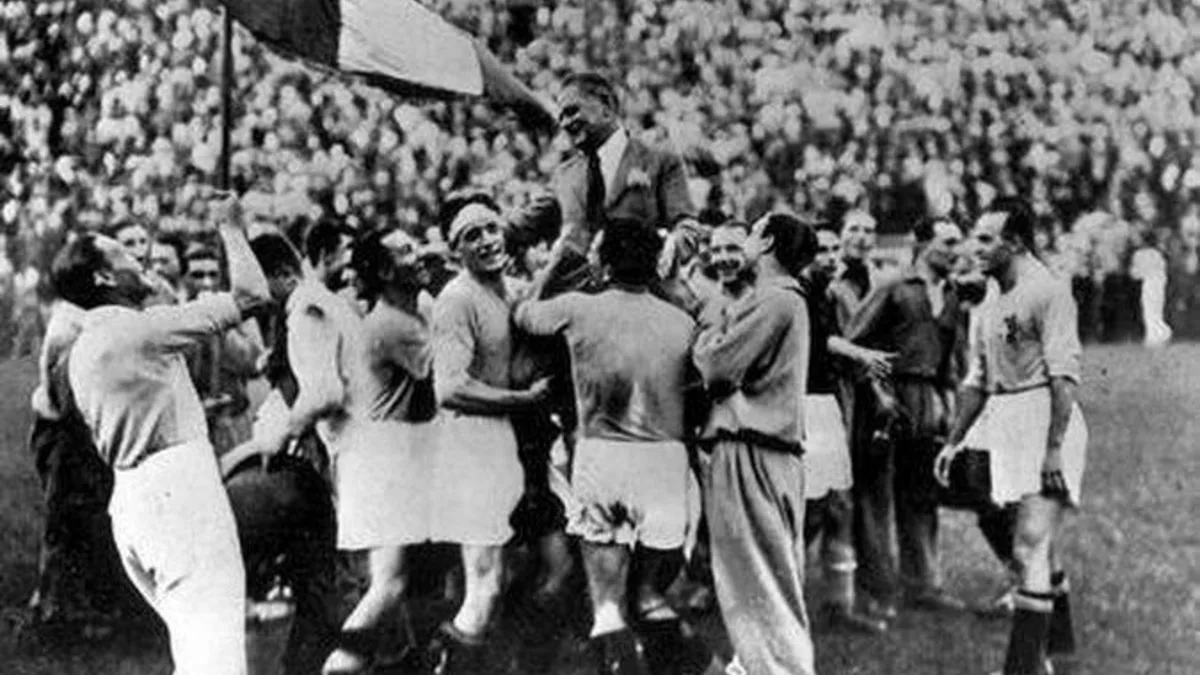
Ninety minutes settled nothing, and so 1934 became the first World Cup final to go to extra time — a thing that had never happened before, and the start of a lineage that runs through Wembley in 1966 to Iniesta in Johannesburg and Götze in the Maracanã. It took Italy five minutes of it. Angelo Schiavio scored in the 95th, and a tired, boiling, half-broken Italian side held what it had. The rest of the game passed without another goal. Italy were champions.
The man in the middle
No account of 1934 survives contact with the referee question. Ivan Eklind of Sweden was 28 — still the youngest man ever to referee a World Cup final — and he took charge of both Italy's semi-final against Austria's celebrated Wunderteam and the final itself. That double assignment, for the host nation, in a tournament run by a government that had made no secret of what it wanted, was enough on its own to raise eyebrows. What followed raised more. Czechoslovak players and officials protested that blatant fouls went unpunished and that two clear penalties were waved away. The Prague press called it a scandal.
It is known that Mussolini entertained one referee to dinner the night before an Italian game, while the referee for another was changed last minute, and with no explanation.
RTÉ Brainstorm, 'Why the 1934 World Cup in Mussolini's Italy was so controversial', July 2026
Honesty demands the other half of the sentence. No match-fixing was ever proven. FIFA took no action. Eklind was neither banned nor sanctioned and went on refereeing internationally until 1951. And Italy were, by any measure, a genuinely excellent side — they beat Austria's Wunderteam, they won the Olympic tournament in 1936, and they retained the World Cup in 1938 in France, on someone else's soil, with a referee nobody had bought dinner for. That last fact is the strongest argument the Azzurri of the 1930s have, and it is a good one.
The truth is probably the uncomfortable one: a very good team won a tournament in conditions that were arranged to help them, and we will never be able to separate the two cleanly. As one recent account put it, controversy has clung to this Italian team and the validity of their win has been questioned ever since.
What Rome left behind
Italy's players collected the Jules Rimet trophy. They also collected the Coppa del Duce, a vastly larger cup of Mussolini's own commissioning, which told anyone watching exactly whose victory this was meant to be. The image of that podium is why 1934 is remembered as the moment sport learned it could be conscripted — a lesson the Berlin Olympics would take up two years later, and one that has never really been unlearned.
Czechoslovakia went home with nothing and never got as close again; they lost another final in 1962 and then, as a country, ran out of time. Plánička outlived them all, the last survivor of that afternoon in Rome, dying in 1996 at 92. Pozzo, meanwhile, became the only manager ever to win two World Cups — a record that has stood for nearly ninety years and shows no sign of falling.
For all the shadow over it, the football itself holds up. A goal that could not be repeated, a comeback with nine minutes left, the first extra time any World Cup final had ever needed. Read the full history of every final and 1934 sits there as the second entry and the first genuinely complicated one — the year the tournament stopped being an experiment and became something worth capturing. If you want to find out how it feels to chase a 1-0 deficit with the clock gone, War of Soccer is free and takes about ten seconds to start.
Ninety-two years later the final returns to a stadium in New Jersey with Spain against Argentina. Nobody has bought the referee dinner. That, in itself, is progress of a kind.
Frequently asked questions
Who won the 1934 World Cup final?
Italy beat Czechoslovakia 2-1 after extra time on 10 June 1934 at the Stadio Nazionale PNF in Rome, in front of 55,000 people. Antonín Puč put Czechoslovakia ahead in the 71st minute, Raimundo Orsi equalised in the 81st, and Angelo Schiavio won it in the 95th.
Was the 1934 World Cup fixed?
Nothing was ever proven and FIFA took no action. But Mussolini's government openly used the tournament as propaganda, referee Ivan Eklind took charge of both Italy's semi-final and the final, and Czechoslovakia protested that two clear penalties were ignored. Italy were also a genuinely great side who retained the trophy abroad in 1938.
Why didn't Uruguay defend their title in 1934?
Uruguay boycotted. Very few European nations had travelled to Uruguay for the inaugural 1930 tournament, and Uruguay returned the snub by refusing to travel to Italy. They remain the only reigning champions never to defend a World Cup.
Who were the oriundi?
South American players of Italian descent given Italian citizenship and selected by Vittorio Pozzo. Raimundo Orsi, Luis Monti, Enrique Guaita and Attilio Demaría were born in Argentina; Anfilogino Guarisi in Brazil. Orsi scored Italy's equaliser in the final.
Was 1934 the first World Cup final to go to extra time?
Yes. Italy and Czechoslovakia were level at 1-1 after 90 minutes, making it the first final in the competition's history to need extra time. Schiavio scored five minutes into it.
Sources
War of Soccer is an independent, unofficial game and website by Nyza Creations LLC. It is not affiliated with, endorsed by, or sponsored by FIFA, any national federation, club, or any player — including Lionel Messi. Naming someone is not a claim to represent them. Team names, competition names and players are referred to descriptively, for identification and commentary only. Historical match data comes from public records — every page lists its sources.