History
The First World Cup: 13 Teams, a 15-Day Boat, Two Balls
Thirteen teams, a fortnight at sea, and a coin toss over whose ball to use. The first World Cup was assembled from almost nothing - and still produced a final worth telling properly.
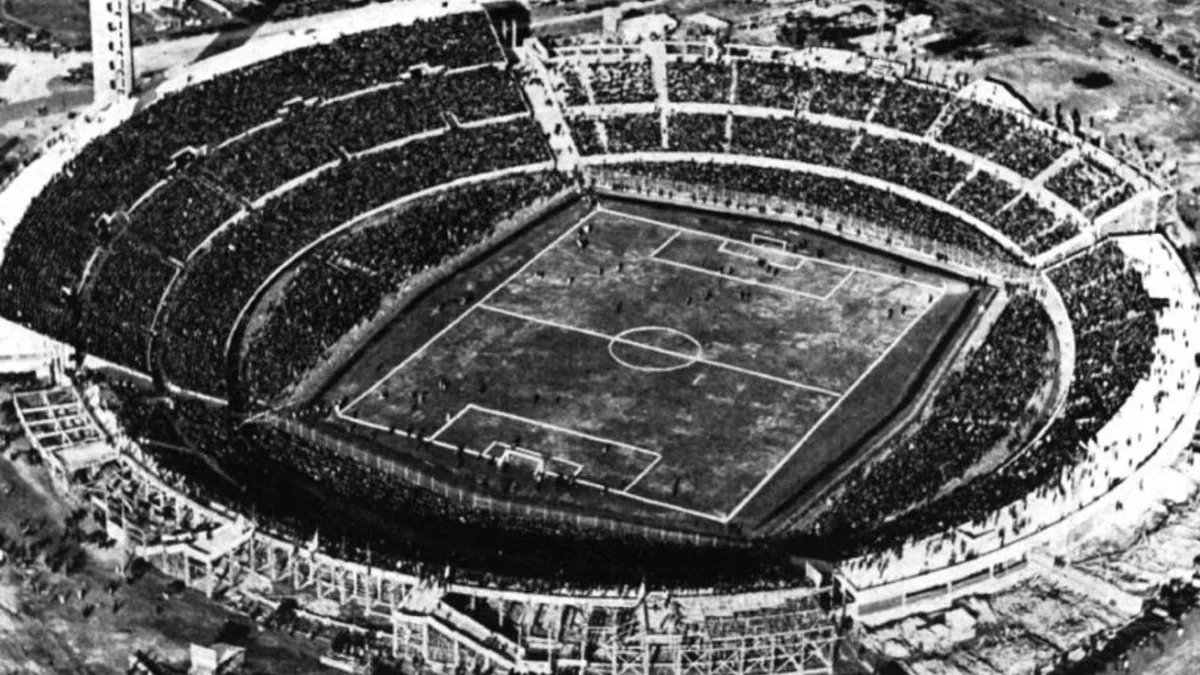
There was no World Cup trophy tradition to defend in July 1930, because there was no World Cup yet. FIFA had voted the tournament into existence in Barcelona in 1929, awarded the first edition to Uruguay, and then spent the following months discovering that almost nobody in Europe wanted to make the trip. What eventually kicked off in Montevideo was not the slick, broadcast-ready event that reaches its 2026 final at MetLife Stadium this month - it was thirteen teams, a fortnight at sea for the Europeans who bothered to show up, and a final so contested that the two finalists could not agree on whose ball to play with.
Thirteen teams, not sixteen
FIFA's original plan called for sixteen entrants. It ended up with thirteen. Egypt missed their own departure after a storm delayed their qualifying voyage across the Mediterranean, and Japan and Siam withdrew rather than commit to a monthlong round trip to South America. What remained was lopsided by design as much as accident: seven South American sides, four European, and two from North America, split into one group of four and three groups of three - a structure no later World Cup has used, because there was no qualifying tournament to trim the field first. FIFA simply invited every affiliated federation and set a deadline of 28 February 1930 for entries.
- Teams
- 13 (planned: 16)
- By confederation
- 7 South American, 4 European, 2 North American
- Qualifying rounds
- None - direct invitation only
- Entry deadline
- 28 February 1930
Fifteen days on the Conte Verde
Only four European federations were willing to make the crossing: France, Belgium, Romania and Yugoslavia. The reluctance was not really about football - it was cost, and time away from work, sharpened by a Great Depression that was already emptying European economies. The four teams that did travel sailed together on the liner Conte Verde: Romania boarded at Genoa, France and Yugoslavia were picked up at Villefranche-sur-Mer on 21 June, and Belgium joined at Barcelona. The ship stopped in Rio de Janeiro on 29 June to collect Brazil's squad before finally reaching Montevideo on 4 July, more than a week before a ball was kicked.
We were 15 days on the ship Conte Verde getting out there.
Lucien Laurent, France forward, 1930 World Cup
That the tournament had four European teams at all owed less to football politics than to personal persuasion. FIFA president Jules Rimet and Uruguayan diplomat Enrique Buero spent the early months of 1930 lobbying European federations directly, after the February entry deadline passed with no European nation confirmed. Without that intervention, the first World Cup might have been an entirely South American and North American affair.
A stadium still wet with paint, and a threat against Luis Monti
Montevideo built its centrepiece from nothing, too. The Estadio Centenario was commissioned to mark the centenary of Uruguayan independence as much as to host football, designed by Juan Scasso with room for 90,000 - at the time the largest football ground outside the British Isles. A wet winter delayed construction so badly that it was not ready for use until five days into the tournament it was meant to open.
The final itself carried a weight that had nothing to do with construction schedules. Argentina's Luis Monti, their commanding centre-half, went into the match having received a threat against his family. His granddaughter, Lorena, later said the message arrived at half-time, with Argentina leading 2-1: if Argentina did not lose, his grandmother and aunt would be killed. Whether or not it changed the outcome, Monti had what teammates called one of his quieter games, and Uruguay came back to win 4-2. Four years later, playing a World Cup final for Italy instead, Monti found the joke wrote itself.
In Uruguay they would kill me if we won. In Italy they would kill me if I lost.
Luis Monti, quoted in These Football Times
Two balls, one coin toss
The dispute that has followed the 1930 final for nearly a century started before kickoff. Argentina and Uruguay each turned up with their own ball, and neither trusted the other's: Argentina's was the Tiento, a lighter, 12-panel model actually manufactured in Scotland; Uruguay's was an 11-panel, Wembley-style ball made by J. Salter and Son of Aldershot, England. Belgian referee John Langenus settled it the only way he could - by carrying both balls out to the centre circle himself and tossing a coin.
Both teams brought their own ball and demanded to play with it. That's why I found myself carrying a ball under each arm. The match ball was chosen by the toss of a coin.
John Langenus, referee, 1930 World Cup final
Argentina won the toss and kicked off with the Tiento, going 2-1 up by half-time through Carlos Peucelle and Guillermo Stábile. The story told ever since - repeated in FIFA's own record and in Wikipedia's account of the match - is that Uruguay then switched to their own ball for the second half, and the change of ball changed the game: Uruguay scored three times in the second period to win 4-2.
| Argentina's ball | Uruguay's ball | |
|---|---|---|
| Name | Tiento ("Touch") | T-model, Wembley-style |
| Construction | 12 rectangular panels | 11 interlocking T-shaped panels |
| Made by | Players, Scotland | J. Salter and Son, Aldershot, England |
| Confirmed in play | From kickoff, via coin toss | Never confirmed by contemporary sources |
What thirteen teams and a coin flip actually built
Whichever ball was on the pitch, Uruguay's second-half performance was not in doubt. Pedro Cea leveled it in the 57th minute, Santos Iriarte put Uruguay ahead in the 68th, and Hector Castro - who had lost his right forearm to an electric saw as a teenager and played the tournament nicknamed 'El Manco' - scored the fourth in the 89th minute in front of 68,346 people at the Estadio Centenario. Uruguay had already won Olympic football gold in 1928; now they were the first World Cup champions too, and the trophy - not yet carrying Jules Rimet's name - was presented to Raul Jude, head of the Uruguayan federation.
None of it looked like the tournament that decides its 2026 champion between Spain and Argentina at MetLife Stadium this Sunday. But the line runs straight back to Montevideo: a competition assembled from thirteen teams who actually turned up, a boat that took a fortnight, and a coin toss over whose ball to trust. For anyone who wants to keep playing once that final whistle blows, War of Soccer - a free 3D browser game - goes live the moment the 2026 final is decided.
Frequently asked questions
Why did only thirteen teams play in the first World Cup?
FIFA planned for sixteen but Egypt missed their own qualifying voyage after a storm, and Japan and Siam withdrew rather than commit to a monthlong trip to South America, leaving seven South American, four European and two North American sides.
How did European teams get to the 1930 World Cup in Uruguay?
Four European federations - France, Belgium, Romania and Yugoslavia - sailed together on the liner Conte Verde, picking up teams at Genoa, Villefranche-sur-Mer and Barcelona before docking in Rio de Janeiro for Brazil and reaching Montevideo on 4 July 1930, a journey of about fifteen days.
Were two different balls really used in the 1930 World Cup final?
Argentina and Uruguay did each bring their own ball, and referee John Langenus settled which one started the match with a coin toss that Argentina won. The popular claim that Uruguay switched to their own ball at half-time is not backed by any contemporary account, including Langenus's own memoir, and surviving photographs suggest Argentina's ball was used throughout.
What was the score in the first World Cup final?
Uruguay beat Argentina 4-2 at the Estadio Centenario in Montevideo on 30 July 1930, in front of 68,346 people, with goals from Pablo Dorado, Pedro Cea, Santos Iriarte and Hector Castro against Carlos Peucelle and Guillermo Stábile.
Why was Uruguay chosen to host the first World Cup?
Uruguay had won Olympic football gold in 1928 and was celebrating the centenary of its independence in 1930; every other nation that had bid to host - Italy, Sweden, the Netherlands, Spain and Hungary - withdrew their applications, leaving Uruguay unopposed.
Sources
Comments
Loading comments…
War of Soccer is an independent, unofficial game and website by Nyza Creations LLC. It is not affiliated with, endorsed by, or sponsored by FIFA, any national federation, club, or any player — including Lionel Messi. Naming someone is not a claim to represent them. Team names, competition names and players are referred to descriptively, for identification and commentary only. Historical match data comes from public records — every page lists its sources.