History
Jules Rimet and the World Cup That Almost Never Happened
Jules Rimet invented the World Cup, then had to talk Europe into actually showing up to the first one - and watch a world war nearly kill the whole idea.
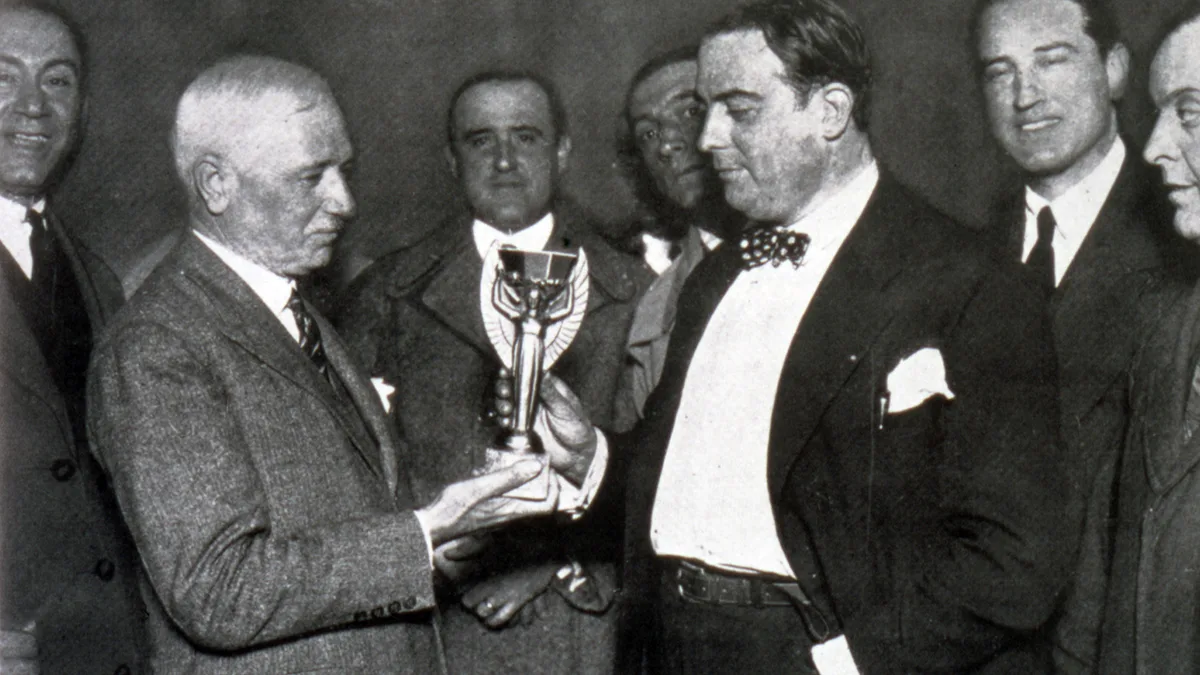
There would be no 2026 final at MetLife Stadium, no Messi chasing a last trophy, no Spain against Argentina in front of a global television audience, without a French lawyer who spent the better part of a decade talking people into an idea they mostly did not want. Jules Rimet did not just found the World Cup. He had to keep rescuing it - from indifference, from the Olympic movement, from a boycott that nearly emptied the first tournament of its best teams, and finally from a war that shut football's biggest competition down for twelve years. The trophy still carries his name. Fewer people know how many times, in the years around 1930, the whole project nearly did not survive to be named after anyone.
A grocer's son with an idea from the pulpit
Jules Rimet was born on 14 October 1873 in Theuley, a small commune in eastern France, the son of a grocer. The family moved to Paris when he was eleven, and he trained as a lawyer. In 1897 he founded a sports club, Red Star, built deliberately so that membership did not depend on class - an unusual position for French sport at the time. Rimet was a devout Catholic, and by his own family's account the encyclical Rerum Novarum, Pope Leo XIII's 1891 letter on the dignity of labour and the excesses of unrestrained capitalism, shaped him at seventeen and stayed with him. His grandson Yves later summed up what drove him:
A humanist and idealist, who believed that sport could unite the world.
Yves, Jules Rimet's grandson, quoted by These Football Times
That belief was not sentimental decoration. Rimet built his football career on it - president of France's football league from 1910, president of the French federation from 1919, and by 1921, president of FIFA. He held that last job for 33 years, still the longest tenure in the organisation's history, and used it to grow FIFA's membership from twelve national associations to 85.
Voting for a tournament that did not exist yet
Before there was a World Cup, international football's biggest stage was the Olympics - and the Olympics, under Pierre de Coubertin's amateur ideal, had no real place for a sport that was rapidly turning professional across South America and parts of Europe. Rimet wanted a tournament FIFA controlled outright, open to professionals, answerable to no one else's rulebook. It took years of lobbying inside FIFA to get there. The breakthrough came at FIFA's congress in Amsterdam in 1928, where the organisation's 30 member associations voted to create a quadrennial World Cup - a tournament that, at the moment of the vote, had no host, no format, and no guarantee that anyone significant would actually enter.
The tournament that almost had no one to play in it
Uruguay won the right to host the first World Cup, partly because the Uruguayan federation offered to cover travelling teams' costs - a serious inducement in 1930, with the Depression biting and a crossing of more than two weeks standing between most of Europe and Montevideo. It was not enough. By FIFA's own February 1930 deadline, not a single European association had entered. England's Football Association was not even in the conversation: the Home Nations had already resigned from FIFA over the amateurism dispute, and when Uruguay sent England an invitation anyway, it was turned down in November 1929.
Rimet worked the problem personally, alongside the Uruguayan diplomat Enrique Buero, and eventually talked four European federations - France, Belgium, Romania and Yugoslavia - into going. He then travelled with them. All four teams, plus Rimet and three European referees, boarded the Italian liner Conte Verde, picking up passengers at Villefranche-sur-Mer, Barcelona and Genoa before the fortnight-long crossing to Montevideo. The trophy itself - not yet carrying his name - travelled with Rimet in his luggage. Thirteen teams competed in the end: seven from South America, four from Europe, two from North America. Uruguay beat Argentina 4-2 in that first final in front of a home crowd of 68,346 at the Estadio Centenario, and the competition Rimet had spent years arguing into existence had, barely, made it to its first final whistle.
A trophy named for him, and a competition that vanished for twelve years
The trophy itself was not called after Rimet at first - French sculptor Abel Lafleur's gold-plated design was originally named Victory, and only renamed the Jules Rimet Trophy in 1946, in tribute to the man who had willed the tournament into being. Italy beat Hungary 4-2 in the 1938 final in France, the last World Cup played before the war swallowed the competition whole. The trophy itself nearly disappeared along with it: kept in a bank vault in Rome, it was moved out and hidden - reportedly in a shoebox under his bed - by Italian football official Ottorino Barassi once the city came under Nazi occupation, to keep it from being seized and melted down. The World Cup itself fared worse than the trophy: FIFA cancelled the tournaments due in 1942 and 1946 outright, and by the time the war ended the organisation had, by its own later account, neither the money nor the staff to plan a peacetime competition. Twelve years separated the 1938 final from the next one, in Brazil in 1950 - the longest gap the World Cup has ever gone through, longer than any of the format changes or expansions since. (The trophy's own later story - a 1966 theft and recovery in London, and its permanent, unresolved disappearance in Brazil in the 1980s - is its own tale.)
What outlived him
- FIFA president
- 1921-1954 (33 years, longest-serving)
- World Cup approved
- 1928, FIFA Congress, Amsterdam
- First tournament
- 1930, Uruguay - 13 teams
- FIFA membership growth under Rimet
- 12 to 85 national associations
- Died
- 16 October 1956, aged 83
Rimet stepped down as FIFA president in 1954, two years before his death, and was nominated for the Nobel Peace Prize in 1956 for the work of building a tournament that, by then, was drawing the world together every four years regardless of its founder's original travel headaches. He died on 16 October 1956 in Suresnes, just two days after his 83rd birthday - close enough to the World Cup he had built that it is easy to forget how nearly it never got off the ground at all. The trophy that carried his name for 24 years was retired in 1970, when Brazil's third title won it outright under a rule Rimet himself had set, and it was replaced by the Gazzaniga-designed trophy still lifted today. Every tournament since - including the first 48-team edition arriving at MetLife Stadium in 2026, the year Spain and Argentina meet for the trophy - is still, structurally, the tournament Rimet spent a decade fighting to get anyone to enter. War of Soccer, the free 3D browser game that goes live the moment that 2026 final ends, exists on the far side of exactly that century-long chain of stubbornness.
Frequently asked questions
Who was Jules Rimet?
A French lawyer who founded the Red Star sports club in 1897, led the French Football Federation from 1919, and served as FIFA president from 1921 to 1954 - still the longest tenure in FIFA's history. He is credited as the driving force behind the creation of the World Cup.
Did Jules Rimet actually invent the World Cup?
He pushed FIFA to vote the tournament into existence at the 1928 Amsterdam Congress and then personally persuaded European federations to enter the first edition in 1930, after most had refused. Historians credit him as the competition's founder even though the format has changed enormously since.
Why did European teams almost not show up to the first World Cup?
The 1930 tournament in Uruguay required an Atlantic crossing of more than two weeks and roughly three months away from domestic football, at a heavy cost during the Depression. By FIFA's February 1930 entry deadline, no European association had signed up. Rimet personally lobbied France, Belgium, Romania and Yugoslavia into entering, and travelled with them aboard the SS Conte Verde.
Why is the original World Cup trophy called the Jules Rimet Trophy?
The trophy, sculpted by Abel Lafleur and originally named Victory, was renamed in 1946 in honour of Rimet's role in creating the tournament. Brazil won it outright in 1970 after their third title, under a rule Rimet had set, and it was replaced by the current Gazzaniga-designed trophy.
Why was there no World Cup between 1938 and 1950?
World War II forced FIFA to cancel the tournaments scheduled for 1942 and 1946. The organisation had neither the funds nor the staff to plan a peacetime competition until football resumed in Brazil in 1950 - a twelve-year gap, the longest in World Cup history.
Sources
Comments
Loading comments…
War of Soccer is an independent, unofficial game and website by Nyza Creations LLC. It is not affiliated with, endorsed by, or sponsored by FIFA, any national federation, club, or any player — including Lionel Messi. Naming someone is not a claim to represent them. Team names, competition names and players are referred to descriptively, for identification and commentary only. Historical match data comes from public records — every page lists its sources.