History
The World Cup Trophy: Stolen Twice, Found by a Dog
The Jules Rimet Trophy was stolen from a stamp exhibition in 1966, found six days later by a dog named Pickles, then stolen again in Rio in 1983 and never seen since.
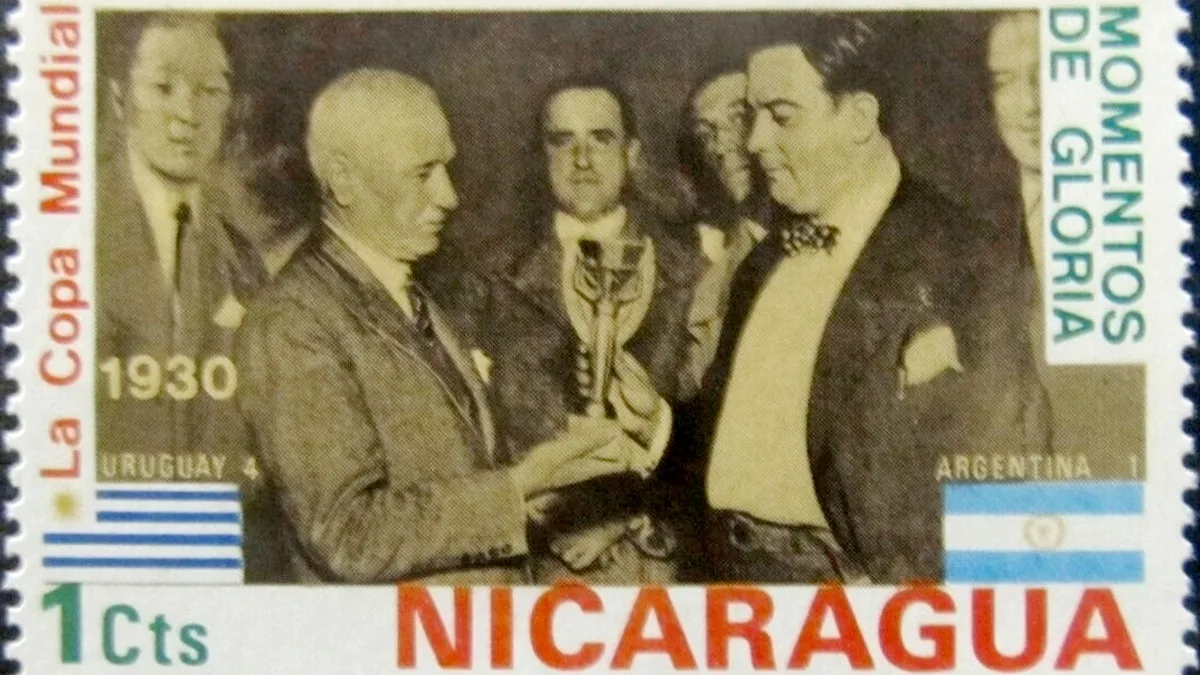
When someone lifts the World Cup final trophy at MetLife Stadium on Sunday, they will be lifting a replica. Every World Cup winner since 1974 has lifted a replica - the real trophy stays in a case at the FIFA World Football Museum in Zurich and only comes out for the draw, the opening match and the final itself, before going straight back. That arrangement exists because football has already lost one World Cup trophy completely. The story of how is stranger than almost anything that has happened on the pitch: a theft from a London stamp exhibition, a ransom note, a dog finding the trophy under a hedge, and then, seventeen years later, a second theft in Rio de Janeiro that was never solved and left nothing behind.
The first trophy, and the rule that ended it
The original trophy was designed by French sculptor Abel Lafleur for the first World Cup in 1930: gold-plated sterling silver on a lapis lazuli base, 35 centimetres tall, 3.8 kilograms, showing Nike, the Greek goddess of victory, holding up a decagonal cup. It was called simply Victory when it sailed from Villefranche-sur-Mer to Montevideo aboard the liner Conte Verde for that first tournament. In 1946, FIFA renamed it the Jules Rimet Trophy, after the FIFA president who had pushed the World Cup into existence in 1929.
FIFA's rule was that whichever country won the World Cup three times would keep the trophy outright, permanently. Brazil got there first. They beat Italy 4-1 in the 1970 final at the Estadio Azteca in Mexico City - Pele, Gerson, Jairzinho and Carlos Alberto scoring the goals - for their third title after 1958 and 1962. The Jules Rimet Trophy went home to Rio de Janeiro for good. It lasted there thirteen years.
Stolen from a stamp show, found by a dog
Four months before England hosted the 1966 World Cup, the trophy was on public display at a stamp exhibition, Stampex, in Westminster Central Hall - guarded, according to the Football Association's own later account, by only a handful of officers, one of them reportedly 74 years old. On 20 March 1966, while the guards were on a break, it disappeared from its cabinet. A ransom note soon arrived, signed 'Jackson', demanding 15,000 pounds. Scotland Yard set up a handoff at Battersea Park with an undercover officer carrying a briefcase of newspaper topped with five-pound notes. The man calling himself Jackson was arrested - his real name was Edward Betchley - but he insisted he was only a middleman for a man he called 'the Pole', who was never identified. The trophy itself was still missing. The FA, taking no chances, had already commissioned silversmith George Bird to quietly build a replica in case it never turned up.
It turned up a week later, on 27 March, in South London - found not by a detective but by a mixed-breed collie named Pickles, out on a walk with his owner, David Corbett, in the Beulah Hill area. Pickles drew Corbett's attention to a newspaper-wrapped parcel lying by a neighbour's car.
I put the lead on Pickles and he went over to the neighbour's car. Pickles drew my attention to a package, tightly bound in newspaper, lying by the front wheel. I picked it up and tore some paper and saw a woman holding a dish over her head, and disks with the words Germany, Uruguay, Brazil. I rushed inside to my wife... I said, 'I've found the World Cup! I've found the World Cup!'
David Corbett, quoted in Sports Illustrated
Corbett walked the trophy to the local police station in his slippers and was immediately treated as a suspect, questioned until 2:30am before being cleared. Betchley was convicted of demanding money with menaces and breaking and entering, and given two years. Pickles, meanwhile, became a genuine national celebrity: he appeared in the film The Spy with a Cold Nose, was named Dog of the Year, and stood beside England captain Bobby Moore on a hotel balcony during the World Cup victory celebrations that July, four months after his find. Corbett received rewards totalling 6,000 pounds. Pickles died less than a year later, choking after his lead caught on a branch while chasing a cat in Corbett's garden.
Stolen again in Rio - and never seen since
Brazil's permanent ownership of the Jules Rimet Trophy lasted until 19 December 1983, when it was stolen from the headquarters of the Brazilian Football Confederation (CBF) in Rio de Janeiro. Two men - a former police officer, Francisco Rivera, and a decorator, Jose Luiz Vieira - broke in, disabled the night watchman and took the trophy along with two other pieces of silverware. The plan was masterminded by a banker and football agent, Sergio Pereira Ayres. A safecracker they had first approached, Antonio Setta, turned the job down; according to the Wikipedia account of the case, he refused out of patriotism, and because his own brother had died of a heart attack watching Brazil win the trophy in the first place.
This time there was no ransom note and no recovery. Investigators concluded the trophy had been sold to a gold dealer, Juan Carlos Hernandez, and melted down into bars. Not everyone accepted that. Pedro Berwanger, the Brazilian federal police officer who led the original investigation, argued the maths didn't work.
The trophy was not made of solid gold; it could not be melted into gold bars, and it would be worth much more if left intact.
Pedro Berwanger, lead investigator, 1983 case
Whichever version is true, the object itself never resurfaced. All three men were eventually arrested and convicted. None of it ended well for them: Rivera was shot dead in a bar in 1989, Setta died in a car crash in 1985 on his way to testify about the case, and Ayres, freed from prison in 1998, died of a heart attack in 2003. A replica of the Jules Rimet Trophy was presented to the CBF in 1984. It is the closest thing to the original that exists anywhere today.
The trophy they lift now
With the Jules Rimet Trophy gone for good, FIFA had already needed a replacement for 1974 regardless - Brazil had kept the old one, after all - and ran a competition. Fifty-three sculptors from seven countries submitted designs. The winner was Italian sculptor Silvio Gazzaniga, whose piece shows two human figures reaching up to hold the Earth.
The lines spring out from the base, rising in spirals, stretching out to receive the world.
Silvio Gazzaniga, on his design for the FIFA World Cup Trophy
West Germany's Franz Beckenbauer was the first captain to lift it, in 1974. It is solid enough to look heavy and hollow enough to actually lift: a University of Nottingham chemist, Martyn Poliakoff, worked out in 2010 that if it were solid gold it would weigh 70 to 80 kilograms - unliftable by one person. In reality it is 36.5 centimetres tall and 6.175 kilograms, made from 5 kilograms of 18-carat gold around a malachite base, with each winning nation's name engraved on a plate on the underside, invisible while the trophy stands upright, rearranged into a spiral to make room for the next champion.
| Jules Rimet Trophy (1930-1970) | FIFA World Cup Trophy (1974-present) | |
|---|---|---|
| Sculptor | Abel Lafleur | Silvio Gazzaniga |
| Height / weight | 35 cm, 3.8 kg | 36.5 cm, 6.175 kg |
| Materials | Gold-plated silver, lapis lazuli base | 18-carat gold, malachite base |
| Design | Nike, goddess of victory, holding a cup | Two figures holding up the Earth |
| What happened to it | Stolen in Rio, 1983 - never recovered | Kept at the FIFA museum, Zurich; winners lift a replica |
That last line is the whole reason the current trophy has a different story than the first one. Since Brazil's permanent ownership of the Jules Rimet Trophy is exactly what triggered the theft that lost it, FIFA never lets the new one leave its custody: winning teams keep a gold-plated replica, and the original goes back into its case in Switzerland. So when Spain or Argentina lift the trophy after Sunday's final at MetLife Stadium, the object in the photographs will be a copy of a design that has now outlasted the one it replaced by more than fifty years - still gold, still unstolen, and, for one evening in East Rutherford, still the entire point of the tournament.
Frequently asked questions
Was the original Jules Rimet Trophy ever found after 1983?
No. It was stolen from the Brazilian Football Confederation's headquarters in Rio de Janeiro on 19 December 1983 and has never been recovered. Investigators believe it was sold to a gold dealer and melted down, though the lead investigator on the case argued the trophy was not solid enough gold for that to make financial sense. Either way, the physical object has never resurfaced.
Who found the World Cup trophy after it was stolen in 1966?
A mixed-breed collie named Pickles found it, on a walk with his owner David Corbett in Beulah Hill, south London, on 27 March 1966 - a week after it was stolen from a stamp exhibition at Westminster Central Hall. It was wrapped in newspaper under a hedge near a parked car.
Do World Cup winners get to keep the real trophy?
No. Since 1974, winning nations receive a gold-plated replica to keep, while the original FIFA World Cup Trophy stays at the FIFA World Football Museum in Zurich, brought out only for the draw, the opening match and the final itself.
Why was the Jules Rimet Trophy replaced in 1974?
FIFA's rule stated that the first country to win the World Cup three times would keep the trophy permanently. Brazil did that in 1970, beating Italy 4-1 in the final, so FIFA needed a new trophy for future tournaments. Italian sculptor Silvio Gazzaniga's design, chosen from 53 submissions, became the FIFA World Cup Trophy still used today.
What is the current World Cup trophy made of?
It stands 36.5 centimetres tall and weighs 6.175 kilograms: 5 kilograms of 18-carat gold plus a malachite base. It is hollow - a solid gold version at that size would weigh 70 to 80 kilograms and be too heavy for one person to lift.
Sources
Comments
Loading comments…
War of Soccer is an independent, unofficial game and website by Nyza Creations LLC. It is not affiliated with, endorsed by, or sponsored by FIFA, any national federation, club, or any player — including Lionel Messi. Naming someone is not a claim to represent them. Team names, competition names and players are referred to descriptively, for identification and commentary only. Historical match data comes from public records — every page lists its sources.